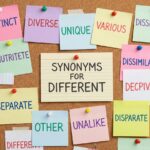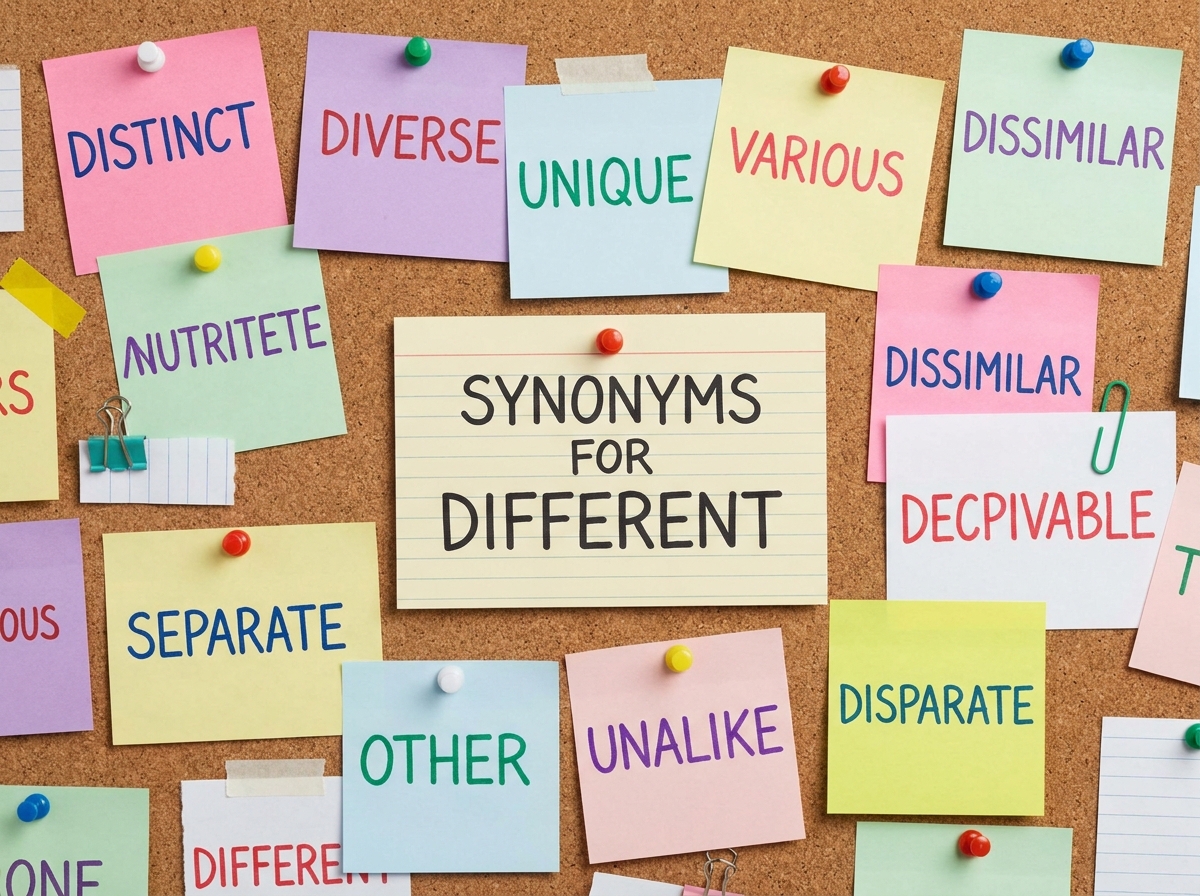
Different means not the same as another person, thing, or idea. Imagine two students wearing the same school uniform. One has a blue backpack, while the other has a red backpack. Their backpacks are different. We use this word every day because people, places, ideas, choices, and things are often not the same.
Learning synonyms for different can help English learners speak and write with more variety. It can also help content writers avoid using the same word again and again. A strong vocabulary makes writing clearer, more natural, and more interesting. In this article, we will explore the meaning of different and 30 useful synonyms. We will also look at examples, grammar, pronunciation, etymology, word formation, connotative meaning, semantic categories, antonyms, and common questions about the word.
Meaning of Different
Definition
Different (adjective): Not the same as another person, thing, idea, or situation.
Examples
- My new phone is different from my old phone.
- We have different opinions about the best way to solve the problem.
Connotative Meaning
- Positive tone: Different can suggest originality, creativity, uniqueness, or freshness.
- Negative tone: Different can sometimes suggest that someone or something does not fit in or is unusual in an unwanted way.
- Neutral tone: Different can simply mean that two things are not the same, without any good or bad feeling.
Learn more abouthttps://myprayerss.com/synonyms-for-good/
Etymology
- Source: The word different comes from Latin through Old French.
- Latin: differentem, from differre.
- Original meaning: “To carry apart,” “to set apart,” or “to be unlike.”
- The Latin parts relate to the idea of things being separated or unlike each other.
Short History of “Different”
Old English (450–1100): The modern word different was not a common Old English word. English speakers used other words and phrases to express ideas such as “unlike,” “separate,” or “not the same.”
Middle English (1100–1500): After the Norman influence on English, many French and Latin words entered the language. Different developed in English from French and Latin forms and became associated with being unlike or distinct.
Modern English (1500–Present): Different became a very common English adjective. Today, it is used for people, objects, opinions, cultures, styles, situations, and choices.
Pronunciation (US & UK – IPA)
US: /ˈdɪfərənt/
UK: /ˈdɪfrənt/
Syllables
dif-fer-ent
Affixation Pattern of Different
- Root: differ
- Prefix: None in the modern word
- Suffix: -ent
- Word formation: The base family contains many related grammatical forms, including differ (verb), different (adjective), difference (noun), differently (adverb), differentiate (verb), differentiation (noun), and differential (adjective/noun).
Synonyms of Different
1. Distinct (Adjective) — US /dɪˈstɪŋkt/ | UK /dɪˈstɪŋkt/
Meaning: Clearly different from something else.
Examples:
- The two cultures have distinct traditions.
- The bird has a distinct pattern on its wings.
2. Dissimilar (Adjective) — US /dɪˈsɪmələr/ | UK /dɪˈsɪmɪlə/
Meaning: Not alike in appearance, nature, or qualities.
Examples:
- The two paintings are quite dissimilar.
- Their personalities are very dissimilar.
3. Unlike (Preposition/Adjective) — US /ʌnˈlaɪk/ | UK /ʌnˈlaɪk/
Meaning: Not similar to someone or something.
Examples:
- This design is unlike the old one.
- Unlike his brother, Ali enjoys quiet places.
4. Diverse (Adjective) — US /daɪˈvɜrs/ | UK /daɪˈvɜːs/
Meaning: Including many different types, people, or ideas.
Examples:
- The city has a diverse population.
- We need a diverse range of ideas.
5. Varied (Adjective) — US /ˈverid/ | UK /ˈveərid/
Meaning: Including many different types or forms.
Examples:
- The restaurant offers a varied menu.
- She has a varied collection of books.
6. Separate (Adjective) — US /ˈsepərət/ | UK /ˈseprət/
Meaning: Not joined, connected, or considered together.
Examples:
- The children have separate bedrooms.
- These are two separate problems.
7. Alternative (Adjective/Noun) — US /ɔlˈtɝnət/ | UK /ɔːlˈtɜːnət/
Meaning: Different from the usual choice or option.
Examples:
- We need an alternative plan.
- Walking is an alternative to driving.
8. Unique (Adjective) — US /juˈnik/ | UK /juˈniːk/
Meaning: Very special or unlike anything else.
Examples:
- Every person has a unique personality.
- The building has a unique design.
9. Unusual (Adjective) — US /ʌnˈjuːʒuəl/ | UK /ʌnˈjuːʒuəl/
Meaning: Not common or not expected.
Examples:
- It was unusual to see snow in that area.
- She has an unusual way of solving problems.
10. Contrasting (Adjective) — US /kənˈtræstɪŋ/ | UK /kənˈtrɑːstɪŋ/
Meaning: Showing a clear difference between two or more things.
Examples:
- The artist used contrasting colors.
- They have contrasting views on education.
11. Divergent (Adjective) — US /daɪˈvɜrdʒənt/ | UK /daɪˈvɜːdʒənt/
Meaning: Moving, developing, or becoming different from the same point.
Examples:
- The researchers developed divergent theories.
- Their opinions became increasingly divergent.
12. Disparate (Adjective) — US /ˈdɪspərət/ | UK /ˈdɪspərət/
Meaning: Very different in type, quality, or nature.
Examples:
- The project combines disparate ideas.
- The group included people from disparate backgrounds.
13. Assorted (Adjective) — US /əˈsɔrtɪd/ | UK /əˈsɔːtɪd/
Meaning: Containing several different kinds.
Examples:
- The box contained assorted chocolates.
- She bought an assorted collection of stationery.
14. Miscellaneous (Adjective) — US /ˌmɪsəˈleɪniəs/ | UK /ˌmɪsəˈleɪniəs/
Meaning: Made up of different things that do not belong to one clear group.
Examples:
- The drawer was full of miscellaneous items.
- I have several miscellaneous tasks to finish.
15. Individual (Adjective) — US /ˌɪndəˈvɪdʒuəl/ | UK /ˌɪndɪˈvɪdʒuəl/
Meaning: Separate or belonging to one particular person or thing.
Examples:
- Each student has an individual learning style.
- The coach spoke to the players about their individual needs.
16. Independent (Adjective) — US /ˌɪndɪˈpendənt/ | UK /ˌɪndɪˈpendənt/
Meaning: Separate from others and not controlled by them.
Examples:
- The company is independent from the larger group.
- She became financially independent at a young age.
17. Novel (Adjective) — US /ˈnɑvəl/ | UK /ˈnɒvəl/
Meaning: New, original, or different from what is usual.
Examples:
- The scientist proposed a novel solution.
- They found a novel way to teach the subject.
18. New (Adjective) — US /nuː/ | UK /njuː/
Meaning: Recent, fresh, or not known or used before.
Examples:
- She bought a new computer.
- We need a new approach to the problem.
19. Another (Determiner/Pronoun) — US /əˈnʌðər/ | UK /əˈnʌðə/
Meaning: One more or a different one of the same general kind.
Examples:
- Can you give me another example?
- Let’s try another method.
20. Other (Adjective/Pronoun) — US /ˈʌðər/ | UK /ˈʌðə/
Meaning: Not the one already mentioned or being discussed.
Examples:
- Do you have any other ideas?
- The other answer is more accurate.
21. Changed (Adjective) — US /tʃeɪndʒd/ | UK /tʃeɪndʒd/
Meaning: Made or become different from an earlier state.
Examples:
- His attitude has changed over time.
- The town looks changed after the new buildings were added.
22. Modified (Adjective) — US /ˈmɑdəˌfaɪd/ | UK /ˈmɒdɪfaɪd/
Meaning: Changed slightly to improve, adapt, or adjust something.
Examples:
- We used a modified version of the original plan.
- The teacher gave us a modified assignment.
23. Varying (Adjective) — US /ˈveriɪŋ/ | UK /ˈveəriɪŋ/
Meaning: Different from one another in amount, level, or type.
Examples:
- The students have varying levels of English.
- The product comes in varying sizes.
24. Contrary (Adjective) — US /ˈkɑntreri/ | UK /ˈkɒntrəri/
Meaning: Opposite or very different from something else.
Examples:
- His actions were contrary to his words.
- She gave a contrary opinion during the meeting.
25. Inconsistent (Adjective) — US /ˌɪnkənˈsɪstənt/ | UK /ˌɪnkənˈsɪstənt/
Meaning: Not staying the same or not matching something else.
Examples:
- His answers were inconsistent.
- The report contains inconsistent information.
26. Innovative (Adjective) — US /ˈɪnəˌveɪtɪv/ | UK /ˈɪnəˌveɪtɪv/
Meaning: Using a new and creative idea or method.
Examples:
- The company created an innovative product.
- The teacher uses innovative methods in class.
27. Distinctive (Adjective) — US /dɪˈstɪŋktɪv/ | UK /dɪˈstɪŋktɪv/
Meaning: Having a quality that makes something easy to recognize as different.
Examples:
- The singer has a distinctive voice.
- The building has a distinctive shape.
28. Discrete (Adjective) — US /dɪˈskriːt/ | UK /dɪˈskriːt/
Meaning: Separate and clearly different from other parts.
Examples:
- The study examined several discrete groups.
- The system has five discrete stages.
29. Special (Adjective) — US /ˈspeʃəl/ | UK /ˈspeʃəl/
Meaning: Different from normal in a way that makes something important or valuable.
Examples:
- She planned a special dinner for her family.
- This place has a special meaning for me.
30. Peculiar (Adjective) — US /pɪˈkjuːliər/ | UK /pɪˈkjuːliə/
Meaning: Strange or unusual in a noticeable way.
Examples:
- There was a peculiar sound outside.
- He has a peculiar sense of humor.
Prototype Meaning
The most typical meaning of different is “not the same.” When people hear this word, they usually imagine two or more things being compared. For example, two phones may have different features, two people may have different opinions, or two places may have different cultures. The word does not always say whether the difference is good or bad. The meaning depends on the context.
Prototype Categorization
- General difference: distinct, unlike, dissimilar, different are useful when two things are simply not the same.
- Many types or forms: diverse, varied, assorted, and miscellaneous work well when there are many kinds of things.
- Clear separation: separate, discrete, and independent suggest that things are apart or treated individually.
- New or original: novel, innovative, new, and alternative are useful when something is different because it offers a fresh idea or choice.
- Special or unusual: unique, distinctive, unusual, special, and peculiar describe something that stands out from what is normal.
- Strong contrast: contrasting, contrary, divergent, and disparate are useful when the difference is strong or important.
- Change or variation: changed, modified, varying, and inconsistent describe differences caused by change or lack of sameness.
Antonyms of Different
- Same — not different.
- Similar — almost the same in important ways.
- Alike — similar in appearance, nature, or qualities.
- Identical — exactly the same.
- Equal — the same in value, amount, or level.
- Uniform — staying the same throughout.
- Matching — having the same or suitable appearance or qualities.
- Comparable — similar enough to be compared.
Short Questions and Answers
- What does different mean?
Different means not the same as another person, thing, idea, or situation. - When should synonyms for different be used?
Use them when you want to avoid repetition or express a more exact type of difference. For example, use diverse for many types, unique for something one-of-a-kind, and novel for something new. - Is different positive or negative?
Different is usually neutral. It can sound positive when it means creative or special, but it can sound negative when it means strange or unwanted. - How is different different from similar words?
Different is a broad word. Distinct suggests a clear difference, unique suggests something one-of-a-kind, diverse suggests many types, and unusual suggests something uncommon.
Conclusion
Learning different and its synonyms is a simple way to build a stronger English vocabulary. The word is common, but its many alternatives let you express ideas with greater accuracy. Words such as distinct, diverse, unique, unusual, varied, novel, alternative, and dissimilar can help you describe different kinds of differences.Using the right synonym also makes writing and speaking more natural. It prevents repetition and helps readers understand your exact meaning. For English learners, practicing these words can build confidence in daily conversations, essays, emails, and online content. Content writers can also use them to create clearer and more engaging articles.Try learning three new synonyms each day. Write your own sentences, read them aloud, and use the words in real conversations. With regular practice, your vocabulary will become richer and more flexible.