Introduction
Great is a small word with a big job. Picture this: your friend cooks dinner for the first time, and it turns out amazing. You take one bite and say, “This is great!” That single word carries your joy, your surprise, and your praise all at once. This is why people use “great” so often. It is short, simple, and it fits almost any happy moment.
But using the same word again and again can make your writing sound flat. English learners and content writers need more tools. Learning synonyms helps you sound natural, avoid repetition, and choose the right word for the right feeling. A word for a delicious meal is not always the best word for a stunning sunset.
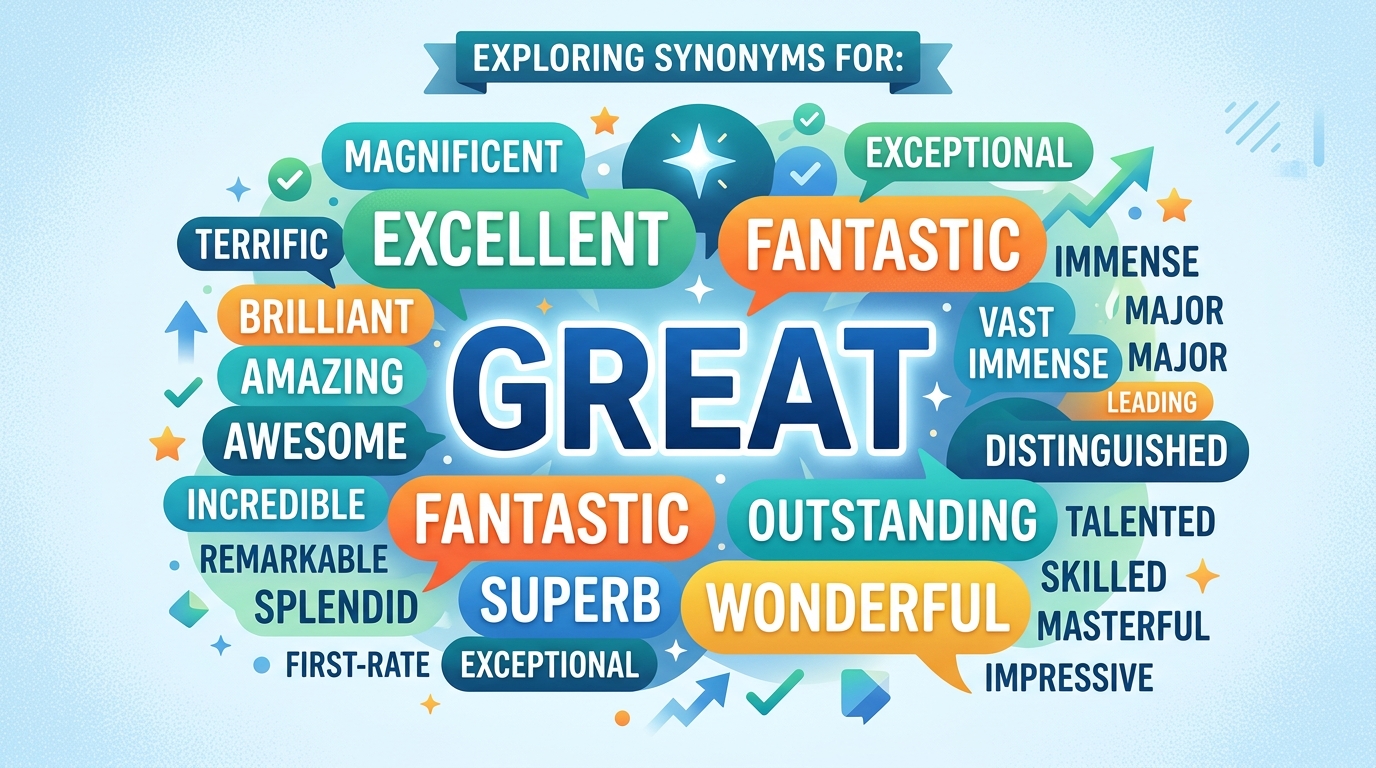
This article explores the meaning of “great,” its history, pronunciation, and grammar. You will also find 30 synonyms, each with clear meanings, examples, and pronunciation in both US and UK English.
Meaning of Great
Definition
Great (Adjective): very good, large, or impressive in a positive way.
Examples
- We had a great time at the beach.
- She is a great teacher who explains things clearly.
Connotative Meaning
The feeling behind a word is its connotation. (Connotation: the emotional or cultural feeling a word carries, beyond its plain dictionary meaning.)
- Positive tone: Most uses of “great” show praise, joy, or approval, like “great job” or “great news.”
- Negative tone: Rarely, “great” can sound sarcastic, such as “Oh great, it’s raining again.”
- Neutral tone: In phrases like “great distance” or “great size,” the word simply means large, with no emotion attached.
LEARN ABOUT MORE https://myprayerss.com/synonyms-for-failure/
Etymology
- “Great” comes from the Old English word grēat, which meant thick, coarse, or massive.
- It is related to the Old Saxon word grōt and the Dutch word groot, both meaning big or large.
- Over time, the meaning shifted from describing physical size to describing quality and importance.
Short History
- Old English (450–1100): “Grēat” described physical size, like a thick tree trunk or a stout person.
- Middle English (1100–1500): The word began to describe importance, rank, and power, such as a “great king.”
- Modern English (1500–Present): “Great” now mainly describes excellence, skill, and strong approval, as in “a great idea.”
Pronunciation (US & UK – IPA)
- US: /ɡreɪt/
- UK: /ɡreɪt/
Syllables
great (one syllable)
Affixation Pattern of Great
- Root: great
- Prefix: none in common use
- Suffix: -ly (greatly), -ness (greatness), -er/-est (greater, greatest)
Word Formation
From the root “great,” English forms several related words:
- greatly (adverb) – to a large degree
- greatness (noun) – the quality of being great
- greater (adjective, comparative) – more great
- greatest (adjective, superlative) – most great
Synonyms of Great
1. Excellent (Adjective) — US: /ˈek.sə.lənt/ | UK: /ˈek.səl.ənt/
Meaning: Extremely good in quality.
Examples:
- Her essay was excellent and full of clear ideas.
- The food at this restaurant is excellent.
2. Wonderful (Adjective) — US: /ˈwʌn.dɚ.fəl/ | UK: /ˈwʌn.də.fəl/
Meaning: Very good and full of joy.
Examples:
- We had a wonderful trip to the mountains.
- It was wonderful to see my old friends again.
3. Fantastic (Adjective) — US: /fænˈtæs.tɪk/ | UK: /fænˈtæs.tɪk/
Meaning: Extremely good or impressive.
Examples:
- That movie was fantastic from start to end.
- You did a fantastic job on this project.
4. Terrific (Adjective) — US: /təˈrɪf.ɪk/ | UK: /təˈrɪf.ɪk/
Meaning: Very good or exciting.
Examples:
- She gave a terrific speech at the event.
- We had a terrific weekend at the lake.
5. Amazing (Adjective) — US: /əˈmeɪ.zɪŋ/ | UK: /əˈmeɪ.zɪŋ/
Meaning: Causing great surprise or wonder because it is so good.
Examples:
- The view from the mountain was amazing.
- He has an amazing talent for painting.
6. Superb (Adjective) — US: /suˈpɝb/ | UK: /suːˈpɜːb/
Meaning: Of very high quality; excellent.
Examples:
- The chef prepared a superb three-course meal.
- Her superb performance won her the award.
7. Marvelous (Adjective) — US: /ˈmɑːr.vəl.əs/ | UK: /ˈmɑː.vəl.əs/
Meaning: Causing wonder because it is so good.
Examples:
- We spent a marvelous evening by the sea.
- The garden looked marvelous in spring.
8. Outstanding (Adjective) — US: /aʊtˈstæn.dɪŋ/ | UK: /aʊtˈstæn.dɪŋ/
Meaning: Extremely good; standing out from others.
Examples:
- His outstanding grades earned him a scholarship.
- The team gave an outstanding performance tonight.
9. Remarkable (Adjective) — US: /rɪˈmɑːr.kə.bəl/ | UK: /rɪˈmɑː.kə.bəl/
Meaning: Worthy of attention because it is unusual or impressive.
Examples:
- She made a remarkable recovery after her surgery.
- It was a remarkable achievement for such a young athlete.
10. Magnificent (Adjective) — US: /mæɡˈnɪf.ə.sənt/ | UK: /mæɡˈnɪf.ɪ.sənt/
Meaning: Extremely beautiful, grand, or impressive.
Examples:
- The castle offered a magnificent view of the valley.
- Her magnificent dress caught everyone’s eye.
11. Splendid (Adjective) — US: /ˈsplen.dɪd/ | UK: /ˈsplen.dɪd/
Meaning: Very impressive and beautiful.
Examples:
- They lived in a splendid old house by the river.
- We had a splendid time at the festival.
12. Fabulous (Adjective) — US: /ˈfæb.jə.ləs/ | UK: /ˈfæb.jʊ.ləs/
Meaning: Extremely good or attractive.
Examples:
- You look fabulous in that outfit.
- The party was absolutely fabulous.
13. Incredible (Adjective) — US: /ɪnˈkred.ə.bəl/ | UK: /ɪnˈkred.ɪ.bəl/
Meaning: So good or impressive it is hard to believe.
Examples:
- She has an incredible memory for names.
- The magician’s tricks were incredible.
14. Awesome (Adjective) — US: /ˈɑː.səm/ | UK: /ˈɔː.səm/
Meaning: Causing feelings of great admiration or excitement.
Examples:
- The concert last night was awesome.
- That’s an awesome idea for the project.
15. Brilliant (Adjective) — US: /ˈbrɪl.jənt/ | UK: /ˈbrɪl.jənt/
Meaning: Extremely clever, skilled, or impressive.
Examples:
- He came up with a brilliant solution to the problem.
- The film received brilliant reviews from critics.
16. Exceptional (Adjective) — US: /ɪkˈsep.ʃən.əl/ | UK: /ɪkˈsep.ʃən.əl/
Meaning: Unusually good; much better than average.
Examples:
- She showed exceptional skill in the competition.
- His exceptional patience helped calm the situation.
17. Phenomenal (Adjective) — US: /fəˈnɑː.mə.nəl/ | UK: /fəˈnɒm.ɪ.nəl/
Meaning: Very remarkable or impressive; extraordinary.
Examples:
- The singer gave a phenomenal performance.
- Sales grew at a phenomenal rate this year.
18. Impressive (Adjective) — US: /ɪmˈpres.ɪv/ | UK: /ɪmˈpres.ɪv/
Meaning: Causing admiration because of its size, skill, or quality.
Examples:
- The building’s design is truly impressive.
- She gave an impressive presentation to the board.
19. Stupendous (Adjective) — US: /stuˈpen.dəs/ | UK: /stjuːˈpen.dəs/
Meaning: Extremely large or impressive; astonishing.
Examples:
- The fireworks display was stupendous.
- They achieved stupendous success in just one year.
20. Tremendous (Adjective) — US: /trɪˈmen.dəs/ | UK: /trɪˈmen.dəs/
Meaning: Very great in amount, size, or quality.
Examples:
- She put in a tremendous amount of effort.
- The team showed tremendous courage during the game.
21. Wondrous (Adjective) — US: /ˈwʌn.drəs/ | UK: /ˈwʌn.drəs/
Meaning: Inspiring a feeling of wonder; marvelous.
Examples:
- The night sky looked wondrous, full of stars.
- It was a wondrous journey through the forest.
22. Glorious (Adjective) — US: /ˈɡlɔːr.i.əs/ | UK: /ˈɡlɔː.ri.əs/
Meaning: Beautiful, impressive, or deserving great praise.
Examples:
- We watched a glorious sunset over the ocean.
- It was a glorious victory for the whole team.
23. Superior (Adjective) — US: /suˈpɪr.i.ɚ/ | UK: /suːˈpɪə.ri.ə/
Meaning: Higher in quality than others.
Examples:
- This fabric is superior to the cheaper option.
- The hotel offers superior service to its guests.
24. First-rate (Adjective) — US: /ˈfɝːst.reɪt/ | UK: /ˈfɜːst.reɪt/
Meaning: Of the very best quality.
Examples:
- The hospital provides first-rate medical care.
- He is a first-rate writer with a unique style.
25. Top-notch (Adjective) — US: /ˈtɑːp.nɑːtʃ/ | UK: /ˈtɒp.nɒtʃ/
Meaning: Excellent; the very best of its kind.
Examples:
- The company hired a top-notch design team.
- We enjoyed top-notch service at the hotel.
26. Sensational (Adjective) — US: /senˈseɪ.ʃən.əl/ | UK: /senˈseɪ.ʃən.əl/
Meaning: Extremely exciting or impressive.
Examples:
- The gymnast gave a sensational performance.
- Her debut novel was a sensational success.
27. Extraordinary (Adjective) — US: /ɪkˈstrɔːr.dən.er.i/ | UK: /ɪkˈstrɔː.dən.ər.i/
Meaning: Very unusual or remarkable; beyond the ordinary.
Examples:
- She showed extraordinary strength during the crisis.
- It was an extraordinary story of survival.
28. Admirable (Adjective) — US: /ˈæd.mər.ə.bəl/ | UK: /ˈæd.mər.ə.bəl/
Meaning: Deserving respect and approval.
Examples:
- His honesty is truly admirable.
- She showed admirable dedication to her studies.
29. Exemplary (Adjective) — US: /ɪɡˈzem.plər.i/ | UK: /ɪɡˈzem.plər.i/
Meaning: Serving as a perfect example; excellent.
Examples:
- The student’s exemplary behavior earned him praise.
- Her exemplary work ethic inspired the whole team.
30. Stellar (Adjective) — US: /ˈstel.ɚ/ | UK: /ˈstel.ə/
Meaning: Outstanding or excellent, like a star performance.
Examples:
- He had a stellar year at work.
- The band delivered a stellar show last night.
Prototype Meaning
When most people hear the word “great,” they picture something that stands out in a good way. It could be a great meal, a great friend, or a great idea. The typical image is simple: something good enough to earn praise. This is the core, most common meaning that comes to mind first, before any special or unusual uses of the word.
Prototype Categorization
Grouping synonyms into categories helps writers pick the exact word they need.
- Everyday praise: excellent, wonderful, fantastic, terrific, awesome, brilliant
- Strong emotional impact: amazing, incredible, marvelous, stupendous, wondrous
- Formal or professional use: outstanding, exceptional, remarkable, superior, first-rate, exemplary, admirable
- Grand or visual beauty: magnificent, splendid, glorious, fabulous
- High performance or achievement: phenomenal, tremendous, sensational, stellar, top-notch, extraordinary, impressive
This kind of grouping helps writers match tone and setting. A resume might use “exceptional” or “exemplary,” while a text to a friend might use “awesome” or “fantastic.”
Antonyms of Great
terrible, awful, poor, mediocre, dreadful, ordinary, bad, unimpressive
Short Questions and Answers
- What does “great” mean?
It means very good, large, or impressive in a positive way. - When should synonyms for great be used?
Use them to avoid repeating “great” too often and to match the tone of your writing, whether casual, formal, or emotional. - Is “great” positive or negative?
It is mostly positive. It can sound negative or sarcastic only in certain tones of voice or context. - How is it different from similar words?
“Great” is general and common, while words like “phenomenal” or “exemplary” carry a stronger or more formal tone. Choosing the right synonym depends on the situation.
Conclusion
Learning the word “great” and its synonyms does more than add new words to your list. It improves your vocabulary, strengthens your writing and speaking, and helps you avoid repeating the same word again and again. It also builds your confidence in English, because you can express the same idea in many different ways. Try using one new synonym each day. Small daily practice adds up, and soon these words will feel natural in your everyday conversations and writing.