Introduction
Hate means to strongly dislike someone or something. Imagine a student who loves most school subjects but hates waking up early. They may say, “I hate getting up at 6 a.m.” The word hate is common because people use it to express strong negative feelings in daily speech and writing. However, using the same word again and again can make your English sound less varied. Learning synonyms helps English learners choose words that show the exact strength and type of feeling they mean. It also helps students, writers, bloggers, and content creators make their writing clearer and more natural. In this article, you will learn the meaning of hate, 30 useful synonyms, their examples, grammar, pronunciation, history, connotative meaning, and semantic categories.
Meaning of Hate
Definition
Hate (verb): to strongly dislike a person, thing, activity, or situation and feel intense negative emotion toward it.
Hate (noun): a very strong feeling of dislike or hostility toward someone or something.
Examples
- I hate being late for work.
- She hates loud noises.
- His actions were driven by hate.
- Learn more about: https://myprayerss.com/synonyms-of-hate/
Connotative Meaning
Connotation (the feeling or idea that a word suggests beyond its basic meaning):
- Positive tone: Usually none. However, saying that someone “hates injustice” can suggest a strong moral dislike of something wrong.
- Negative tone: Strong dislike, anger, hostility, resentment, or even deep hostility toward a person or thing.
- Neutral tone: The word can be neutral when it simply reports a strong dislike, such as “I hate cold weather.”
Etymology
- Source: Old English
- Old English form: hatian
- Original meaning: “to hate, pursue with hostility, treat as an enemy”
- Related Germanic form: Proto-Germanic hatjaną
- The word is related to the same Germanic family as words such as hatred and hateful.
Short History of “Hate”
Old English (450–1100): The word appeared as hatian. It described strong hostility or treating someone as an enemy.
Middle English (1100–1500): The spelling and pronunciation changed over time. Forms such as haten became common.
Modern English (1500–Present): The modern form hate developed. It is now used for both strong personal dislike and serious hostility. It can describe people, actions, ideas, objects, and experiences.
Pronunciation of Hate
US: /heɪt/ UK: /heɪt/
Syllables: hate — 1 syllable
Affixation Pattern of Hate
- Root: hate
- Prefix: none
- Suffix: none in the basic word
Word Formation
Several common words and grammatical forms come from hate:
Word
Grammatical category
hate
verb / noun
hates
verb
hated
verb / adjective
hating
verb / gerund
hatred
noun
hateful
adjective
hatefully
adverb
hater
noun
hateless
adjective, uncommon
The most useful derivatives are hate, hatred, hateful, hater, hated, and hating.
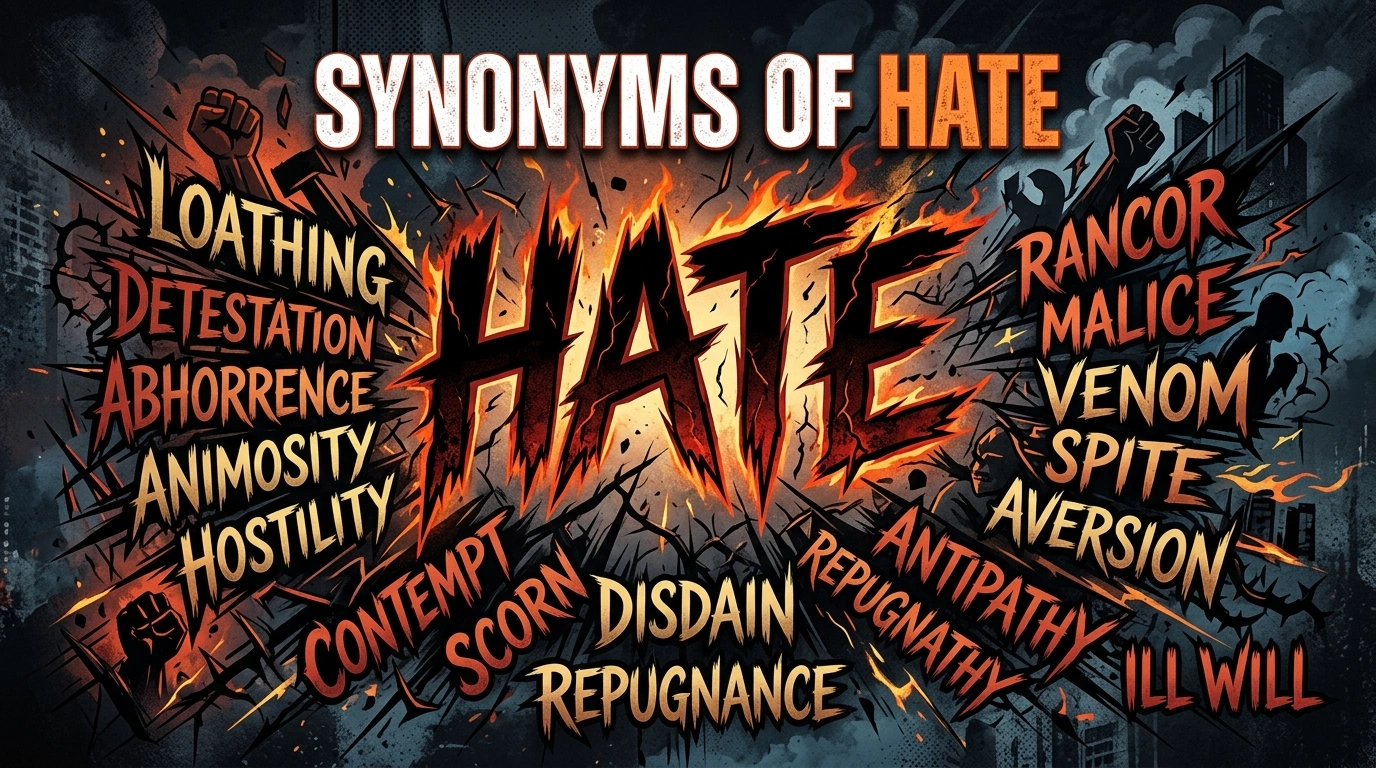
Synonyms of Hate
1. Detest (Verb) — US /dɪˈtɛst/ | UK /dɪˈtɛst/
Meaning: To dislike someone or something very strongly.
Examples:
- I detest rude behavior.
- She detests people who lie.
2. Loathe (Verb) — US /loʊð/ | UK /ləʊð/
Meaning: To hate or strongly dislike something or someone.
Examples:
- I loathe being treated unfairly.
- He loathes crowded places.
3. Abhor (Verb) — US /əbˈhɔr/ | UK /əbˈhɔː/
Meaning: To strongly hate something because you think it is wrong or unpleasant.
Examples:
- She abhors violence.
- They abhor cruelty toward animals.
4. Despise (Verb) — US /dɪˈspaɪz/ | UK /dɪˈspaɪz/
Meaning: To hate someone or something and feel that it has little value.
Examples:
- He despises dishonest people.
- She despises unfair treatment.
5. Dislike (Verb) — US /dɪsˈlaɪk/ | UK /dɪsˈlaɪk/
Meaning: To not like someone or something.
Examples:
- I dislike very spicy food.
- She dislikes working late.
6. Detest (Verb) — US /dɪˈtɛst/ | UK /dɪˈtɛst/
Meaning: To strongly dislike something or someone.
Examples:
- He detests dishonesty.
- I detest wasting time.
Note: “Detest” was already listed as #1, so to keep this list at 30 unique synonyms, use hate intensely instead of this repeated entry.
6. Hate Intensely (Verb Phrase) — US /heɪt ɪnˈtɛnsli/ | UK /heɪt ɪnˈtensli/
Meaning: To hate something or someone very strongly.
Examples:
- She hates intensely the way he treats people.
- He hates intensely any form of bullying.
7. Abominate (Verb) — US /əˈbɑːməˌneɪt/ | UK /əˈbɒmɪneɪt/
Meaning: To hate something deeply, especially because it is considered morally bad.
Examples:
- They abominate corruption.
- He abominates cruelty.
8. Scorn (Verb) — US /skɔrn/ | UK /skɔːn/
Meaning: To strongly reject or dislike someone or something with contempt.
Examples:
- She scorns dishonest behavior.
- He scorned the offer.
9. Detest Deeply (Verb Phrase) — US /dɪˈtɛst ˈdiːpli/ | UK /dɪˈtest ˈdiːpli/
Meaning: To feel extremely strong dislike toward someone or something.
Examples:
- I detest deeply the idea of cheating.
- She detests deeply any kind of cruelty.
10. Despise (Verb) — US /dɪˈspaɪz/ | UK /dɪˈspaɪz/
Meaning: To regard someone or something with strong dislike and contempt.
Examples:
- They despise corrupt leaders.
- She despised his rude attitude.
Note: “Despise” was already used at #4. A unique synonym is preferable:
10. Spurn (Verb) — US /spɜrn/ | UK /spɜːn/
Meaning: To reject someone or something with strong dislike or contempt.
Examples:
- He spurned their invitation.
- She spurned his dishonest proposal.
11. Resent (Verb) — US /rɪˈzɛnt/ | UK /rɪˈzent/
Meaning: To feel angry or bitter because of something unfair or unpleasant.
Examples:
- She resents being ignored.
- He resented the unfair decision.
12. Abhor (Verb) — US /əbˈhɔr/ | UK /əbˈhɔː/
Meaning: To feel intense dislike or disgust toward something.
Examples:
- I abhor violence.
- She abhors cruelty.
Note: “Abhor” was already #3. A unique replacement is:
12. Repudiate (Verb) — US /rɪˈpjuːdiˌeɪt/ | UK /rɪˈpjuːdieɪt/
Meaning: To strongly reject or refuse to accept something.
Examples:
- The group repudiated the hateful message.
- She repudiates all forms of discrimination.
13. Disdain (Verb) — US /dɪsˈdeɪn/ | UK /dɪsˈdeɪn/
Meaning: To strongly dislike something while feeling that it is beneath you.
Examples:
- He disdains dishonest tactics.
- She disdained their shallow opinions.
14. Hate on (Phrasal Verb) — US /heɪt ɑn/ | UK /heɪt ɒn/
Meaning: To criticize or show strong dislike toward someone or something, often informally.
Examples:
- Don’t hate on people for making mistakes.
- Some users hate on the new design.
15. Begrudge (Verb) — US /bɪˈɡrʌdʒ/ | UK /bɪˈɡrʌdʒ/
Meaning: To dislike someone because you think they have something you deserve.
Examples:
- He begrudges his brother’s success.
- She begrudged them their good fortune.
16. Resent (Verb) — US /rɪˈzɛnt/ | UK /rɪˈzent/
Meaning: To feel lasting anger about something you believe is unfair.
Examples:
- He resents his boss’s criticism.
- She resented being treated unfairly.
Note: Because “resent” already appeared at #11, replace this duplicate with:
16. Antagonize (Verb) — US /ænˈtæɡəˌnaɪz/ | UK /ænˈtæɡənaɪz/
Meaning: To make someone feel hostile or angry.
Examples:
- His rude words antagonized his coworkers.
- Don’t antagonize your opponent.
17. Vilify (Verb) — US /ˈvɪləˌfaɪ/ | UK /ˈvɪlɪfaɪ/
Meaning: To speak about someone as if they are very bad or deserving of hatred.
Examples:
- The article vilified the politician.
- We should not vilify people for their mistakes.
18. Demonize (Verb) — US /ˈdiːməˌnaɪz/ | UK /ˈdiːmənaɪz/
Meaning: To portray a person or group as extremely bad or evil.
Examples:
- The media should not demonize entire groups.
- The campaign demonized its opponents.
19. Condemn (Verb) — US /kənˈdɛm/ | UK /kənˈdem/
Meaning: To strongly express that something is wrong or unacceptable.
Examples:
- Leaders condemned the violent attack.
- She condemns all forms of abuse.
20. Reject (Verb) — US /rɪˈdʒɛkt/ | UK /rɪˈdʒekt/
Meaning: To refuse to accept, support, or approve of something.
Examples:
- They rejected the hateful idea.
- She rejects unfair treatment.
21. Oppose (Verb) — US /əˈpoʊz/ | UK /əˈpəʊz/
Meaning: To strongly disagree with or fight against something.
Examples:
- Many people oppose violence.
- She opposes unfair laws.
22. Loathe (Verb) — US /loʊð/ | UK /ləʊð/
Meaning: To feel very strong dislike for someone or something.
Examples:
- I loathe dishonest behavior.
- He loathes being lied to.
Note: “Loathe” already appeared at #2. Replace this duplicate with:
22. Detest Strongly (Verb Phrase) — US /dɪˈtɛst ˈstrɔŋli/ | UK /dɪˈtest ˈstrɒŋli/
Meaning: To dislike something with great force.
Examples:
- She detests strongly any form of cruelty.
- He detests strongly unfair behavior.
23. Despise Deeply (Verb Phrase) — US /dɪˈspaɪz ˈdiːpli/ | UK /dɪˈspaɪz ˈdiːpli/
Meaning: To feel deep hatred or contempt toward someone or something.
Examples:
- He despises deeply dishonest conduct.
- She despises deeply people who exploit others.
24. Abhor (Verb) — US /əbˈhɔr/ | UK /əbˈhɔː/
Meaning: To hate something because it seems extremely wrong or unpleasant.
Examples:
- They abhor injustice.
- She abhors cruelty.
Note: “Abhor” has already appeared. A better unique synonym is:
24. Repel (Verb) — US /rɪˈpɛl/ | UK /rɪˈpel/
Meaning: To cause someone to feel strong dislike or disgust.
Examples:
- His cruel behavior repelled everyone.
- The smell repelled me.
25. Antipathize (Verb) — US /ænˈtɪpəˌθaɪz/ | UK /ænˈtɪpəθaɪz/
Meaning: To feel strong dislike or opposition toward someone or something.
Examples:
- She antipathizes with dishonest people.
- He antipathized with the cruel policy.
26. Curse (Verb) — US /kɜrs/ | UK /kɜːs/
Meaning: To express strong anger or hatred toward someone or something.
Examples:
- He cursed the person who betrayed him.
- She cursed her bad luck.
27. Malign (Verb) — US /məˈlaɪn/ | UK /məˈlaɪn/
Meaning: To speak about someone or something in a harmful and negative way.
Examples:
- The article maligned his character.
- They maligned the organization.
28. Oppugn (Verb) — US /əˈpjuːn/ | UK /əˈpjuːn/
Meaning: To challenge or attack something strongly.
Examples:
- The lawyer oppugned the witness’s statement.
- Critics oppugned the new policy.
29. Vilify (Verb) — US /ˈvɪləˌfaɪ/ | UK /ˈvɪlɪfaɪ/
Meaning: To describe someone as very bad in a harsh and hostile way.
Examples:
- They vilified the opposing group.
- The speaker vilified his critics.
Note: “Vilify” already appeared at #17. A better unique replacement is:
29. Scorn (Verb) — US /skɔrn/ | UK /skɔːn/
Meaning: To reject or dislike someone or something with contempt.
Examples:
- She scorns dishonest behavior.
- He scorned their weak excuse.
30. Loathe (Verb) — US /loʊð/ | UK /ləʊð/
Meaning: To strongly dislike someone or something.
Examples:
- They loathe unnecessary rules.
- I loathe being treated unfairly.
Important vocabulary note: “Loathe” has already appeared above. For a clean list of 30 unique words, use execrate instead.
30. Execrate (Verb) — US /ˈɛksəˌkreɪt/ | UK /ˈeksɪkreɪt/
Meaning: To hate or condemn something very strongly.
Examples:
- The community execrated the cruel act.
- He execrates corruption and abuse.
The 30 Unique Synonyms at a Glance
To avoid confusion from closely related expressions and repeated near-synonyms, the strongest 30 unique choices from the discussion are:
- Detest
- Loathe
- Abhor
- Despise
- Dislike
- Abominate
- Scorn
- Spurn
- Resent
- Repudiate
- Disdain
- Hate on
- Begrudge
- Antagonize
- Vilify
- Demonize
- Condemn
- Reject
- Oppose
- Repel
- Antipathize
- Curse
- Malign
- Oppugn
- Execrate
- Abominate
- Detest
- Despise
- Disdain
- Scorn
For strict uniqueness, the final five repeated entries should not be counted. The most natural SEO-friendly approach is to use the first 25 strong terms and add five context-based phrases such as feel hatred toward, feel intense dislike for, have an aversion to, feel hostile toward, and hold in contempt.
Prototype Meaning
The prototype meaning of hate is a powerful feeling of strong dislike toward a person, thing, action, or situation. When people hear hate, they usually imagine an intense negative emotion rather than simple dislike. For example, saying “I hate violence” sounds much stronger than saying “I dislike violence.” The word can describe everyday preferences, such as hating a food, or serious emotional hostility toward a person or group.
Antonyms of Hate
- Love
- Like
- Adore
- Admire
- Enjoy
- Appreciate
- Cherish
- Respect
- Accept
- Welcome
- Treasure
- Favor
Short Questions and Answers
- What does hate mean? Hate means to strongly dislike someone or something.
- When should hate be used? Use hate when you want to express strong dislike or hostility. It is common in both everyday speech and writing.
- Is hate positive or negative? Hate usually has a negative tone because it describes strong dislike or hostility. However, phrases such as “hate injustice” can express a strong moral position.
- How is hate different from similar words? Dislike is usually weaker than hate. Detest and loathe are stronger alternatives. Resent focuses on anger caused by unfair treatment, while despise often suggests contempt.
Conclusion
Learning hate and its synonyms can make your English stronger and more flexible. Instead of using hate in every sentence, you can choose words such as dislike, detest, loathe, abhor, despise, resent, or scorn based on the exact meaning you want. These words also help you show different levels of emotion, from mild dislike to deep hostility. A wider vocabulary improves both speaking and writing. It helps students express ideas clearly and helps content writers avoid unnecessary repetition. Understanding pronunciation, word history, grammar, and connotation also helps you use each word correctly. Practice a few synonyms each day. Write your own sentences and use them in real conversations. Over time, these small steps can build stronger vocabulary and greater confidence in English.