Sarah stared at the burnt toast on her plate and said, “I hate Monday mornings.” Everyone knows this feeling. The word hate shows up in daily talk, in books, in songs, and in arguments. People use it because it says one thing fast: a strong, negative feeling toward someone or something. But if you use hate every time, your writing sounds flat and repeats itself. English learners and content writers need more words to paint the same feeling in different shades. Some synonyms sound harsh. Some sound formal. And some sound quiet and sad. This article walks you through the full meaning of hate, its history, its pronunciation, and its grammar. Then it gives you 30 strong synonyms, each with a clear meaning, US and UK pronunciation, and example sentences. By the end, you will pick the right word for the right moment.
Meaning of Hate
Definition
Hate (verb, noun): to feel a very strong dislike for someone or something, or a very strong dislike itself.
Examples
- She hates waiting in long lines at the airport.
- His hate for lying comes from a bad experience as a child.
Connotative Meaning
- Positive tone: Rare. Sometimes used lightly, as in “I hate to bother you,” which is polite, not angry.
- Negative tone: Very strong. Shows anger, disgust, or deep dislike toward a person, group, or thing.
- Neutral tone: Almost never neutral. The word carries emotional weight in nearly every use.
Etymology
- Hate comes from Old English hete, meaning strong dislike or enmity.
- It traces back further to Proto-Germanic hatis and Proto-Indo-European kad-, linked to sorrow and ill will.
- Related forms appear in Old Norse (hatr), Old High German (haz), and Gothic (hatis), showing the word’s deep Germanic roots.
Short History
- Old English (450–1100): The noun hete and verb hatian were common in early poems and texts, often describing feuds and war.
- Middle English (1100–1500): The spelling shifted toward haten and hate. The word kept its strong emotional meaning through this period.
- Modern English (1500–Present): Hate settled into its current spelling and use, spreading into everyday speech, law (hate crime), and pop culture (hate mail, hate speech).
read more about https://myprayerss.com/synonyms-for-good/
Pronunciation (US & UK – IPA)
- US: /heɪt/
- UK: /heɪt/
Syllables
hate (one syllable)
Affixation Pattern of Hate
- Root: hate
- Prefix: none in the base word
- Suffix: -ful (hateful), -er (hater), -red (hatred)
Word formation: Hate forms several related words across grammatical categories: hateful (adjective), hatefully (adverb), hatred (noun), hater (noun), and it also functions as both a verb and a noun on its own.
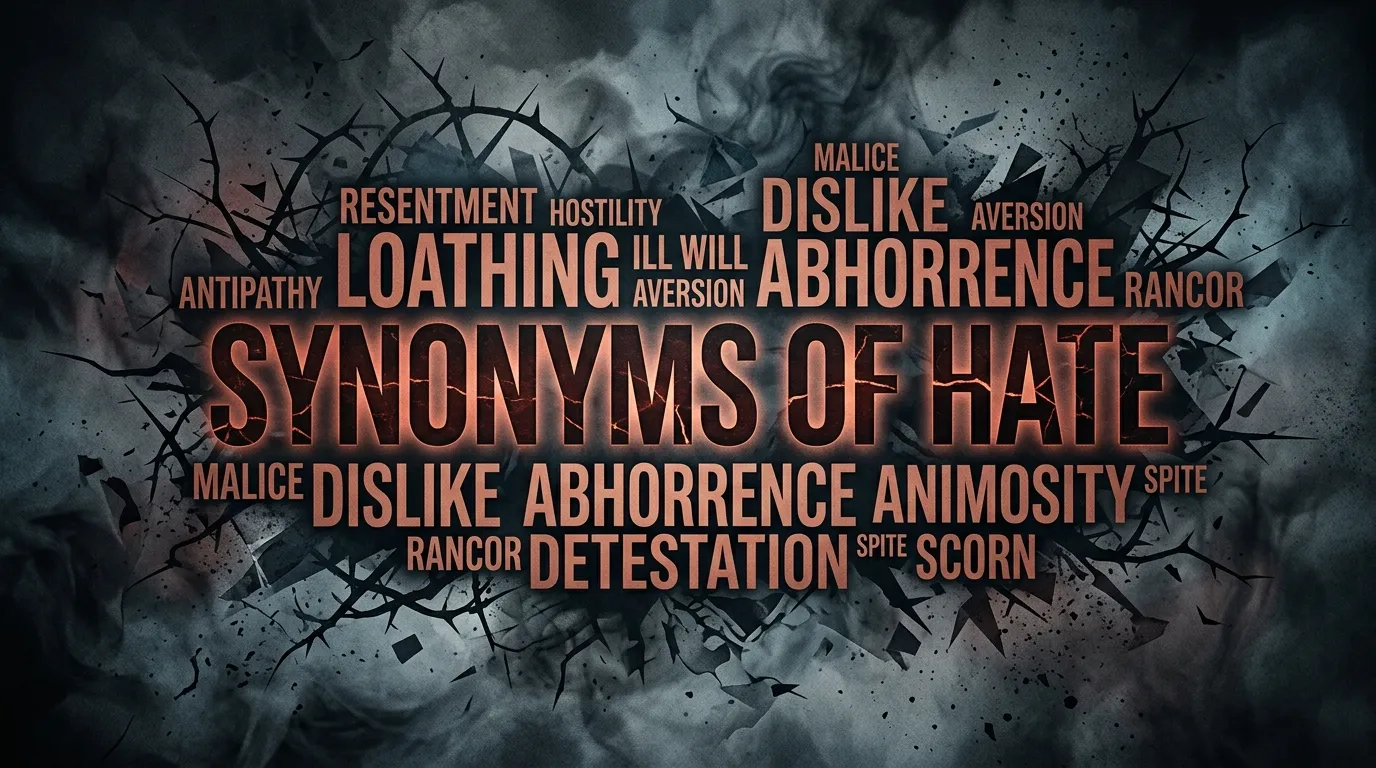
Synonyms of Hate
1. Detest (Verb) — US: /dɪˈtɛst/ | UK: /dɪˈtɛst/
Meaning: To dislike someone or something very strongly. Examples:
- I detest rude behavior in restaurants.
- She detests being interrupted while speaking.
2. Despise (Verb) — US: /dɪˈspaɪz/ | UK: /dɪˈspaɪz/
Meaning: To look down on someone with strong dislike and no respect. Examples:
- He despises dishonest politicians.
- They despise cruelty toward animals.
3. Loathe (Verb) — US: /loʊð/ | UK: /ləʊð/
Meaning: To feel deep disgust or hatred toward something. Examples:
- I loathe the smell of cigarette smoke.
- She loathes waking up before sunrise.
4. Abhor (Verb) — US: /əbˈhɔːr/ | UK: /əbˈhɔː/
Meaning: To hate something so much it feels shocking or disgusting. Examples:
- Most people abhor violence against children.
- The judge abhors any sign of corruption.
5. Abominate (Verb) — US: /əˈbɑːmɪneɪt/ | UK: /əˈbɒmɪneɪt/
Meaning: To hate something with strong moral disgust. Examples:
- He abominates cheating in any form.
- The community abominates acts of betrayal.
6. Execrate (Verb) — US: /ˈɛksɪkreɪt/ | UK: /ˈɛksɪkreɪt/
Meaning: To curse or hate something with great anger. Examples:
- The crowd execrated the corrupt leader.
- Historians execrate the cruelty of that war.
7. Scorn (Verb/Noun) — US: /skɔːrn/ | UK: /skɔːn/
Meaning: To treat someone or something as worthless, with strong dislike. Examples:
- She scorns people who break promises.
- His plan was met with scorn from the team.
8. Disdain (Verb/Noun) — US: /dɪsˈdeɪn/ | UK: /dɪsˈdeɪn/
Meaning: To feel that someone or something is beneath respect. Examples:
- He disdains fast food and never eats it.
- Her voice was full of disdain.
9. Resent (Verb) — US: /rɪˈzɛnt/ | UK: /rɪˈzɛnt/
Meaning: To feel bitter or angry about something unfair. Examples:
- She resents being blamed for his mistake.
- I resent how they treated my friend.
10. Revile (Verb) — US: /rɪˈvaɪl/ | UK: /rɪˈvaɪl/
Meaning: To criticize or insult someone with strong hatred. Examples:
- The traitor was reviled by his own country.
- Critics reviled the film for its weak story.
11. Condemn (Verb) — US: /kənˈdɛm/ | UK: /kənˈdɛm/
Meaning: To strongly disapprove of something as wrong. Examples:
- Leaders condemned the attack on the city.
- She condemns any form of bullying.
12. Deplore (Verb) — US: /dɪˈplɔːr/ | UK: /dɪˈplɔː/
Meaning: To feel or express strong disapproval of something. Examples:
- We deplore the loss of the old forest.
- He deplores the way workers were treated.
13. Spurn (Verb) — US: /spɜːrn/ | UK: /spɜːn/
Meaning: To reject someone or something with dislike. Examples:
- She spurned his offer of help.
- The team spurned the unfair contract.
14. Repudiate (Verb) — US: /rɪˈpjuːdieɪt/ | UK: /rɪˈpjuːdieɪt/
Meaning: To refuse to accept or support something, often with strong dislike. Examples:
- The senator repudiated the harsh comments.
- He repudiated his old beliefs completely.
15. Antipathy (Noun) — US: /ænˈtɪpəθi/ | UK: /ænˈtɪpəθi/
Meaning: A strong feeling of dislike toward someone or something. Examples:
- There is a deep antipathy between the two families.
- Her antipathy toward crowds keeps her home.
16. Aversion (Noun) — US: /əˈvɜːrʒən/ | UK: /əˈvɜːʃən/
Meaning: A strong feeling of not wanting to face or deal with something. Examples:
- He has an aversion to public speaking.
- She feels a strong aversion to spicy food.
17. Animosity (Noun) — US: /ˌænɪˈmɑːsəti/ | UK: /ˌænɪˈmɒsəti/
Meaning: Strong anger or hatred, often between two people or groups. Examples:
- Years of animosity divided the two nations.
- There is no animosity left between the old rivals.
18. Hostility (Noun) — US: /hɑːˈstɪləti/ | UK: /hɒˈstɪləti/
Meaning: Unfriendly or angry behavior, showing strong dislike. Examples:
- The new employee faced hostility from the team.
- Her hostility toward the plan surprised everyone.
19. Enmity (Noun) — US: /ˈɛnməti/ | UK: /ˈɛnməti/
Meaning: A deep, lasting feeling of hatred between enemies. Examples:
- The war left deep enmity between the countries.
- Their enmity lasted for over a decade.
20. Rancor (Noun) — US: /ˈræŋkər/ | UK: /ˈræŋkə/
Meaning: Bitter, long-lasting hatred or resentment. Examples:
- She spoke about the divorce without rancor.
- Years later, the rancor between them remained.
21. Malice (Noun) — US: /ˈmælɪs/ | UK: /ˈmælɪs/
Meaning: A strong wish to harm someone. Examples:
- He acted with malice toward his rival.
- There was no malice in her honest comment.
22. Loathing (Noun) — US: /ˈloʊðɪŋ/ | UK: /ˈləʊðɪŋ/
Meaning: A very strong feeling of hatred or disgust. Examples:
- She felt loathing for the cruel manager.
- His loathing of dishonesty shaped his career.
23. Repugnance (Noun) — US: /rɪˈpʌɡnəns/ | UK: /rɪˈpʌɡnəns/
Meaning: A strong feeling of dislike and disgust. Examples:
- He felt repugnance at the sight of the mess.
- Her repugnance toward violence is well known.
24. Contempt (Noun) — US: /kənˈtɛmpt/ | UK: /kənˈtɛmpt/
Meaning: A feeling that someone deserves no respect at all. Examples:
- He looked at the cheater with contempt.
- Their contempt for the rules caused problems.
25. Odium (Noun) — US: /ˈoʊdiəm/ | UK: /ˈəʊdiəm/
Meaning: Widespread hatred or strong disapproval from many people. Examples:
- The scandal brought odium upon the company.
- He faced public odium after the betrayal.
26. Hatred (Noun) — US: /ˈheɪtrɪd/ | UK: /ˈheɪtrɪd/
Meaning: A very strong feeling of dislike toward someone or something. Examples:
- Their hatred grew after years of conflict.
- She feels hatred toward unfair treatment.
27. Distaste (Noun) — US: /dɪsˈteɪst/ | UK: /dɪsˈteɪst/
Meaning: A mild but clear feeling of not liking something. Examples:
- He showed distaste for the loud music.
- Her distaste for gossip is obvious.
28. Detestation (Noun) — US: /ˌdiːtɛˈsteɪʃən/ | UK: /ˌdiːtɛˈsteɪʃən/
Meaning: A very strong feeling of hatred or disgust. Examples:
- He spoke of the crime with detestation.
- Their detestation of injustice united the group.
29. Repulsion (Noun) — US: /rɪˈpʌlʃən/ | UK: /rɪˈpʌlʃən/
Meaning: A strong feeling of disgust that pushes you away from something. Examples:
- She felt repulsion at the dirty kitchen.
- His repulsion toward lying kept him honest.
30. Bitterness (Noun) — US: /ˈbɪtərnəs/ | UK: /ˈbɪtənəs/
Meaning: A feeling of anger and hurt that lasts a long time. Examples:
- Bitterness over the loss never left him.
- She spoke without bitterness, only sadness.
Prototype Meaning
When most people hear the word hate, they picture a strong, burning feeling aimed at a person, group, or thing. It feels hot, sudden, and personal — like anger mixed with disgust. This is the prototype: an intense, negative emotion that makes someone want to avoid, fight, or reject its target. Softer synonyms, like distaste, move away from this core image. Stronger ones, like abhor or loathe, sit right at the center of it.
Prototype Categorization
- Mild dislike: distaste, aversion, resentment
- Strong personal hatred: detest, despise, loathe, abhor, abominate
- Group or public hatred: hostility, animosity, enmity, odium
- Hatred with judgment or moral disapproval: condemn, deplore, revile, execrate
- Cold, distant dislike: disdain, scorn, contempt
- Lasting bitter feelings: rancor, bitterness, malice
Grouping synonyms this way helps writers match the right word to the right situation. A quiet dislike calls for distaste. A furious public reaction calls for odium or outrage-adjacent words. Choosing the correct category keeps writing accurate and avoids sounding too strong or too weak for the moment.
Antonyms of Hate
love, adore, admire, cherish, appreciate, like, fancy
Short Questions and Answers
- What does hate mean? Hate means to feel a very strong dislike for someone or something.
- When should stronger synonyms like abhor or loathe be used? Use them when the feeling is intense, such as strong moral disgust or deep personal dislike, not for small annoyances.
- Is hate positive or negative? Hate is almost always negative. It shows anger, disgust, or strong disapproval.
- How is hate different from similar words like dislike or resent? Dislike is mild and everyday. Resent adds a feeling of unfairness. Hate is the strongest of the three, showing deep, burning negative emotion.
Conclusion
Learning hate and its 30 synonyms gives you more than new words. It builds a sharper, more expressive vocabulary for both speaking and writing. Instead of repeating hate again and again, you can choose despise for personal dislike, hostility for group conflict, or distaste for something small. This variety keeps your language fresh and precise. It also helps you understand tone, so your writing matches the true strength of the feeling you want to share. Make it a habit to learn a few new synonyms each week. Read them in sentences, say them out loud, and use them in your own writing. Over time, this small daily practice builds real confidence in English, one word at a time.