Failure means not reaching a goal. It means something did not work. Think of a student who studies hard but fails a test. Or a business owner who opens a shop that closes in a year. These are both cases of failure. The word shows up in school, work, sports, and daily talk. People use it often because everyone faces failure at some point in life.
Synonyms of Failure for common words like failure helps English learners and writers grow. It makes speech and writing more interesting. It stops the same word from repeating again and again. A rich vocabulary also helps you express feelings with more detail and more truth.
This article looks closely at the word failure or Synonyms of Failure. You will learn its meaning, its history, how to say it, and how it is built. You will also learn 30 strong synonyms, each with meaning, pronunciation, and example sentences. By the end, you will know how to pick the right word for the right moment.
Meaning of Failure
Definition
Failure (Noun): A lack of success. It happens when a plan, a person, or a thing does not do what it was supposed to do.
Examples
- The rocket launch ended in failure after the engine stopped working.
- Her fear of failure kept her from trying new things.
Connotative Meaning
- Positive tone: Sometimes people use failure to show growth, like “failure taught me a lot.”
- Negative tone: Most often, it points to loss, sadness, or disappointment.
- Neutral tone: In technical writing, it can simply describe a fact, like “system failure.”
Etymology
- The word comes from the Old French word faillir, meaning “to fail” or “to be lacking.”
- This traces back to the Latin word fallere, meaning “to deceive” or “to trick.”
- Over time, the meaning shifted from “deceiving” to “falling short” or “not succeeding.”
Short History
- Old English (450–1100): The word failure did not exist yet. English speakers used native words like misfaran (to go wrong) instead.
- Middle English (1100–1500): French words entered English after the Norman Conquest. Failen (to fail) came into use during this period.
- Modern English (1500–Present): The noun failure took its current form in the 1600s. It has stayed stable in spelling and meaning since then.
Also read more abouthttps://myprayerss.com/synonyms-for-ugly/
Pronunciation (US & UK – IPA)
- US: /ˈfeɪ.ljɚ/
- UK: /ˈfeɪ.ljə/
Syllables
fail-ure
Affixation Pattern of Failure
- Root: fail (from Latin fallere)
- Prefix: none
- Suffix: -ure (turns a verb into a noun)
Word formation:
From the root fail, English has formed several words. Fail (verb), failure (noun), failed (adjective/past tense), and failing (noun/adjective, as in “a failing business”). This shows how one root can grow into many grammatical forms.
Synonyms of Failure
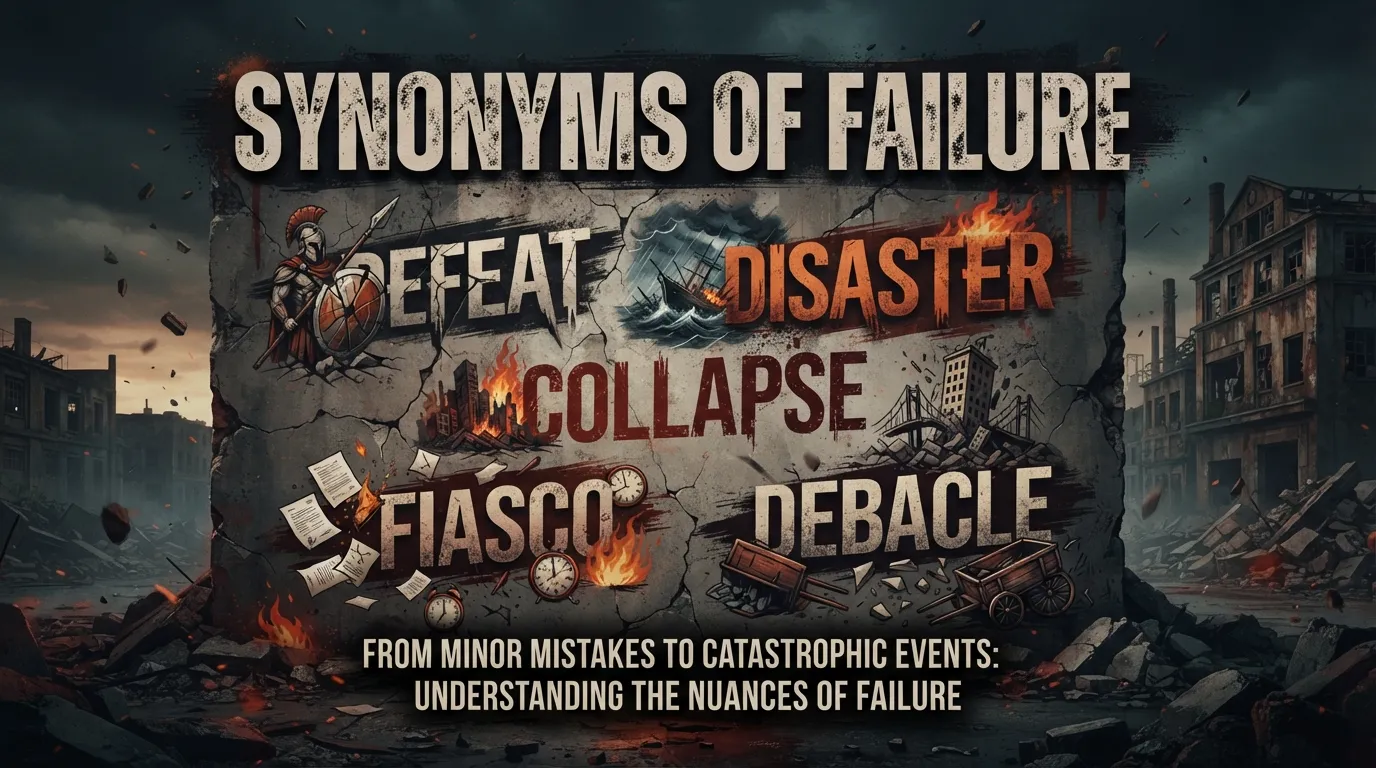
1. Defeat (Noun) — US /dɪˈfiːt/ | UK /dɪˈfiːt/
Meaning: A loss in a fight, game, or contest. Examples:
- The team faced a hard defeat in the final match.
- His defeat in the election surprised many people.
2. Loss (Noun) — US /lɔːs/ | UK /lɒs/
Meaning: The state of not winning or not keeping something. Examples:
- The company reported a big loss last year.
- It was a painful loss for the whole town.
3. Flop (Noun) — US /flɑːp/ | UK /flɒp/
Meaning: Something that fails badly, often used for shows or products. Examples:
- The new movie was a total flop at the box office.
- His first business idea was a flop.
4. Fiasco (Noun) — US /fiˈæs.koʊ/ | UK /fiˈæs.kəʊ/
Meaning: A complete and embarrassing failure. Examples:
- The wedding turned into a fiasco when the power went out.
- The product launch was a public fiasco.
5. Disaster (Noun) — US /dɪˈzæs.tɚ/ | UK /dɪˈzɑː.stə/
Meaning: A very bad event with harmful results. Examples:
- The trip was a disaster from start to finish.
- Poor planning led to a financial disaster.
6. Downfall (Noun) — US /ˈdaʊn.fɔːl/ | UK /ˈdaʊn.fɔːl/
Meaning: A sudden loss of power, success, or status. Examples:
- Greed was the cause of his downfall.
- The scandal led to the company’s downfall.
7. Collapse (Noun) — US /kəˈlæps/ | UK /kəˈlæps/
Meaning: A sudden and complete failure or breakdown. Examples:
- The economic collapse affected millions of people.
- The talks ended in collapse after both sides argued.
8. Breakdown (Noun) — US /ˈbreɪk.daʊn/ | UK /ˈbreɪk.daʊn/
Meaning: A failure to work or function properly. Examples:
- A breakdown in communication caused the problem.
- The car breakdown delayed our trip.
9. Setback (Noun) — US /ˈsɛt.bæk/ | UK /ˈsɛt.bæk/
Meaning: A problem that slows or stops progress. Examples:
- The injury was a major setback for the athlete.
- Despite the setback, the team kept working.
10. Blunder (Noun) — US /ˈblʌn.dɚ/ | UK /ˈblʌn.də/
Meaning: A careless and often embarrassing mistake. Examples:
- Forgetting the client’s name was a big blunder.
- The manager made a costly blunder in the report.
11. Mistake (Noun) — US /mɪˈsteɪk/ | UK /mɪˈsteɪk/
Meaning: An action or decision that is wrong. Examples:
- It was a mistake to leave so late.
- Everyone makes mistakes while learning.
12. Shortfall (Noun) — US /ˈʃɔːrt.fɔːl/ | UK /ˈʃɔːt.fɔːl/
Meaning: An amount that is less than what is needed. Examples:
- There was a shortfall in the budget this year.
- The rainfall shortfall hurt the farmers’ crops.
13. Miscarriage (Noun) — US /ˈmɪs.kær.ɪdʒ/ | UK /ˈmɪs.kær.ɪdʒ/
Meaning: A failure to achieve the right or planned result, often used with “justice.” Examples:
- The trial was called a miscarriage of justice.
- A miscarriage of the plan left everyone confused.
14. Bust (Noun) — US /bʌst/ | UK /bʌst/
Meaning: An informal word for a failed plan or business. Examples:
- The concert was a total bust with few fans showing up.
- Their startup ended up a bust after two years.
15. Washout (Noun) — US /ˈwɑːʃ.aʊt/ | UK /ˈwɒʃ.aʊt/
Meaning: A complete failure, especially of an event or person. Examples:
- The picnic was a washout because of the storm.
- Critics called the film a washout.
16. Dud (Noun) — US /dʌd/ | UK /dʌd/
Meaning: Something that fails to work or succeed as expected. Examples:
- The new phone model turned out to be a dud.
- That firework was a dud; it never went off.
17. Letdown (Noun) — US /ˈlɛt.daʊn/ | UK /ˈlɛt.daʊn/
Meaning: A disappointing result after high hopes. Examples:
- The sequel was a letdown compared to the first movie.
- His speech was a letdown for the excited crowd.
18. Debacle (Noun) — US /dɪˈbɑː.kəl/ | UK /deɪˈbɑː.kəl/
Meaning: A sudden and total failure, often public and messy. Examples:
- The election was called a debacle by many reporters.
- The product recall was a public debacle.
19. Ruin (Noun) — US /ˈruː.ɪn/ | UK /ˈruː.ɪn/
Meaning: Complete destruction or failure of something. Examples:
- Bad choices led to his financial ruin.
- The storm left the old building in ruin.
20. Catastrophe (Noun) — US /kəˈtæs.trə.fi/ | UK /kəˈtæs.trə.fi/
Meaning: A sudden, large-scale disaster or failure. Examples:
- The flood was a catastrophe for the whole region.
- Losing the data was a catastrophe for the company.
21. Botch (Noun) — US /bɑːtʃ/ | UK /bɒtʃ/
Meaning: A poorly done job or a clumsy failure. Examples:
- The repair was a total botch job.
- His attempt at cooking dinner was a botch.
22. Slip-up (Noun) — US /ˈslɪp.ʌp/ | UK /ˈslɪp.ʌp/
Meaning: A small mistake or error. Examples:
- One slip-up cost them the contract.
- It was a minor slip-up, easy to fix.
23. Miss (Noun) — US /mɪs/ | UK /mɪs/
Meaning: A failure to hit, achieve, or reach a target. Examples:
- The last shot was a near miss.
- That marketing plan was a miss for the brand.
24. Fumble (Noun) — US /ˈfʌm.bəl/ | UK /ˈfʌm.bəl/
Meaning: A clumsy failure to handle something well. Examples:
- The player’s fumble cost the team the game.
- Their fumble in the meeting made a bad impression.
25. Stumble (Noun) — US /ˈstʌm.bəl/ | UK /ˈstʌm.bəl/
Meaning: A small failure or mistake while trying to move forward. Examples:
- The company had a stumble early on but recovered.
- Her stumble in the speech was quickly forgotten.
26. Downturn (Noun) — US /ˈdaʊn.tɜːrn/ | UK /ˈdaʊn.tɜːn/
Meaning: A decline, often used for business or economy. Examples:
- The economic downturn led to job losses.
- Sales showed a sharp downturn last quarter.
27. Regression (Noun) — US /rɪˈɡrɛʃ.ən/ | UK /rɪˈɡrɛʃ.ən/
Meaning: A return to a worse or earlier state after progress. Examples:
- The patient’s regression worried the doctors.
- A regression in skills happened after the long break.
28. Wreck (Noun) — US /rɛk/ | UK /rɛk/
Meaning: Something badly damaged or ruined, often used for plans or vehicles. Examples:
- The project was a wreck by the end of the month.
- His health was a wreck after years of stress.
29. Malfunction (Noun) — US /mælˈfʌŋk.ʃən/ | UK /mælˈfʌŋk.ʃən/
Meaning: A failure of a machine or system to work correctly. Examples:
- A malfunction caused the plane to delay takeoff.
- The software malfunction froze every computer in the office.
30. Non-starter (Noun) — US /ˌnɑːnˈstɑːr.tɚ/ | UK /ˌnɒnˈstɑː.tə/
Meaning: An idea or plan that fails before it even begins. Examples:
- The proposal was a non-starter from day one.
- Without funding, the project was a non-starter.
Prototype Meaning
When most people hear the word failure or Synonyms of Failure, they picture a clear moment when something did not work. It could be a failed test, a broken plan, or a lost game. The image is often tied to disappointment and a need to try again. This common picture helps explain why failure feels heavier than lighter words like slip-up or miss also Synonyms of Failure.
Prototype Categorization
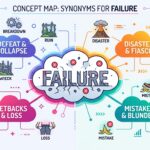
- Mild failures: slip-up, miss, stumble, fumble
- Business or system failures: shortfall, downturn, malfunction, breakdown, bust
- Public or dramatic failures: fiasco, debacle, washout, flop, catastrophe
- Failures tied to power or status: downfall, collapse, ruin, defeat
- General or formal failures: loss, mistake, blunder, setback, regression, miscarriage, non-starter, wreck, disaster
Antonyms of Failure
success, victory, triumph, achievement, win
Short Questions and Answers
- What does failure mean? It means not reaching a goal or not succeeding at something.
- When should failure be used? Use it when talking about a clear lack of success, in school, work, sports, or life plans.
- Is failure positive or negative? It is mostly negative, but it can turn positive when used to describe learning and growth.
- How is it different from similar words? Failure is a general term. Words like fiasco or debacle show a bigger, more public failure. Words like slip-up or stumble show a small, minor one.
Conclusion
Synonyms of Failure builds strong English skills. It helps you speak and write with more color and more truth. You will not need to repeat the same word again and again. Instead, you can choose the exact word that fits your story, your tone, and your message. This skill also builds confidence. You start to sound clear, natural, and smart in English. Keep practicing new words every day. Read them, say them, and use them in real sentences. Small daily practice adds up to big vocabulary growth over time by using Synonyms of Failure.