Light is one of the most common words in English. Imagine waking up early, opening your curtains, and letting the morning light enter your room. The room becomes bright, and you can see everything clearly. In this simple situation, light means the natural or artificial energy that makes things visible.
We use the word light every day. It can also describe something that is not heavy, a pale color, an easy task, or the act of starting a fire. Because it has many meanings, learning its synonyms can help English learners choose more exact words. It can also help students, writers, bloggers, and content creators avoid repeating the same word.
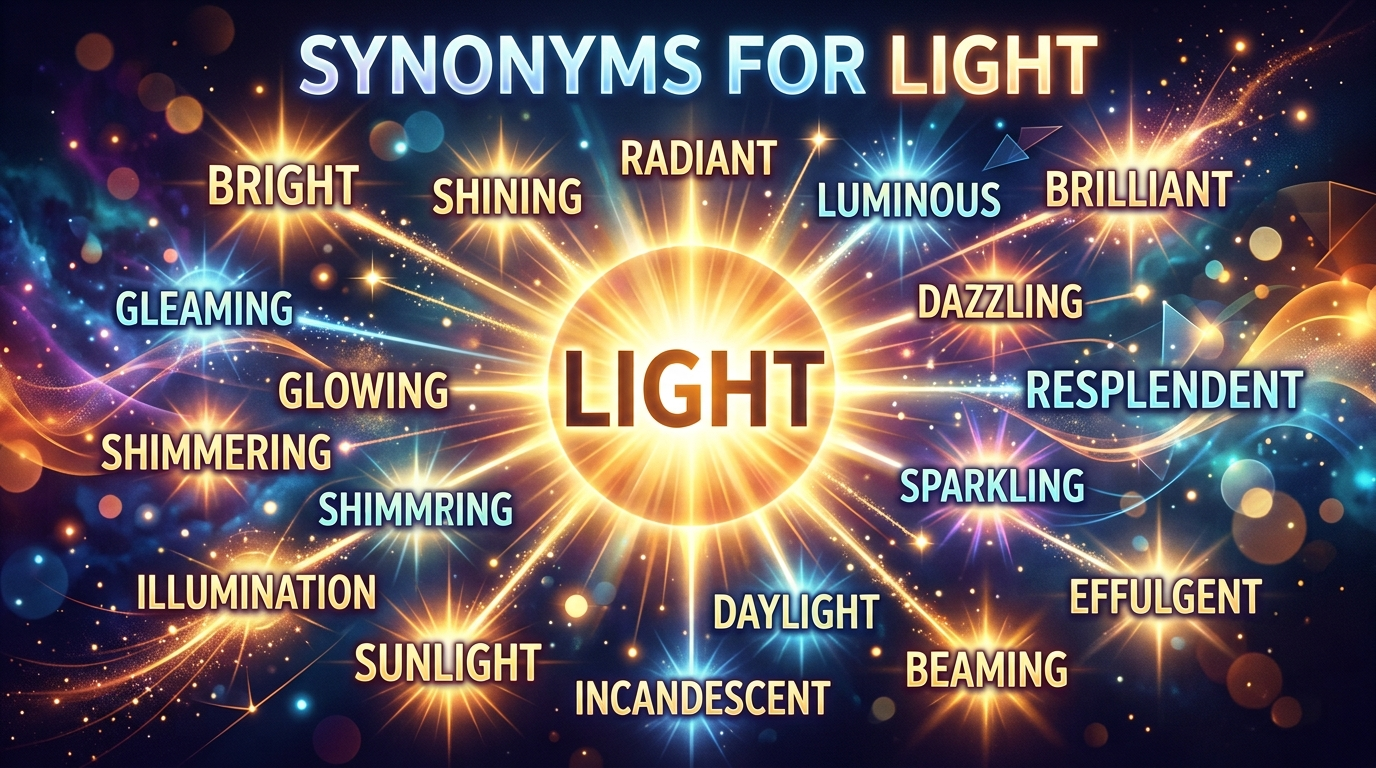
This guide explains the meaning, connotations, history, pronunciation, word formation, and 30 useful synonyms of light. Each synonym includes a simple meaning and natural examples.
Learn more about: https://myprayerss.com/synonyms-of-hate/
Meaning of Light
Definition
Light (noun, adjective, verb): A word that can mean visible brightness, something that is not heavy, a pale color, something easy, or the act of making something burn.
Examples
- The light from the window filled the room.
- This bag is very light, so I can carry it easily.
Connotative Meaning
- Positive tone: Light can suggest hope, clarity, freedom, beauty, or happiness.
- Negative tone: In some contexts, light can suggest weakness, lack of seriousness, or something that is too mild.
- Neutral tone: It can simply describe brightness, weight, color, or intensity.
Connotation (the feeling or idea that a word suggests beyond its basic dictionary meaning).
Etymology
- Source: The noun light comes from Old English lēoht, meaning brightness or daylight.
- It is related to similar Germanic words, including Old High German lioht and German Licht.
- The adjective light, meaning “not heavy,” comes from Old English leoht, from an older Germanic root related to “light” in weight.
- These two meanings developed from different historical roots even though they have the same spelling today.
Short History
- Old English (450–1100): Light appeared as lēoht, referring to brightness, daylight, and the ability to see.
- Middle English (1100–1500): Forms such as light and liȝt became common. The word developed wider uses related to brightness, color, and physical weight.
- Modern English (1500–Present): Light gained many common uses, including meanings connected with mood, color, food, movement, difficulty, and starting a fire.
Pronunciation (US & UK – IPA)
US: /laɪt/ UK: /laɪt/
Syllables
light
It is a one-syllable word.
Affixation Pattern of Light
Root: light
Prefix: None
Suffix: None
Word formation: Light is a basic English word that can function in several grammatical categories.
- Noun: light, lights
- Adjective: light, lighter, lightest
- Verb: light, lights, lit/lighted, lighting
- Adverbial use: light, as in “travel light”
Synonyms of Light
The best synonym depends on the meaning of light. The following 30 words cover its major uses, including brightness, color, weight, ease, and fire.
1. Bright (Adjective) — US /braɪt/ | UK /braɪt/
Meaning: Giving off or reflecting a strong amount of light.
Examples:
- The room was bright in the morning.
- She wore a bright yellow dress.
2. Luminous (Adjective) — US /ˈluːmənəs/ | UK /ˈluːmɪnəs/
Meaning: Giving off or appearing to give off light.
Examples:
- The moon looked luminous against the dark sky.
- The painting had a luminous quality.
3. Radiant (Adjective) — US /ˈreɪdiənt/ | UK /ˈreɪdiənt/
Meaning: Sending out light, warmth, or a strong glow.
Examples:
- The sun was radiant above the hills.
- Her face looked radiant with happiness.
4. Glowing (Adjective) — US /ˈɡloʊɪŋ/ | UK /ˈɡləʊɪŋ/
Meaning: Producing a soft and steady light.
Examples:
- A glowing lamp stood beside the bed.
- The fire left the room glowing with warm light.
5. Shining (Adjective) — US /ˈʃaɪnɪŋ/ | UK /ˈʃaɪnɪŋ/
Meaning: Reflecting or producing visible light.
Examples:
- The stars were shining above us.
- His shoes were clean and shining.
6. Gleaming (Adjective) — US /ˈɡliːmɪŋ/ | UK /ˈɡliːmɪŋ/
Meaning: Reflecting light brightly from a clean or polished surface.
Examples:
- The car stood gleaming in the sun.
- Her new shoes were gleaming.
7. Glimmer (Noun) — US /ˈɡlɪmər/ | UK /ˈɡlɪmə/
Meaning: A small, weak, or uncertain amount of light.
Examples:
- We saw a glimmer of light in the distance.
- A glimmer came through the trees.
8. Gleam (Noun) — US /ɡliːm/ | UK /ɡliːm/
Meaning: A brief or small flash of light.
Examples:
- A gleam of sunlight entered the room.
- I noticed a gleam on the surface of the water.
9. Glow (Noun) — US /ɡloʊ/ | UK /ɡləʊ/
Meaning: A soft, warm, or steady light.
Examples:
- The candle gave off a soft glow.
- The sunset left a golden glow in the sky.
10. Radiance (Noun) — US /ˈreɪdiəns/ | UK /ˈreɪdiəns/
Meaning: A strong and beautiful quality of light.
Examples:
- The radiance of the sun filled the garden.
- The bride’s face seemed full of radiance.
11. Illumination (Noun) — US /ɪˌluːməˈneɪʃən/ | UK /ɪˌluːmɪˈneɪʃən/
Meaning: The light that makes a place or object visible.
Examples:
- Good illumination is important when reading.
- The museum used soft illumination.
12. Brightness (Noun) — US /ˈbraɪtnəs/ | UK /ˈbraɪtnəs/
Meaning: The amount or quality of light produced or reflected.
Examples:
- You can adjust the brightness of the screen.
- The brightness of the sun hurt my eyes.
13. Luminosity (Noun) — US /ˌluːməˈnɒsəti/ | UK /ˌluːmɪˈnɒsəti/
Meaning: The quality or amount of light produced by something.
Examples:
- Scientists measured the star’s luminosity.
- The stone had a strange luminosity.
14. Beam (Noun) — US /biːm/ | UK /biːm/
Meaning: A narrow line or stream of light.
Examples:
- A beam of sunlight entered through the window.
- The flashlight sent a strong beam across the road.
15. Ray (Noun) — US /reɪ/ | UK /reɪ/
Meaning: A narrow line of light that comes from a source.
Examples:
- A ray of sunlight touched the floor.
- The first rays of the sun appeared at dawn.
16. Weightless (Adjective) — US /ˈweɪtləs/ | UK /ˈweɪtləs/
Meaning: Having little or no weight.
Examples:
- The material feels almost weightless.
- The astronaut appeared weightless in space.
Usage note: Weightless is stronger than light. It means having no apparent weight rather than simply being easy to carry.
17. Lightweight (Adjective) — US /ˈlaɪtˌweɪt/ | UK /ˈlaɪtˌweɪt/
Meaning: Weighing less than similar objects.
Examples:
- This jacket is lightweight and easy to pack.
- I bought a lightweight laptop for travel.
18. Airy (Adjective) — US /ˈeri/ | UK /ˈeəri/
Meaning: Very light, delicate, or seeming to move easily through the air.
Examples:
- She wore an airy summer dress.
- The curtains had an airy appearance.
19. Featherweight (Adjective) — US /ˈfeðərˌweɪt/ | UK /ˈfeðəˌweɪt/
Meaning: Extremely light in weight.
Examples:
- The new bag is almost featherweight.
- These shoes are featherweight and comfortable.
20. Slim (Adjective) — US /slɪm/ | UK /slɪm/
Meaning: Thin and often designed to take up little space or weight.
Examples:
- I bought a slim laptop for work.
- The phone has a slim and light design.
Usage note: Slim is not a direct synonym of light. It is useful when light refers to a thin, compact object.
21. Pale (Adjective) — US /peɪl/ | UK /peɪl/
Meaning: Having a light color with little strong color.
Examples:
- She painted the walls pale blue.
- He wore a pale green shirt.
22. Faint (Adjective) — US /feɪnt/ | UK /feɪnt/
Meaning: Weak in strength, brightness, sound, or appearance.
Examples:
- We could see a faint light in the distance.
- There was a faint glow behind the clouds.
23. Subtle (Adjective) — US /ˈsʌtəl/ | UK /ˈsʌtəl/
Meaning: Soft, gentle, or not easy to notice.
Examples:
- The room had subtle lighting.
- She chose a subtle shade of pink.
24. Mild (Adjective) — US /maɪld/ | UK /maɪld/
Meaning: Not strong, severe, or intense.
Examples:
- The dish has a mild flavor.
- He prefers mild lighting in the evening.
Usage note: Mild is a synonym only when light means low in strength or intensity.
25. Easy (Adjective) — US /ˈiːzi/ | UK /ˈiːzi/
Meaning: Not difficult to do, understand, or deal with.
Examples:
- The teacher gave us a light assignment.
- The test was easy for most students.
Usage note: Easy can replace light when light describes a task or workload that is not demanding.
26. Simple (Adjective) — US /ˈsɪmpəl/ | UK /ˈsɪmpəl/
Meaning: Easy to understand or do and not complicated.
Examples:
- The instructions were simple.
- We chose a simple design for the room.
27. Gentle (Adjective) — US /ˈdʒentəl/ | UK /ˈdʒentəl/
Meaning: Soft, mild, or not forceful.
Examples:
- The room was filled with gentle light.
- A gentle breeze moved the curtains.
28. Ignite (Verb) — US /ɪɡˈnaɪt/ | UK /ɪɡˈnaɪt/
Meaning: To make something start burning.
Examples:
- He used a match to ignite the fire.
- A spark can ignite dry grass.
Usage note: Ignite is related to the verb light when light means “to start a fire.”
29. Kindle (Verb) — US /ˈkɪndəl/ | UK /ˈkɪndəl/
Meaning: To start a fire or cause something to begin burning.
Examples:
- She used dry wood to kindle the fire.
- He kindled a small fire before sunset.
30. Illuminate (Verb) — US /ɪˈluːməˌneɪt/ | UK /ɪˈluːmɪˌneɪt/
Meaning: To provide light or make something easier to see.
Examples:
- Street lamps illuminate the road.
- The candles illuminated the room.
Prototype Meaning
The most typical meaning of light is the brightness that allows people to see. When most people hear light, they may imagine sunlight entering a room, a lamp glowing at night, or a bright object in a dark place. This is the core meaning of the noun light. However, the word has several other common meanings, so context is important when choosing a synonym.
Prototype Categorization
Synonyms and related words for light can be grouped by meaning:
- Brightness: bright, luminous, radiant, glowing, shining
- Small or soft light: glimmer, gleam, glow, faint, subtle
- Light as illumination: illumination, brightness, luminosity, beam, ray
- Light as low weight: lightweight, weightless, airy, featherweight
- Light as pale color: pale, subtle
- Light as low intensity: faint, mild, gentle
- Light as easy or not difficult: easy, simple
- Light as starting a fire: ignite, kindle
- Light as providing brightness: illuminate
Antonyms of Light
The opposite of light depends on its meaning.
Word opposite of light as brightness
- Dark
- Darkness
- Dimness
- Shadow
light as weight
- Heavy
- Weighty
- Hefty
- Bulky
Opposite of light as color
- Dark
- Deep
- Strong
- Rich
Word opposite of light as difficulty
- Difficult
- Hard
- Challenging
- Demanding
Opposite of light as intensity
- Strong
- Severe
- Intense
- Harsh
Short Questions and Answers
- What does light mean? Light can mean brightness, something that is not heavy, a pale color, something easy, or the act of starting a fire.
- When should light be used? Use light when you need a common, simple word and the meaning is clear from context.
- Is light positive or negative? Light is usually neutral, but it can have a positive meaning when it suggests hope, clarity, freedom, or happiness. Its tone depends on the context.
- How is light different from similar words? Light is a broad word. More specific words such as glimmer, radiance, lightweight, pale, and easy describe particular meanings more precisely.
Conclusion
Learning the different meanings and synonyms of light can make your English stronger and more flexible. Instead of using the same word again and again, you can choose a more exact word for each situation. For example, radiant can describe strong and beautiful light, while glimmer describes a small amount of light. Lightweight works for something that is easy to carry, while easy can describe a task that is not difficult.
Understanding synonyms also improves writing and speaking. It helps students express ideas more clearly and gives writers more ways to create natural and engaging content. The best way to build vocabulary is to learn a few new words each day and use them in real sentences. With regular practice, you can use light and its related words with greater accuracy and confidence.