Introduction
Failure means the state of not doing something you tried to do. Think of a student who studies hard for a test but still gets a low score. That student faced a failure. This word shows up in daily talk, school, business, and sports. People use it because life is full of tries that do not always work out.
Learning synonyms of common words like failure helps English learners and content writers a lot. It makes your speech and writing sound rich, not repetitive. It also helps you pick the exact word that fits your feeling or situation. This article will explain the meaning of failure, its history, pronunciation, word parts, and 30 useful synonyms with examples. You will also learn how to group these words by meaning and use them the right way.
Meaning of Failure
Definition
Failure (noun): the fact of not succeeding at something you planned or tried to do.
Examples
- The new product was a failure because no one bought it.
- His business ended in failure after two hard years.
Connotative Meaning
- Positive tone: Rare, but sometimes used to show growth (“Failure taught me a lot.”)
- Negative tone: Common. Shows loss, sadness, or disappointment.
- Neutral tone: Used in reports or facts, like “system failure,” without strong emotion.
LEARN ABOUT MOREhttps://myprayerss.com/synonyms-for-hot/
Etymology
- The word failure comes from the Old French word faillir, meaning “to be lacking” or “to miss.”
- This came from the Latin word fallere, meaning “to deceive” or “to trick.”
- The noun form failure developed in English in the 1600s from the verb fail.
Short History
- Old English (450–1100): The word failure did not exist yet. English speakers used native words like misfaran (to go wrong).
- Middle English (1100–1500): The verb failen entered English from French, brought by Norman influence after 1066.
- Modern English (1500–Present): The noun failure formed around the 1600s and became common in business, science, and daily English by the 1800s.
Pronunciation (US & UK – IPA)
- US: /ˈfeɪl.jɚ/
- UK: /ˈfeɪl.jə/
Syllables
fail-ure
Affixation Pattern of Failure
- Root: fail (from Latin fallere)
- Prefix: none
- Suffix: -ure (turns a verb into a noun)
Word Formation
The root fail forms several related words:
- fail (verb) — to not succeed
- failure (noun) — the state of not succeeding
- failing (noun/adjective) — a weakness or shortcoming
- failed (adjective) — did not succeed
- fail-safe (adjective) — designed to prevent failure
Synonyms of Failure
1. Defeat (noun) — US /dɪˈfiːt/ | UK /dɪˈfiːt/
Meaning: A loss in a fight, game, or contest. Examples:
- The team suffered a hard defeat last night.
- She accepted defeat with grace.
2. Collapse (noun) — US /kəˈlæps/ | UK /kəˈlæps/
Meaning: A sudden and total failure or breakdown. Examples:
- The company faced financial collapse.
- The plan ended in collapse within weeks.
3. Downfall (noun) — US /ˈdaʊnˌfɔːl/ | UK /ˈdaʊnfɔːl/
Meaning: A sudden loss of power, success, or status. Examples:
- Pride was his downfall.
- The scandal caused the leader’s downfall.
4. Breakdown (noun) — US /ˈbreɪkˌdaʊn/ | UK /ˈbreɪkdaʊn/
Meaning: A failure to work or function properly. Examples:
- The talks ended in a complete breakdown.
- There was a breakdown in communication.
5. Fiasco (noun) — US /fiˈæskoʊ/ | UK /fiˈæskəʊ/
Meaning: A complete and embarrassing failure. Examples:
- The event turned into a total fiasco.
- Everyone remembers that trip as a fiasco.
6. Disaster (noun) — US /dɪˈzæstɚ/ | UK /dɪˈzɑːstə/
Meaning: A very bad and often unexpected failure. Examples:
- The launch was a disaster from the start.
- Their first date was a disaster.
7. Setback (noun) — US /ˈsɛtˌbæk/ | UK /ˈsɛtbæk/
Meaning: A problem that slows or stops progress. Examples:
- The injury was a big setback for her career.
- We faced a small setback in the project.
8. Flop (noun) — US /flɑːp/ | UK /flɒp/
Meaning: Something that fails, often in entertainment or sales. Examples:
- The movie was a huge flop.
- His new app turned out to be a flop.
9. Letdown (noun) — US /ˈlɛtˌdaʊn/ | UK /ˈlɛtdaʊn/
Meaning: A disappointing result that fails to meet hopes. Examples:
- The ending of the book was a letdown.
- The trip was a real letdown.
10. Loss (noun) — US /lɔːs/ | UK /lɒs/
Meaning: A failure to win or keep something. Examples:
- The team faced another loss this season.
- It was a hard loss for the whole family.
11. Shortfall (noun) — US /ˈʃɔːrtˌfɔːl/ | UK /ˈʃɔːtfɔːl/
Meaning: A failure to reach an expected amount. Examples:
- There was a big shortfall in the budget.
- The harvest showed a shortfall this year.
12. Blunder (noun) — US /ˈblʌndɚ/ | UK /ˈblʌndə/
Meaning: A careless and serious mistake. Examples:
- He made a costly blunder at work.
- That was a major blunder in the report.
13. Mistake (noun) — US /mɪˈsteɪk/ | UK /mɪˈsteɪk/
Meaning: An action or decision that is wrong. Examples:
- I made a mistake on the form.
- It was an honest mistake.
14. Ruin (noun) — US /ˈruːɪn/ | UK /ˈruːɪn/
Meaning: Complete failure or destruction, often financial. Examples:
- Bad choices led to his ruin.
- The storm brought ruin to the crops.
15. Bankruptcy (noun) — US /ˈbæŋkrʌptsi/ | UK /ˈbæŋkrʌptsi/
Meaning: A legal state of financial failure. Examples:
- The store filed for bankruptcy.
- Bankruptcy forced them to close the shop.
16. Washout (noun) — US /ˈwɑːʃˌaʊt/ | UK /ˈwɒʃaʊt/
Meaning: A complete failure, often used informally. Examples:
- The picnic was a total washout.
- His first attempt was a washout.
17. Bust (noun) — US /bʌst/ | UK /bʌst/
Meaning: An informal word for a failure or collapse. Examples:
- The concert was a bust.
- Their plan turned out to be a bust.
18. Debacle (noun) — US /dɪˈbɑːkəl/ | UK /deɪˈbɑːkəl/
Meaning: A sudden and complete failure, often public. Examples:
- The election night was a debacle.
- The product recall was a public debacle.
19. Catastrophe (noun) — US /kəˈtæstrəfi/ | UK /kəˈtæstrəfi/
Meaning: A sudden, extreme failure or disaster. Examples:
- The flood was a natural catastrophe.
- Losing the deal was a catastrophe for the firm.
20. Decline (noun) — US /dɪˈklaɪn/ | UK /dɪˈklaɪn/
Meaning: A slow failure or loss of strength over time. Examples:
- The company saw a steady decline in sales.
- His health went into decline.
21. Lapse (noun) — US /læps/ | UK /læps/
Meaning: A small failure to keep up a standard. Examples:
- It was a brief lapse in judgment.
- A lapse in attention caused the error.
22. Deficiency (noun) — US /dɪˈfɪʃənsi/ | UK /dɪˈfɪʃənsi/
Meaning: A failure to have enough of something needed. Examples:
- The report showed a deficiency in planning.
- His diet had a vitamin deficiency.
23. Inadequacy (noun) — US /ɪnˈædɪkwəsi/ | UK /ɪnˈædɪkwəsi/
Meaning: The state of not being good enough. Examples:
- She felt a sense of inadequacy after the test.
- The plan’s inadequacy became clear later.
24. Miscarriage (noun) — US /mɪsˈkærɪdʒ/ | UK /mɪsˈkærɪdʒ/
Meaning: A failure of a plan or process to work as intended. Examples:
- The trial was called a miscarriage of justice.
- The project ended in miscarriage due to poor planning.
25. Misfire (noun) — US /ˌmɪsˈfaɪɚ/ | UK /ˌmɪsˈfaɪə/
Meaning: An attempt that fails to work as planned. Examples:
- The marketing idea was a misfire.
- His joke was a total misfire.
26. Botch (noun) — US /bɑːtʃ/ | UK /bɒtʃ/
Meaning: A poorly done job that fails badly. Examples:
- The repair was a complete botch.
- They made a botch of the presentation.
27. Non-starter (noun) — US /ˌnɑːnˈstɑːrtɚ/ | UK /ˌnɒnˈstɑːtə/
Meaning: An idea or plan that fails before it even begins. Examples:
- The proposal was a non-starter from day one.
- That idea is simply a non-starter.
28. Dud (noun) — US /dʌd/ | UK /dʌd/
Meaning: Something that completely fails to work or succeed. Examples:
- The firework turned out to be a dud.
- His last film was a dud.
29. Wreck (noun) — US /rɛk/ | UK /rɛk/
Meaning: Something left ruined by failure. Examples:
- The deal left the company a wreck.
- His plans were a total wreck by the end.
30. Slip-up (noun) — US /ˈslɪpˌʌp/ | UK /ˈslɪpʌp/
Meaning: A small, often careless failure or mistake. Examples:
- It was just a small slip-up, nothing serious.
- One slip-up cost them the game.
Prototype Meaning
When most people hear the word failure, they picture a clear moment when a plan, test, or goal did not work out. It often brings to mind feelings of disappointment or loss. This is the prototype, or the most typical picture, tied to the word — not every failure is huge, but the core idea is always “something did not succeed as hoped.”
Prototype Categorization
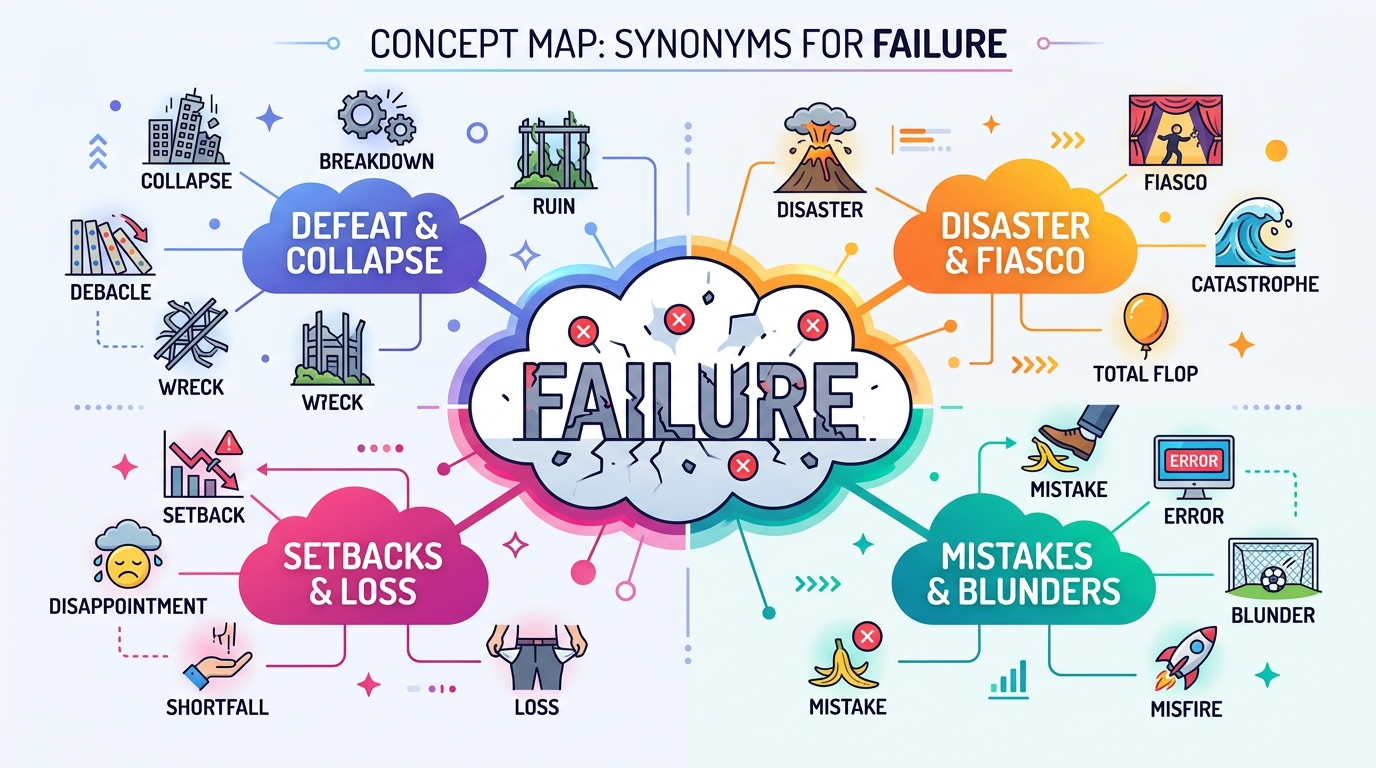
Synonyms of failure can be grouped by how strong or specific they are:
- Small failures: lapse, slip-up, mistake, blunder
- Business or money failures: bankruptcy, shortfall, ruin, decline
- Public or dramatic failures: fiasco, debacle, catastrophe, disaster
- Failed attempts or ideas: flop, dud, misfire, non-starter, washout, bust, botch
- Loss in competition: defeat, loss, setback
- System or process failures: breakdown, collapse, downfall, deficiency, inadequacy, miscarriage, letdown, wreck
Grouping words this way helps writers pick the right tone and strength for each sentence. A small mistake should not be called a “catastrophe,” and a business collapse should not be called a “slip-up.” Choosing the correct category makes writing clear and accurate.
Antonyms of Failure
success, victory, achievement, triumph, accomplishment, win
Short Questions and Answers
- What does failure mean? Failure means not succeeding at something you tried to do.
- When should synonyms for failure be used? Use them to avoid repeating the same word, and to match the size or tone of the situation — small mistake, business loss, or public disaster.
- Is failure positive or negative? It is mostly negative, but in learning and growth contexts, it can carry a positive, helpful meaning.
- How is it different from similar words? Failure is a general word. Words like fiasco or catastrophe show a bigger or more dramatic failure, while lapse or slip-up show a small one.
Conclusion
Learning the word failure and its 30 synonyms helps you build a stronger English vocabulary. It improves both your writing and speaking, since you can pick the right word for each situation instead of repeating the same term. This skill also helps you avoid dull, repetitive sentences and makes your English sound more natural and confident. Keep practicing new words daily, use them in real sentences, and read them aloud to remember their sound and meaning. Small daily practice builds strong, lasting vocabulary skills over time.