However is a word used to show contrast between two ideas. Think about a boy who wants to play outside. Dark clouds fill the sky. However, he grabs his umbrella and goes out anyway. That small word “however” connects two ideas that don’t quite match.
But saying “however” again and again can make writing feel repeated. English learners and writers need synonyms for however too. Synonyms for however help show contrast in different ways, some soft, some strong. Synonyms for however also help writing sound more natural and clear.
This article looks at the word “however” in a simple way. You will learn what it means, how to say it, where it came from, and how to use synonyms for however. Then you will learn 30 other words that mean almost the same thing.
Meaning of However
Definition
However (adverb): A word used to show a difference or contrast between two ideas, meaning “but” or “in spite of that.”
Examples
- She was tired; however, she finished her homework.
- The plan was risky. However, it worked out well.
Connotative Meaning
- Positive tone: “However” can feel hopeful, showing a good result despite a problem, like “It was hard, however, she succeeded.”
- Negative tone: “However” can feel disappointing, showing a bad turn, like “He tried hard; however, he still lost.”
- Neutral tone: In reports or essays, “however” is often just a simple connector, without strong feeling.
Etymology
- “However” comes from Middle English, formed by joining the words “how” and “ever.”
- At first, it meant “in whatever way” or “to whatever degree.”
- Over time, its meaning narrowed to show contrast, close to the meaning of “but” or “still.”
Short History
- Old English (450–1100): The word “however” did not exist yet. Old English used words like “þeah,” meaning “though,” to show contrast.
- Middle English (1100–1500): “However” formed from “how” and “ever.” At first, it meant “in whatever way,” but it slowly grew closer to today’s meaning.
- Modern English (1500–Present): “However” settled into its role as a common linking word. It is now used often in both speech and writing to show contrast between two ideas.
Pronunciation (US & UK – IPA)
- US: /haʊˈɛvər/
- UK: /haʊˈɛvə/
Syllables
how-ev-er
Affixation Pattern of However
- Root: however (a compound word made of “how” and “ever”)
- Prefix: none
- Suffix: none
Word formation: “However” is a compound word, not built from a root with prefixes or suffixes. It joins two smaller words, “how” and “ever,” into one connecting word. A related, more formal word is “howsoever,” which is rarely used today.
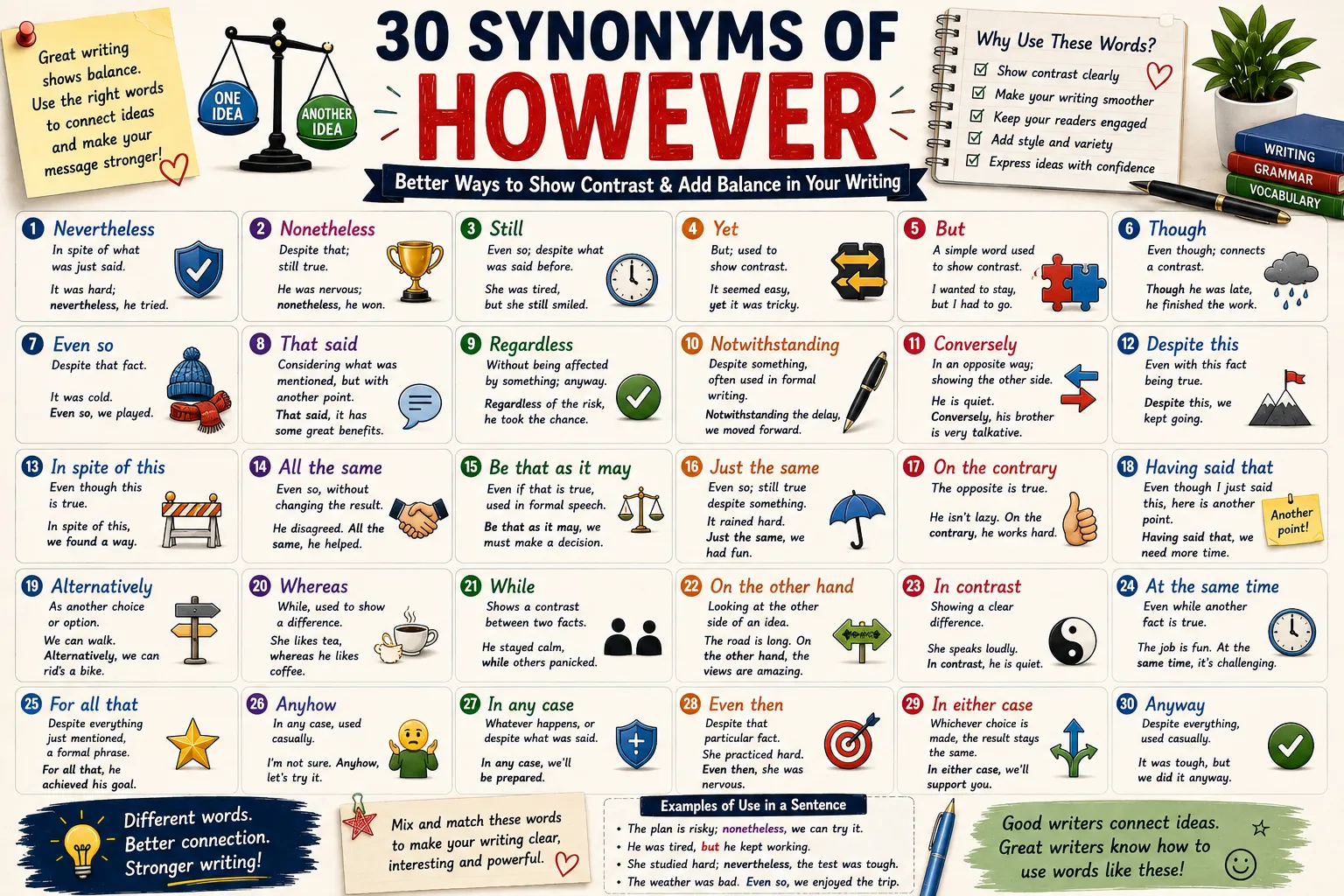
Synonyms of However
1. Nevertheless (adverb) — US /ˌnɛvərðəˈlɛs/ | UK /ˌnɛvəðəˈlɛs/
Meaning: In spite of what was just said. Examples:
- It rained all day; nevertheless, they went hiking.
- The test was hard. Nevertheless, she passed with a good score.
2. Nonetheless (adverb) — US /ˌnʌnðəˈlɛs/ | UK /ˌnʌnðəˈlɛs/
Meaning: Despite that; still true. Examples:
- He was nervous; nonetheless, he gave a great speech.
- The trip was long. Nonetheless, they enjoyed every moment.
3. Still (adverb) — US /stɪl/ | UK /stɪl/
Meaning: Even so; despite what was said before. Examples:
- She was busy, but she still called her mother.
- He lost the game. Still, he felt proud of his effort.
4. Yet (adverb) — US /jɛt/ | UK /jɛt/
Meaning: But; used to show contrast. Examples:
- The road was long, yet they kept walking.
- It looked simple, yet the task took hours.
5. But (conjunction) — US /bʌt/ | UK /bʌt/
Meaning: A simple word used to show contrast between two ideas. Examples:
- She wanted to stay, but she had to leave.
- The room was small but comfortable.
6. Though (conjunction) — US /ðoʊ/ | UK /ðəʊ/
Meaning: Even though; used to connect a fact with a contrast. Examples:
- Though it was late, they kept working.
- He smiled, though he felt tired.
7. Even so (phrase) — US /ˈiːvən soʊ/ | UK /ˈiːvən səʊ/
Meaning: Despite that fact. Examples:
- The weather was bad. Even so, the game continued.
- She was scared; even so, she spoke up.
8. That said (phrase) — US /ðæt sɛd/ | UK /ðæt sɛd/
Meaning: Considering what was just mentioned, but with a different point. Examples:
- The plan has risks. That said, it could work well.
- He is young. That said, he shows real talent.
9. Regardless (adverb) — US /rɪˈɡɑːrdləs/ | UK /rɪˈɡɑːdləs/
Meaning: Without being affected by something; anyway. Examples:
- It was cold, but they went outside regardless.
- Regardless of the outcome, she felt proud of trying.
10. Notwithstanding (adverb) — US /ˌnɑːtwɪθˈstændɪŋ/ | UK /ˌnɒtwɪðˈstændɪŋ/
Meaning: Despite something, often used in formal writing. Examples:
- The rules were strict; notwithstanding, he followed his own path.
- Notwithstanding the delay, the project finished on time.
11. Conversely (adverb) — US /kənˈvɜːrsli/ | UK /kənˈvɜːsli/
Meaning: In an opposite way; showing the other side. Examples:
- He works fast. Conversely, his brother takes his time.
- The city is loud. Conversely, the countryside feels calm.
12. Despite this (phrase) — US /dɪˈspaɪt ðɪs/ | UK /dɪˈspaɪt ðɪs/
Meaning: Even with this fact being true. Examples:
- The store was closed. Despite this, they found a way to shop online.
- He was sick. Despite this, he went to work.
13. In spite of this (phrase) — US /ɪn ˈspaɪt əv ðɪs/ | UK /ɪn ˈspaɪt əv ðɪs/
Meaning: Even though this is true. Examples:
- The road was blocked. In spite of this, they found another way.
- She was tired. In spite of this, she finished the race.
14. All the same (phrase) — US /ɔːl ðə ˈseɪm/ | UK /ɔːl ðə ˈseɪm/
Meaning: Even so, without changing the result. Examples:
- He disagreed. All the same, he followed the plan.
- The trip was hard. All the same, she loved it.
15. Be that as it may (phrase) — US /biː ðæt æz ɪt meɪ/ | UK /biː ðæt æz ɪt meɪ/
Meaning: Even if that is true, used in formal speech. Examples:
- He may be right. Be that as it may, we must follow the rules.
- The plan is risky. Be that as it may, we should try.
16. Just the same (phrase) — US /dʒʌst ðə ˈseɪm/ | UK /dʒʌst ðə ˈseɪm/
Meaning: Even so; still true despite something. Examples:
- She was scared. Just the same, she gave the speech.
- It rained hard. Just the same, they had fun at the park.
17. On the contrary (phrase) — US /ɒn ðə ˈkɑːntrɛri/ | UK /ɒn ðə ˈkɒntrəri/
Meaning: The opposite is true. Examples:
- He isn’t lazy. On the contrary, he works harder than most.
- The plan wasn’t a failure. On the contrary, it was a big success.
18. Having said that (phrase) — US /ˈhævɪŋ sɛd ðæt/ | UK /ˈhævɪŋ sɛd ðæt/
Meaning: Even though I just said this, here is another point. Examples:
- The idea is good. Having said that, we need more time.
- She is talented. Having said that, she still needs practice.
19. Alternatively (adverb) — US /ɔːlˈtɜːrnətɪvli/ | UK /ɔːlˈtɜːnətɪvli/
Meaning: As another choice or option. Examples:
- We could drive there. Alternatively, we could take the train.
- You can study now, or alternatively, wait until tomorrow.
20. Whereas (conjunction) — US /wɛrˈæz/ | UK /weərˈæz/
Meaning: While, used to show a difference between two things. Examples:
- She likes tea, whereas he prefers coffee.
- The first plan was slow, whereas the second was quick.
21. While (conjunction) — US /waɪl/ | UK /waɪl/
Meaning: Used to show a contrast between two facts. Examples:
- While the movie was long, it kept everyone interested.
- He stayed calm, while everyone else panicked.
22. On the other hand (phrase) — US /ɒn ði ˈʌðər hænd/ | UK /ɒn ði ˈʌðə hænd/
Meaning: Looking at the other side of an idea. Examples:
- The city has more jobs. On the other hand, it is more expensive.
- He is quiet at home. On the other hand, he is loud with friends.
23. In contrast (phrase) — US /ɪn ˈkɑːntræst/ | UK /ɪn ˈkɒntræst/
Meaning: Showing a clear difference between two things. Examples:
- The first team played slow. In contrast, the second team played fast.
- Summer is hot here. In contrast, winter is very cold.
24. At the same time (phrase) — US /æt ðə ˈseɪm taɪm/ | UK /æt ðə ˈseɪm taɪm/
Meaning: Even while another fact is true. Examples:
- The job pays well. At the same time, it takes a lot of hours.
- She loves her city. At the same time, she dreams of traveling.
25. For all that (phrase) — US /fər ɔːl ðæt/ | UK /fə ɔːl ðæt/
Meaning: Despite everything just mentioned, a formal phrase. Examples:
- The trip was tiring. For all that, it was worth it.
- He made mistakes. For all that, he learned a lot.
26. Anyhow (adverb) — US /ˈɛnihaʊ/ | UK /ˈɛnihaʊ/
Meaning: In any case, used casually to move on despite something. Examples:
- It was late. Anyhow, they decided to keep working.
- I’m not sure it will work. Anyhow, let’s try it.
27. In any case (phrase) — US /ɪn ˈɛni keɪs/ | UK /ɪn ˈɛni keɪs/
Meaning: Whatever happens, or despite what was said. Examples:
- The weather might change. In any case, we should bring a coat.
- He may be busy. In any case, call him tomorrow.
28. Even then (phrase) — US /ˈiːvən ðɛn/ | UK /ˈiːvən ðɛn/
Meaning: Despite that particular fact. Examples:
- She studied hard. Even then, the test felt difficult.
- They left early. Even then, they were still late.
29. In either case (phrase) — US /ɪn ˈiːðər keɪs/ | UK /ɪn ˈaɪðə keɪs/
Meaning: Whichever choice is made, the result stays the same. Examples:
- You can walk or drive. In either case, bring an umbrella.
- Win or lose, in either case, we tried our best.
30. Anyway (adverb) — US /ˈɛniweɪ/ | UK /ˈɛniweɪ/
Meaning: Despite everything, used casually. Examples:
- It was raining, but they went for a walk anyway.
- I don’t think it will help, but let’s try it anyway.
Prototype Meaning
When people hear the word “however,” they usually picture two ideas being placed side by side that don’t quite agree. One idea sets up an expectation, and “however” signals that something different or surprising follows. This simple idea of connecting two contrasting thoughts sits at the center of the word. Other synonyms add detail, showing whether the contrast feels strong, soft, formal.
l.Prototype Categorization
- Simple, everyday words: but, still, yet, though, anyway, anyhow
- Common formal connectors: nevertheless, nonetheless, regardless, notwithstanding
- Showing the opposite side: on the contrary, conversely, on the other hand, in contrast, whereas
- Softening a point already made: that said, having said that, be that as it may
- Showing contrast despite a fact: despite this, in spite of this, even so, even then, all the same, just the same, for all that
- Showing choices or outcomes: alternatively, in any case, in either case, at the same time.
Antonyms of However
therefore, thus, consequently, accordingly, hence
Short Questions and Answers
- What does “however” mean? It means “but” or “in spite of that.” It shows a contrast between two ideas.
- When should “however” be used? Use it to connect two ideas that don’t fully agree, especially in writing or formal speech.
- Is “however” positive or negative? It depends on the sentence. It can show a good surprise or a disappointing result.
- How is it different from similar words? “However” is common and works in both writing and speech. “But” is more casual. “Nevertheless” and “notwithstanding” feel more formal. “On the other hand” is used to compare two clear sides.
Conclusion
Synonyms for however will help your English grow strong. These words help your writing sound clear and varied, not repeated. Synonyms for however also help you connect ideas with the right tone, whether casual or formal. Anyone learning English can use synonyms for however to write essays, stories, and messages with more skill. Try to learn one new word each day. Use synonyms for however in a sentence that shows two different ideas. Over time, this small habit will make your English much stronger.