Light means the brightness that lets you see. Think about a dark room at night. Someone flips a switch, and you can see everything around you. That brightness is light.
People use this word all day. They talk about sunlight, lamp light, and the light in a room. It is one of the most common words in English, used in science, stories, and daily talk.
But saying “light” again and again can make writing feel plain. English learners and writers need other words too. Synonyms of light help to show different kinds of brightness, like a soft glow or a sudden flash. They also help your writing feel more real and clear.
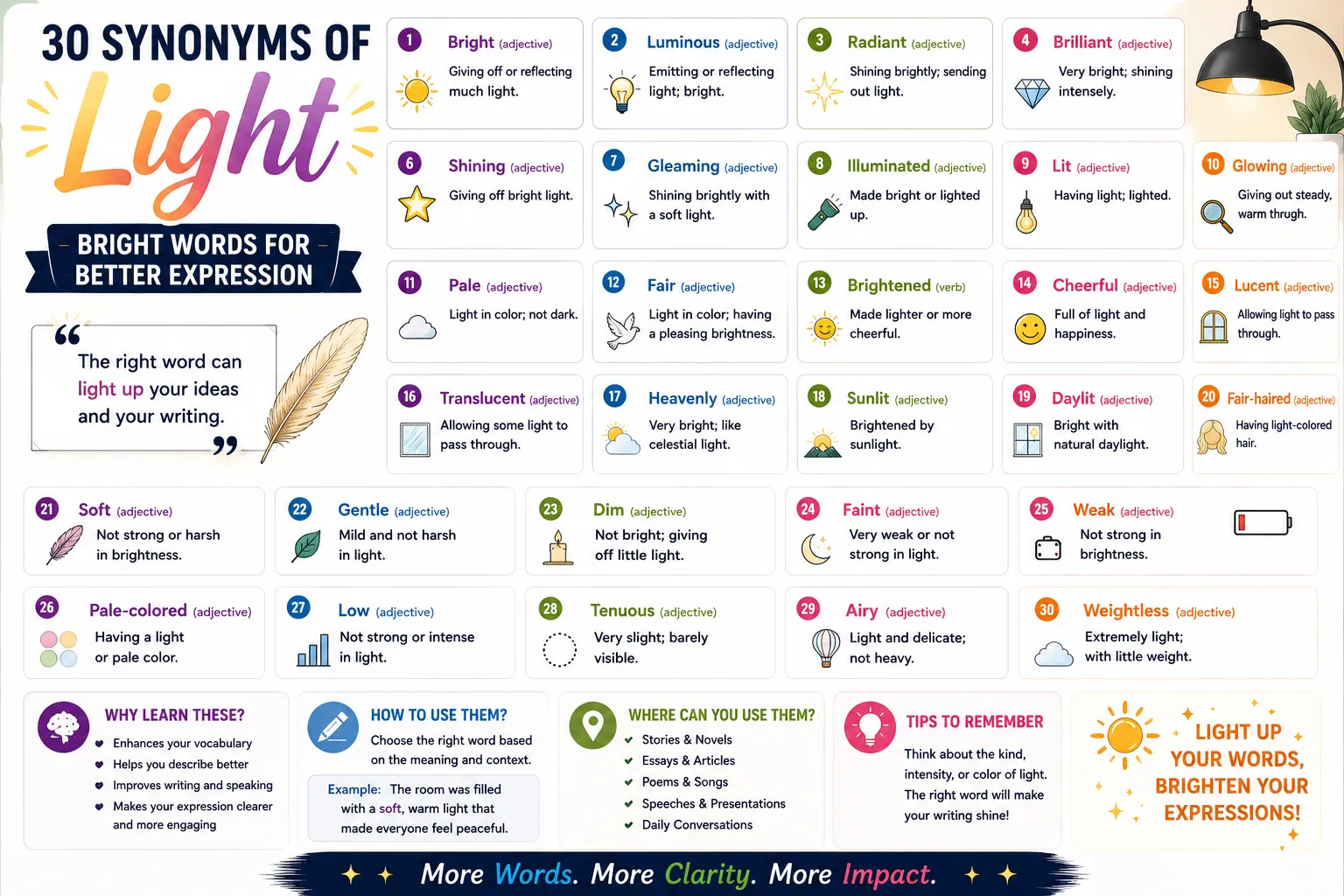
This article looks at the word “light” in a simple way. You will learn what it means, how to say it, where it came from, and how to use it. Then you will learn 30 other words that mean almost the same thing.
Meaning of Light
Definition
Light (noun): The brightness that comes from the sun, a fire, or a lamp, and lets you see things.
Examples
- The light from the window filled the room.
- She turned on the light to read her book.
Connotative Meaning
- Positive tone: “Light” often feels hopeful and good, like sunshine or a bright new day.
- Negative tone: “Light” is rarely negative. It can feel harsh in words like “glare,” which shows too much light.
- Neutral tone: In science or reports, “light” is often just a fact, like “the light traveled at high speed.”
Etymology
- “Light” comes from the Old English word lēoht, which meant brightness or something that lets you see.
- This word came from an old Germanic root, tied to an even older root meaning “brightness” or “to shine.”
- The word has kept a similar meaning for well over a thousand years.
Short History
- Old English (450–1100): “Lēoht” was already a common word. It meant brightness, daylight, and was even used in poems to mean life itself.
- Middle English (1100–1500): The word became “light” or “liht.” It still meant brightness. But people also began using it to talk about understanding, like “shedding light” on a problem.
- Modern English (1500–Present): “Light” kept its main meaning. Science began using it to describe energy that moves in waves. It is also used in sayings, like “light at the end of the tunnel.”
Pronunciation (US & UK – IPA)
- US: /laɪt/
- UK: /laɪt/
Syllables
light (one syllable)
Affixation Pattern of Light
- Root: light
- Prefix: en- (used in “enlighten,” meaning to give light or understanding)
- Suffix: -en (makes the verb “lighten”), -ness (makes the noun “lightness”), -ly (makes the adverb “lightly”)
Word formation: This root gives us many words. “Light” works as a noun, verb, and adjective. “Lighten” is a verb that means to make brighter or less heavy. “Lightness” is a noun. “Enlighten” is a verb that means to help someone understand. “Highlight” is a noun and verb, made by joining “high” and “light.”
Synonyms of Light
1. Brightness (noun) — US /ˈbraɪtnəs/ | UK /ˈbraɪtnəs/
Meaning: The quality of giving off strong light. Examples:
- The brightness of the sun hurt her eyes.
- He turned down the brightness on his screen.
2. Glow (noun) — US /ɡloʊ/ | UK /ɡləʊ/
Meaning: A soft, steady light. Examples:
- The candle gave off a warm glow.
- She loved the soft glow of the fireplace.
3. Radiance (noun) — US /ˈreɪdiəns/ | UK /ˈreɪdiəns/
Meaning: Bright light that spreads outward. Examples:
- The radiance of the sunset filled the sky.
- Her face had a happy radiance.
4. Illumination (noun) — US /ɪˌluːmɪˈneɪʃən/ | UK /ɪˌluːmɪˈneɪʃən/
Meaning: Light that lets you see, often from a source like a lamp. Examples:
- The room needed better illumination for reading.
- Streetlights gave illumination to the dark road.
5. Gleam (noun) — US /ɡliːm/ | UK /ɡliːm/
Meaning: A quick flash of soft light. Examples:
- A gleam of sunlight passed through the window.
- The metal had a small gleam under the lamp.
6. Shine (noun) — US /ʃaɪn/ | UK /ʃaɪn/
Meaning: Bright light coming from something. Examples:
- The shine of the moon lit the yard.
- Her shoes had a fresh shine after cleaning.
7. Sparkle (noun) — US /ˈspɑːrkəl/ | UK /ˈspɑːkəl/
Meaning: Small, quick flashes of light. Examples:
- The sparkle of the diamond caught her eye.
- Snow fell with a light sparkle in the sun.
8. Glimmer (noun) — US /ˈɡlɪmər/ | UK /ˈɡlɪmə/
Meaning: A faint, unsteady light. Examples:
- A glimmer of light showed under the door.
- She saw a glimmer far off in the dark field.
9. Luster (noun) — US /ˈlʌstər/ | UK /ˈlʌstə/
Meaning: A soft shine, often on a smooth surface. Examples:
- The pearl had a beautiful luster.
- Her hair had a healthy luster.
10. Beam (noun) — US /biːm/ | UK /biːm/
Meaning: A narrow line of light. Examples:
- A beam of light shot through the window.
- The flashlight sent a beam across the room.
11. Ray (noun) — US /reɪ/ | UK /reɪ/
Meaning: A thin line of light from a source. Examples:
- A ray of sunlight touched her face.
- The lamp sent a ray of light into the hall.
12. Flash (noun) — US /flæʃ/ | UK /flæʃ/
Meaning: A sudden, bright burst of light. Examples:
- A flash of lightning lit up the sky.
- The camera’s flash surprised everyone.
13. Glare (noun) — US /ɡlɛr/ | UK /ɡleə/
Meaning: Very strong, often uncomfortable light. Examples:
- The glare from the sun made it hard to drive.
- She shielded her eyes from the glare.
14. Sheen (noun) — US /ʃiːn/ | UK /ʃiːn/
Meaning: A soft, shiny light on a surface. Examples:
- The fresh paint gave the car a bright sheen.
- Her dress had a smooth, silky sheen.
15. Brilliance (noun) — US /ˈbrɪljəns/ | UK /ˈbrɪljəns/
Meaning: Very strong, dazzling light. Examples:
- The brilliance of the fireworks amazed the crowd.
- The jewel’s brilliance caught every eye.
16. Shimmer (noun) — US /ˈʃɪmər/ | UK /ˈʃɪmə/
Meaning: A soft, wavering light. Examples:
- The lake had a gentle shimmer at sunset.
- Her dress had a light shimmer under the lights.
17. Twinkle (noun) — US /ˈtwɪŋkəl/ | UK /ˈtwɪŋkəl/
Meaning: A small, quick sparkle of light. Examples:
- The stars had a soft twinkle in the sky.
- There was a twinkle in his eye as he smiled.
18. Flicker (noun) — US /ˈflɪkər/ | UK /ˈflɪkə/
Meaning: A light that moves on and off quickly. Examples:
- The candle’s flicker danced on the wall.
- A flicker of light appeared in the window.
19. Blaze (noun) — US /bleɪz/ | UK /bleɪz/
Meaning: A strong, bright burst of light or fire. Examples:
- The sunset was a blaze of orange and red.
- The fire’s blaze lit the whole yard.
20. Luminescence (noun) — US /ˌluːmɪˈnɛsəns/ | UK /ˌluːmɪˈnɛsəns/
Meaning: Light given off without heat, often in nature. Examples:
- The luminescence of the jellyfish amazed the divers.
- Scientists studied the plant’s strange luminescence.
21. Daylight (noun) — US /ˈdeɪlaɪt/ | UK /ˈdeɪlaɪt/
Meaning: The natural light during the day. Examples:
- They finished the hike before daylight ended.
- The room looked different in daylight.
22. Sunlight (noun) — US /ˈsʌnlaɪt/ | UK /ˈsʌnlaɪt/
Meaning: Light that comes directly from the sun. Examples:
- The plants grew well in the sunlight.
- Sunlight poured through the open curtains.
23. Spark (noun) — US /spɑːrk/ | UK /spɑːk/
Meaning: A tiny, bright flash of light. Examples:
- A spark flew from the campfire.
- The wire gave off a small spark.
24. Flare (noun) — US /flɛr/ | UK /fleə/
Meaning: A sudden, bright light, often used as a signal. Examples:
- The sailors sent up a flare for help.
- A flare of light lit the dark road ahead.
25. Halo (noun) — US /ˈheɪloʊ/ | UK /ˈheɪləʊ/
Meaning: A ring of soft light around something. Examples:
- A halo formed around the streetlamp in the fog.
- The moon had a soft halo that night.
26. Incandescence (noun) — US /ˌɪnkænˈdɛsəns/ | UK /ˌɪnkænˈdɛsəns/
Meaning: Bright light made by heat, like in an old light bulb. Examples:
- The metal glowed with incandescence when heated.
- The bulb’s incandescence filled the small room.
27. Phosphorescence (noun) — US /ˌfɑːsfəˈrɛsəns/ | UK /ˌfɒsfəˈrɛsəns/
Meaning: A soft glow that lasts after light is removed. Examples:
- The toy stars glowed with phosphorescence in the dark.
- The ocean showed a strange phosphorescence at night.
28. Candlelight (noun) — US /ˈkændəllaɪt/ | UK /ˈkændəllaɪt/
Meaning: Soft light that comes from a candle. Examples:
- They ate dinner by candlelight.
- The room felt cozy in the candlelight.
29. Moonlight (noun) — US /ˈmuːnlaɪt/ | UK /ˈmuːnlaɪt/
Meaning: Light that comes from the moon at night. Examples:
- They walked home under the moonlight.
- The lake shone silver in the moonlight.
30. Luminosity (noun) — US /ˌluːmɪˈnɑːsəti/ | UK /ˌluːmɪˈnɒsəti/
Meaning: The measured brightness of a light source. Examples:
- Scientists measured the star’s luminosity.
- The screen’s luminosity was too high for the dark room.
Prototype Meaning
When people hear the word “light,” they usually picture brightness that lets them see. Like sunshine coming through a window or a lamp turned on in a dark room. This simple, useful picture sits at the center of the word. Other synonyms add detail, showing how strong, soft, sudden, or lasting the light is.
Prototype Categorization
You can group these synonyms by the kind of light they describe:
- Soft, gentle light: glow, gleam, glimmer, shimmer, sheen, luster
- Strong, bright light: brightness, brilliance, blaze, glare, radiance
- Quick or moving light: flash, spark, twinkle, flicker, flare
- Natural sources of light: daylight, sunlight, moonlight, candlelight
- Scientific or formal light: illumination, luminescence, incandescence, phosphorescence, luminosity
- Light shaped in a line or ring: beam, ray, halo, shine
Antonyms of Light
darkness, dimness, gloom, shadow, blackness
Short Questions and Answers
- What does “light” mean? It means the brightness that lets you see things, coming from the sun, fire, or a lamp.
- When should “light” be used? Use it to describe brightness in nature, in a room, or from any object that shines.
- Is “light” positive or negative? It is almost always positive. It can feel harsh only in words like “glare,” which shows too much light.
- How is it different from similar words? “Light” is broad and simple. “Glow” shows something soft and steady. “Flash” shows something sudden. “Sunlight” is specific to the sun.
Conclusion
Synonyms of light will help your English grow strong. Each word shows a different kind of brightness, from a soft “glow” to a sudden “flash.” Synonyms of light help your writing sound clear and full of detail, not repeated. They also help you paint a picture with your words, whether it is a quiet candlelit room or a bright, sunny day. Anyone learning English can use synonyms of light to describe the world with more color. Try to learn one new word each day. Use it in a sentence about something you see around you. Over time, this small habit will make your English much stronger.