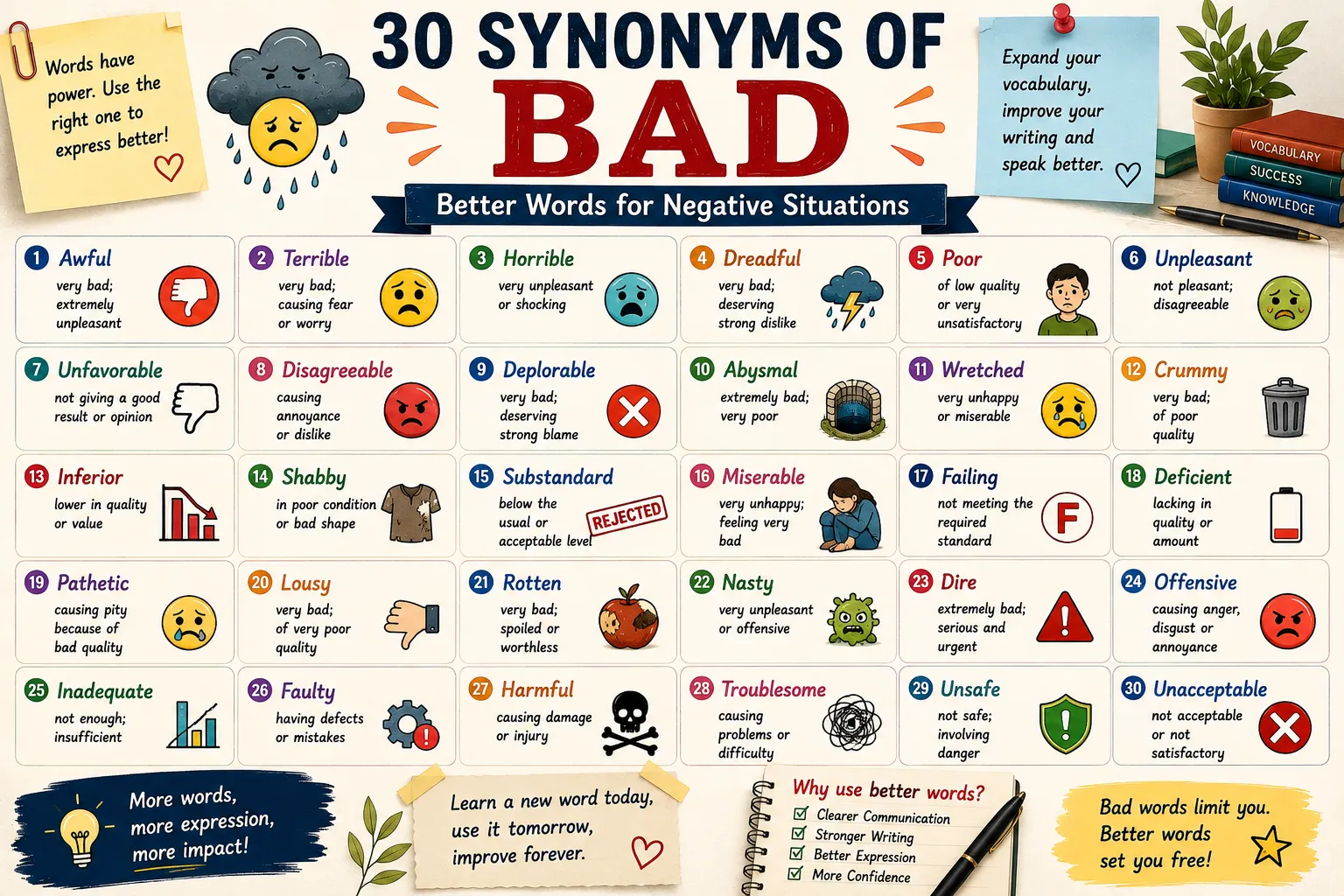
The word bad means poor in quality, harmful, or unpleasant. Imagine pouring fresh milk into your morning cereal bowl. Taking a large bite, realizing the milk has gone sour. Your nose wrinkles, your mouth tastes something awful, and you spit it out because it tastes bad. People use bad or synonyms for bad every day. Because we talk about terrible weather, poor choices, harmful habits, and unpleasant experiences. Learning synonyms for bad is necessary for English learners and content writer. Synonyms for bad helps to improve their vocabulary. Repeating one plain word makes writing dull. This article aims to discuss the meaning of the key word. 30 synonyms for bad with clear examples, grammar facts, word history, pronunciation guides, and semantic categories written.
Meaning of Bad
Definition
Bad (Adjective): Not good, low in quality, harmful, or causing pain and trouble.
Examples
- He stayed home from school because he had a bad headache.
- The restaurant received a bad review due to poor service.
Connotative Meaning
- Positive tone: In modern slang, it can occasionally mean cool, tough, or impressive.
- Negative tone: Expresses extreme disapproval, low quality, severe harm, or moral wrongdoing.
- Neutral tone: Used in medical or technical settings to describe functional failure.
Etymology
- Source language: Came from Old English bæddel, which originally referred to an effeminate or worthless person.
- Old English (450–1100): Written as bæddel, used as a rare insult for someone weak or worthless.
- Middle English (1100–1500): Shifted into badde, expanding to mean wicked, evil, or poor in quality.
- Modern English (1500–Present): Simplified into bad, becoming the primary word for anything unpleasant or harmful.
Also read more about https://myprayerss.com/synonyms-for-rich/
Pronunciation
- US: /bæd/
- UK: /bæd/
Syllables
bad (1 part)
Affixation Pattern of Bad
- Root: Bad
- Prefix: None
- Suffix: None
- Word Formation:
- Adjective: Bad, Worse, Worst
- Adverb: Badly
- Noun: Badness
- Verb: None
Synonyms of Bad
1. Awful (Adjective) — US: /ˈɑːfəl/ | UK: /ˈɔːfəl/
Meaning: Extremely bad, unpleasant, or shocking.
Examples:
The weather was awful during our outdoor picnic.
She heard the awful news about the accident.
2. Terrible (Adjective) — US: /ˈtɛrəbəl/ | UK: /ˈterəbl/
Meaning: Very serious, disagreeable, or causing fear.
Examples:
He made a terrible mistake on his math exam.
The team suffered a terrible loss last night.
3. Horrible (Adjective) — US: /ˈhɔːrəbəl/ | UK: /ˈhɒrəbl/
Meaning: Causing horror, disgust, or deep distress.
Examples:
There was a horrible smell coming from the trash.
She had a horrible dream that kept her awake.
4. Poor (Adjective) — US: /pʊr/ | UK: /pɔː/
Meaning: Low in quality or below an acceptable standard.
Examples:
The student got a poor grade on his assignment.
This car is in poor condition after the storm.
5. Unpleasant (Adjective) — US: /ʌnˈplɛzənt/ | UK: /ʌnˈpleznt/
Meaning: Not enjoyable, disagreeable, or causing slight discomfort.
Examples:
We had an unpleasant conversation about the budget.
The medicine left an unpleasant taste in my mouth.
6. Evil (Adjective) — US: /ˈiːvəl/ | UK: /ˈiːvl/
Meaning: Profoundly immoral, wicked, or harmful to others.
Examples:
The evil villain tried to destroy the peaceful town.
Greed can drive people to do evil things.
7. Wicked (Adjective) — US: /ˈwɪkɪd/ | UK: /ˈwɪkɪd/
Meaning: Morally wrong, mischievous, or harmful.
Examples:
The wicked witch cast a spell on the castle.
He gave a wicked smile before playing the trick.
8. Severe (Adjective) — US: /səˈvɪr/ | UK: /sɪˈvɪə/
Meaning: Very intense, serious, or difficult to endure.
Examples:
The region experienced a severe drought this summer.
She suffered from severe back pain after lifting boxes.
9. Dreadful (Adjective) — US: /ˈdrɛdfəl/ | UK: /ˈdredfl/
Meaning: Inspiring great dread, unhappiness, or shock.
Examples:
The actor gave a dreadful performance in the play.
They heard a dreadful noise in the dark hallway.
10. Nasty (Adjective) — US: /ˈnæsti/ | UK: /ˈnɑːsti/
Meaning: Offensive, dangerous, or disgusting.
Examples:
He got a nasty cut on his knee at the park.
She left a nasty comment on his social media page.
11. Foul (Adjective) — US: /faʊl/ | UK: /faʊl/
Meaning: Dirty, stinking, or morally offensive.
Examples:
The chimney released foul smoke into the clear air.
He was punished for using foul language in class.
12. Defective (Adjective) — US: /dɪˈfɛktɪv/ | UK: /dɪˈfektɪv/
Meaning: Having a fault or flaw that prevents proper function.
Examples:
I returned the defective toaster to the store.
The mechanic fixed the defective brake system.
13. Substandard (Adjective) — US: /sʌbˈstændərd/ | UK: /sʌbˈstændəd/
Meaning: Below the usual, required, or expected quality level.
Examples:
The workers used substandard materials to build the fence.
The hotel provided substandard service to its guests.
14. Inferior (Adjective) — US: /ɪnˈfɪriər/ | UK: /ɪnˈfɪəriə/
Meaning: Lower in status, rank, quality, or value.
Examples:
This fake leather is inferior to real leather.
No one should feel inferior to anyone else.
15. Atrocious (Adjective) — US: /əˈtroʊʃəs/ | UK: /əˈtrəʊʃəs/
Meaning: Shockingly cruel, extremely brutal, or exceptionally bad.
Examples:
His handwriting was so atrocious that no one could read it.
The dictator committed atrocious crimes against the citizens.
16. Abysmal (Adjective) — US: /əˈbɪzməl/ | UK: /əˈbɪzməl/
Meaning: Extremely hopeless, wretched, or bottomless in quality.
Examples:
The company reported abysmal sales during the winter.
Her test results were abysmal despite weeks of studying.
17. Rotten (Adjective) — US: /ˈrɑːtən/ | UK: /ˈrɒtn/
Meaning: Decayed, decomposed, or completely dishonest.
Examples:
The tree fell because its trunk was rotten inside.
He has a rotten attitude toward his teammates.
18. Grim (Adjective) — US: /ɡrɪm/ | UK: /ɡrɪm/
Meaning: Stern, depressing, harsh, or lacking hope.
Examples:
The doctor gave us a grim update on the patient.
The news painted a grim picture of the economy.
19. Harmful (Adjective) — US: /ˈhɑːrmfəl/ | UK: /ˈhɑːmfl/
Meaning: Causing or capable of causing damage or injury.
Examples:
Smoking cigarettes is harmful to your lungs.
Chemicals can have a harmful effect on ocean life.
20. Malevolent (Adjective) — US: /məˈlɛvələnt/ | UK: /məˈlevələnt/
Meaning: Having or showing a strong desire to harm others.
Examples:
The villain glared at him with malevolent eyes.
They uncovered a malevolent plot to steal the money.
21. Sinister (Adjective) — US: /ˈsɪnɪstər/ | UK: /ˈsɪnɪstə/
Meaning: Giving the impression that something evil will happen.
Examples:
There was a sinister shadow lurking near the door.
He spoke with a dark and sinister voice.
22. Vicious (Adjective) — US: /ˈvɪʃəs/ | UK: /ˈvɪʃəs/
Meaning: Deliberately cruel, violent, or dangerous.
Examples:
A vicious dog barked wildly behind the gate.
She fell victim to a vicious rumor at work.
23. Deplorable (Adjective) — US: /dɪˈplɔːrəbəl/ | UK: /dɪˈplɔːrəbl/
Meaning: Deserving strong condemnation or deep regret.
Examples:
The family lived in deplorable conditions without water.
His disrespect toward his parents was deplorable.
24. Noxious (Adjective) — US: /ˈnɑːkʃəs/ | UK: /ˈnɒkʃəs/
Meaning: Poisonous, unhealthy, or harmful to living things.
Examples:
The factory emitted noxious fumes into the air.
Keep children away from noxious cleaning agents.
25. Adverse (Adjective) — US: /ædˈvɜːrs/ | UK: /ˈædvɜːs/
Meaning: Unfavorable, harmful, or acting against success.
Examples:
The medicine caused several adverse side effects.
They flew back home due to adverse weather conditions.
26. Inept (Adjective) — US: /ɪnˈɛpt/ | UK: /ɪnˈept/
Meaning: Lacking skill, ability, or proper execution.
Examples:
The inept mechanic damaged the engine further.
Her inept management caused the project to fail.
27. Repulsive (Adjective) — US: /rɪˈpʌlsɪv/ | UK: /rɪˈpʌlsɪv/
Meaning: Causing strong disgust, dislike, or aversion.
Examples:
The garbage pit had a repulsive odor.
His arrogant behavior made him completely repulsive.
28. Regrettable (Adjective) — US: /rɪˈɡrɛtəbəl/ | UK: /rɪˈɡretəbl/
Meaning: Causing sadness, disappointment, or remorse.
Examples:
It was a regrettable incident that ruined their friendship.
The manager made a regrettable choice to cancel the event.
29. Defective-grade (Adjective) — US: /dɪˈfɛktɪv ɡreɪd/ | UK: /dɪˈfektɪv ɡreɪd/
Meaning: Falling short of safety or standard production quality.
Examples:
The inspector rejected the defective-grade steel beams.
They recalled the defective-grade toys from the market.
30. Unsound (Adjective) — US: /ʌnˈsaʊnd/ | UK: /ʌnˈsaʊnd/
Meaning: Weak, unstable, unhealthy, or unsafe to use.
Examples:
The old wooden bridge is unsound.
He offered an unsound argument during the debate.
Prototype Meaning
When people hear the word bad, they usually picture physical unpleasantness. Failure such as spoiled food that smells terrible, a broken gadget that does not turn on, or a stormy day that ruins outdoor plans.
Prototype Categorization
- Low Quality & Failure: Poor, Defective, Substandard, Inferior, Inept, Defective-grade, Unsound.
- Unpleasant & Disagreeable: Awful, Terrible, Horrible, Unpleasant, Dreadful, Nasty, Foul, Rotten, Repulsive.
- Severe & Painful: Severe, Abysmal, Grim, Harmful, Adverse, Regrettable.
- Morally Wrong & Evil: Evil, Wicked, Atrocious, Malevolent, Sinister, Vicious, Deplorable, Noxious.
Antonyms of Bad
- Good
- Excellent
- Wonderful
- Pleasant
- Moral
- Superior
- Beneficial
Short Questions and Answers
- What does “bad” mean?
“Bad” means poor in quality, harmful, incorrect, or unpleasant. - When should “bad” be used?
Use “bad” to describe poor quality, physical pain, harmful habits, or wrong behavior. - Is “bad” positive or negative?
“Bad” is mostly negative, though it can carry a positive meaning in informal slang. - How is it different from similar words?
“Bad” is the general word, while “poor” focuses on low quality. “Awful” highlights strong dislike, and “evil” describes moral wickedness.
CONCLUSION
Synonyms for bad improves your vocabulary for everyday communication. Relying on the same basic adjective limits your ability to share precise thoughts. Using synonyms for bad like defective for broken items, or harmful for dangers, strengthens your writing and speaking. Avoiding repetition makes your essays and articles far more engaging to read. Expanding your word choice builds English confidence in school, business, and casual settings. Practice using two or three synonyms for bad in your daily sentences.