Fast means moving or happening at a high speed. Think about a runner sprinting across the finish line before anyone else. Her legs move quickly, and she crosses the line in record time. That is what “fast” means.
People use this word every day. They use it for cars, runners, internet speed, and even how quickly someone finishes a task. It is one of the most useful words for describing speed in English.
But saying “fast” again and again can make writing feel plain. English learners and writers need other words too. New words help show different levels of speed, from quick and light to blazing and sudden. They also help your writing sound more exciting and clear.
This article looks at the word “fast” in a simple way. You will learn what it means, how to say it, where it came from, and how to use it. Then you will learn 30 other words that mean almost the same thing.
Meaning of Fast
Definition
Fast (adjective): Moving or happening at a high speed; not slow.
Examples
- The fast car zoomed past them on the highway.
- She is a fast runner and always wins her races.
Connotative Meaning
- Positive tone: “Fast” often feels exciting, showing skill, energy, or success.
- Negative tone: “Fast” can feel risky or careless, like driving too fast.
- Neutral tone: In facts or measurements, “fast” can describe speed, like “the fast lane on the highway.”
Etymology
- “Fast” comes from the Old English word fæst, which meant firm, fixed, or secure.
- At first, the word had nothing to do with speed. It described something strong or held tightly, as in “hold fast.”
- Over time, phrases like “run fast,” meaning to run firmly or strongly, shifted the word toward meaning quick.
Short History
- Old English (450–1100): “Fæst” meant firm or fixed, not fast in speed. People used it in phrases like “stand fast,” meaning to stand firmly in place.
- Middle English (1100–1500): The word slowly changed meaning. Phrases about running or moving “fast,” meaning strongly, began to suggest quickness instead.
- Modern English (1500–Present): “Fast” fully took on its speed meaning. Older meanings still survive in phrases like “hold fast” and “fast asleep,” which mean firmly, not quickly.
Pronunciation (US & UK – IPA)
- US: /fæst/
- UK: /fɑːst/
Syllables
fast (one syllable)
Affixation Pattern of Fast
- Root: fast
- Prefix: none common
- Suffix: -er/-est (makes “faster” and “fastest”)
Word formation:
This root gives us a few related words. “Fast” works as both an adjective and an adverb, as in “run fast.” “Faster” and “fastest” are the comparative and superlative forms. Note that “fast” also exists as an unrelated verb meaning to not eat, which comes from a different Old English word.
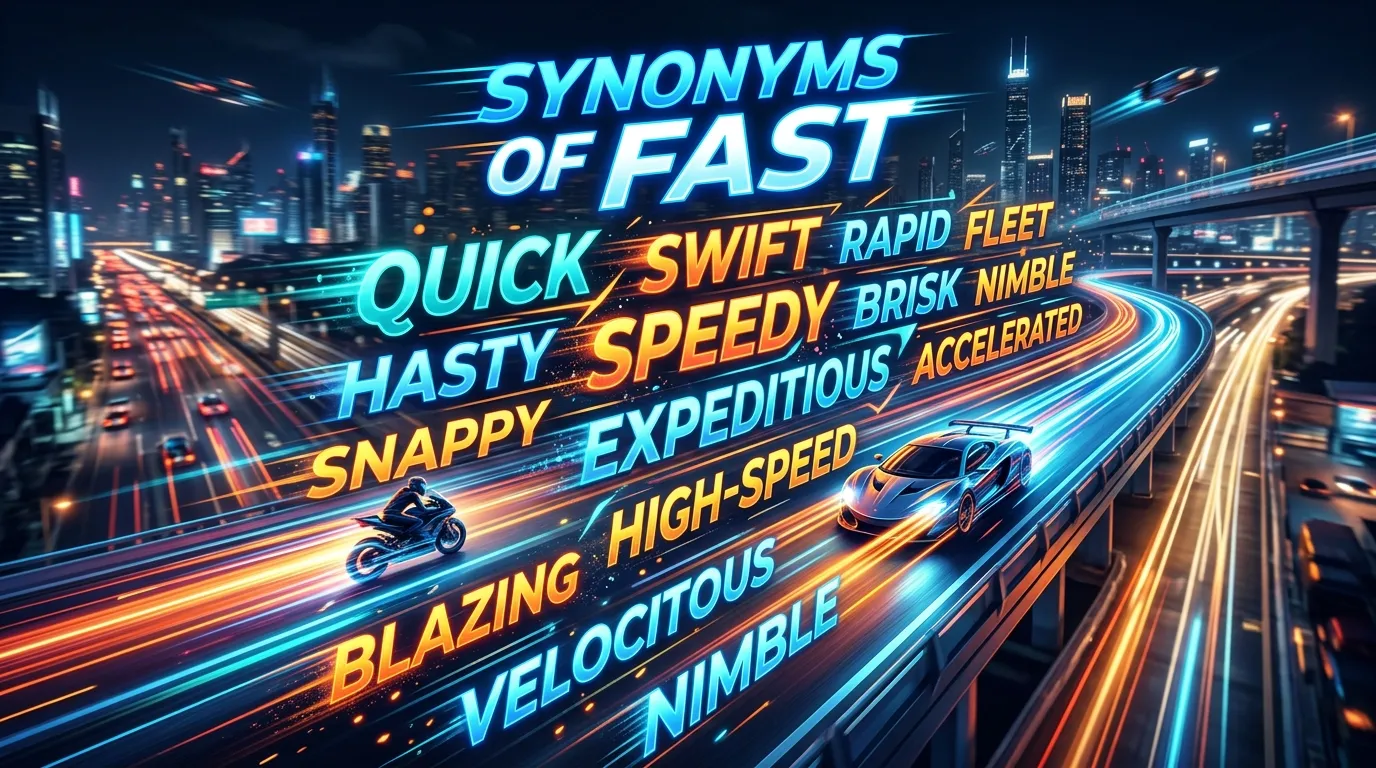
Synonyms of Fast
1. Quick (adjective) — US /kwɪk/ | UK /kwɪk/
Meaning: Fast and done in a short time. Examples:
- She gave a quick answer to the question.
- He took a quick shower before leaving.
2. Rapid (adjective) — US /ˈræpɪd/ | UK /ˈræpɪd/
Meaning: Happening very fast, often used for change or movement. Examples:
- The city saw rapid growth in just a few years.
- His rapid heartbeat worried the doctor.
3. Speedy (adjective) — US /ˈspiːdi/ | UK /ˈspiːdi/
Meaning: Fast, often used to wish for quick results. Examples:
- They wished her a speedy recovery.
- The company promised speedy delivery.
4. Swift (adjective) — US /swɪft/ | UK /swɪft/
Meaning: Fast and smooth in movement. Examples:
- The swift river carried the boat downstream.
- She made a swift decision under pressure.
5. Brisk (adjective) — US /brɪsk/ | UK /brɪsk/
Meaning: Fast and full of energy. Examples:
- They went for a brisk walk before breakfast.
- His brisk pace surprised the other hikers.
6. Hasty (adjective) — US /ˈheɪsti/ | UK /ˈheɪsti/
Meaning: Done too fast, often without enough care. Examples:
- He made a hasty decision that he later regretted.
- Her hasty reply confused the whole team.
7. Prompt (adjective) — US /prɑːmpt/ | UK /prɒmpt/
Meaning: Fast to act, done right away. Examples:
- She gave a prompt reply to the email.
- The prompt service impressed the customers.
8. Fleet (adjective) — US /fliːt/ | UK /fliːt/
Meaning: Fast and light in movement, a more poetic word. Examples:
- The fleet deer ran across the open field.
- Her fleet footsteps barely made a sound.
9. Nimble (adjective) — US /ˈnɪmbəl/ | UK /ˈnɪmbəl/
Meaning: Fast and light, able to move quickly and easily. Examples:
- The nimble cat jumped across the fence.
- His nimble fingers typed the message in seconds.
10. Zippy (adjective) — US /ˈzɪpi/ | UK /ˈzɪpi/
Meaning: Fast and lively, used casually. Examples:
- The zippy little car handled turns well.
- She gave a zippy answer during the quiz.
11. Lightning-fast (adjective) — US /ˈlaɪtnɪŋ fæst/ | UK /ˈlaɪtnɪŋ fɑːst/
Meaning: Extremely fast, as fast as lightning. Examples:
- He typed at a lightning-fast speed.
- The lightning-fast serve won her the match.
12. Blazing (adjective) — US /ˈbleɪzɪŋ/ | UK /ˈbleɪzɪŋ/
Meaning: Very fast, often intense in speed. Examples:
- The car sped by at a blazing speed.
- His blazing pace left the other runners behind.
13. Accelerated (adjective) — US /əkˈsɛləreɪtɪd/ | UK /əkˈsɛləreɪtɪd/
Meaning: Made faster than before, often gradually. Examples:
- The accelerated program helped her finish school early.
- The car’s accelerated speed surprised the driver.
14. Express (adjective) — US /ɪkˈsprɛs/ | UK /ɪkˈsprɛs/
Meaning: Fast, often describing travel or delivery. Examples:
- They took the express train to the city.
- She paid extra for express shipping.
15. Instantaneous (adjective) — US /ˌɪnstənˈteɪniəs/ | UK /ˌɪnstənˈteɪniəs/
Meaning: Happening in an instant, extremely fast. Examples:
- The response from the app felt instantaneous.
- His instantaneous reaction saved the ball from falling.
16. Immediate (adjective) — US /ɪˈmiːdiət/ | UK /ɪˈmiːdiət/
Meaning: Happening right away, without delay. Examples:
- The doctor gave immediate attention to the patient.
- Her immediate reply showed how much she cared.
17. Snappy (adjective) — US /ˈsnæpi/ | UK /ˈsnæpi/
Meaning: Fast and sharp, often used for a quick pace or reply. Examples:
- He gave a snappy comeback during the debate.
- The song had a snappy, upbeat rhythm.
18. Quickfire (adjective) — US /ˈkwɪkfaɪər/ | UK /ˈkwɪkfaɪə/
Meaning: Happening fast, one after another. Examples:
- She answered a round of quickfire questions.
- The show featured a quickfire cooking challenge.
19. Turbocharged (adjective) — US /ˈtɜːrboʊtʃɑːrdʒd/ | UK /ˈtɜːbəʊtʃɑːdʒd/
Meaning: Given extra speed or power. Examples:
- The turbocharged engine made the car much faster.
- Her turbocharged energy helped finish the project early.
20. Whirlwind (adjective) — US /ˈwɜːrlwɪnd/ | UK /ˈwɜːlwɪnd/
Meaning: Very fast and full of activity. Examples:
- They had a whirlwind trip through five cities.
- Their whirlwind romance surprised everyone.
21. Breakneck (adjective) — US /ˈbreɪknɛk/ | UK /ˈbreɪknɛk/
Meaning: Extremely and dangerously fast. Examples:
- He drove at a breakneck speed down the hill.
- The company grew at a breakneck pace.
22. Speeding (adjective) — US /ˈspiːdɪŋ/ | UK /ˈspiːdɪŋ/
Meaning: Moving fast, often too fast, especially about vehicles. Examples:
- The speeding car caught the officer’s attention.
- A speeding train rushed past the platform.
23. Sprightly (adjective) — US /ˈspraɪtli/ | UK /ˈspraɪtli/
Meaning: Fast and full of lively energy. Examples:
- The sprightly puppy ran circles around the yard.
- Her sprightly steps matched her cheerful mood.
24. Racing (adjective) — US /ˈreɪsɪŋ/ | UK /ˈreɪsɪŋ/
Meaning: Moving very fast, as if in a race. Examples:
- Her heart was racing before the interview.
- The racing clouds moved fast across the sky.
25. Rushing (adjective) — US /ˈrʌʃɪŋ/ | UK /ˈrʌʃɪŋ/
Meaning: Moving fast, often in a hurry. Examples:
- The rushing water flowed strongly after the storm.
- She felt rushing thoughts before the exam.
26. Meteoric (adjective) — US /ˌmiːtiˈɔːrɪk/ | UK /ˌmiːtiˈɒrɪk/
Meaning: Extremely fast, often describing quick success. Examples:
- His meteoric rise in the company surprised everyone.
- The band had a meteoric climb to fame.
27. High-speed (adjective) — US /ˈhaɪ spiːd/ | UK /ˈhaɪ spiːd/
Meaning: Moving or working at a fast speed. Examples:
- They installed a high-speed internet connection.
- The high-speed train reached the city in an hour.
28. Supersonic (adjective) — US /ˌsuːpərˈsɑːnɪk/ | UK /ˌsuːpəˈsɒnɪk/
Meaning: Faster than the speed of sound . Examples:
- The supersonic jet crossed the sky in seconds.
- Scientists studied supersonic speeds during the test.
29. Fast-paced (adjective) — US /ˈfæst peɪst/ | UK /ˈfɑːst peɪst/
Meaning: Happening or moving quickly. Examples:
- The fast-paced movie kept everyone interested.
- She enjoys working in a fast-paced office.
30. Hurried (adjective) — US /ˈhɜːrid/ | UK /ˈhʌrid/
Meaning: Done quickly, often because of limited time. Examples:
- He ate a hurried breakfast before work.
- Her hurried steps echoed down the hallway.
Prototype Meaning
When people hear the word “fast,” they usually picture something moving , like a running athlete, a speeding car, or a quick reply. It brings to mind energy, urgency, and little wasted time. This simple picture sits at the center of the word. Other synonyms add detail, showing whether the speed feels smooth, sudden, careless, or extreme.
Prototype Categorization
- Everyday fast: quick, speedy, prompt, brisk, express
- Smooth or graceful speed: swift, fleet, nimble, zippy
- Extreme speed: lightning-fast, blazing, breakneck, supersonic, meteoric
- Instant or immediate speed: instantaneous, immediate, snappy, quickfire
- Speed that feels rushed or careless: hasty, hurried, rushing, speeding
- Speed in growth or activity: rapid, accelerated, whirlwind, turbocharged, high-speed, fast-paced, racing
Antonyms of Fast
slow, sluggish, gradual, unhurried, leisurely
Short Questions and Answers
What does “fast” mean?
It means moving or happening at a high speed; not slow.
When should “fast” be used? Use it to describe anything that moves or happens quickly, from people to machines to events.
Is “fast” positive or negative? It depends on the situation. It can feel exciting and skilled, or careless and risky.
How is it different from similar words? “Fast” is simple and common. “Swift” sounds smoother and more graceful. “Hasty” shows speed that leads to mistakes. “Breakneck” shows a dangerous, extreme level of speed.
Conclusion
Synonyms of Fast and its 30 synonyms will help your English grow strong. Each word shows a different kind of speed, from a simple “quick” reply to a “breakneck” pace. These words help your writing sound clear and full of energy, not repeated. They also help you describe speed with more color, whether it feels smooth, sudden, or careless. Anyone learning English can use these words to speak and write with more confidence. Try to learn one new word each day. Use it in a sentence about something fast in your own life. Over time, this small habit will make your English much stronger.