Cold means having a low temperature. Think about a winter morning when snow covers the ground. You step outside, and the air bites at your face and hands. That sharp feeling is cold.
People use this word every day. They use it for weather, food, drinks, and even rooms. It is one of the first words English learners learn to describe how things feel.
But saying “cold” again and again can make writing feel plain. English learners and writers need synonyms for cold too. synonyms for cold help show different levels of cold, from a light chill to a deep freeze. They also help your writing feel more real and clear.
This article looks at the word “cold” in a simple way. You will learn what it means, how to say it, where it came from, and how to use it. Then you will learn 30 other words that mean almost the same thing.
Meaning of Cold
Definition
Cold (adjective): Having a low temperature; not warm or hot.
Examples
- The water in the lake was very cold.
- She wore a thick coat on the cold morning.
Connotative Meaning
- Positive tone: “Cold” can feel refreshing, like a cold drink on a hot day.
- Negative tone: “Cold” often feels harsh or uncomfortable, like a cold, windy night.
- Neutral tone: In weather reports or science, “cold” is oftena fact, like “the cold front will arrive tonight.”
Etymology
- “Cold” comes from the Old English word ceald, which meant cold or chilly.
- This word came from an old Germanic root, related to the Latin word gelidus, meaning icy.
- The word has kept the same simple meaning for over a thousand years: low temperature.
Short History
- Old English (450–1100): “Ceald” was a common word. It described cold weather and was also used to describe unfriendly people.
- Middle English (1100–1500): The word became “cold.” It kept its meaning for weather and temperature, and continued to describe cold or distant behavior.
- Modern English (1500–Present): “Cold” kept its main meaning. Today, it is used for weather, food, feelings, and even science, like describing cold temperatures in space.
Pronunciation (US & UK – IPA)
- US: /koʊld/
- UK: /kəʊld/
Syllables
cold (one syllable)
Affixation Pattern of Cold
- Root: cold
- Prefix: none common
- Suffix: -ly (makes the adverb “coldly”), -ness (makes the noun “coldness”), -er/-est (makes “colder” and “coldest”)
Word formation: This root gives us several words. “Cold” works as an adjective and also as a noun, as in “she caught a cold.” “Coldly” is an adverb. “Coldness” is a noun that means the state of being cold. “Colder” and “coldest” are the comparative and superlative forms.
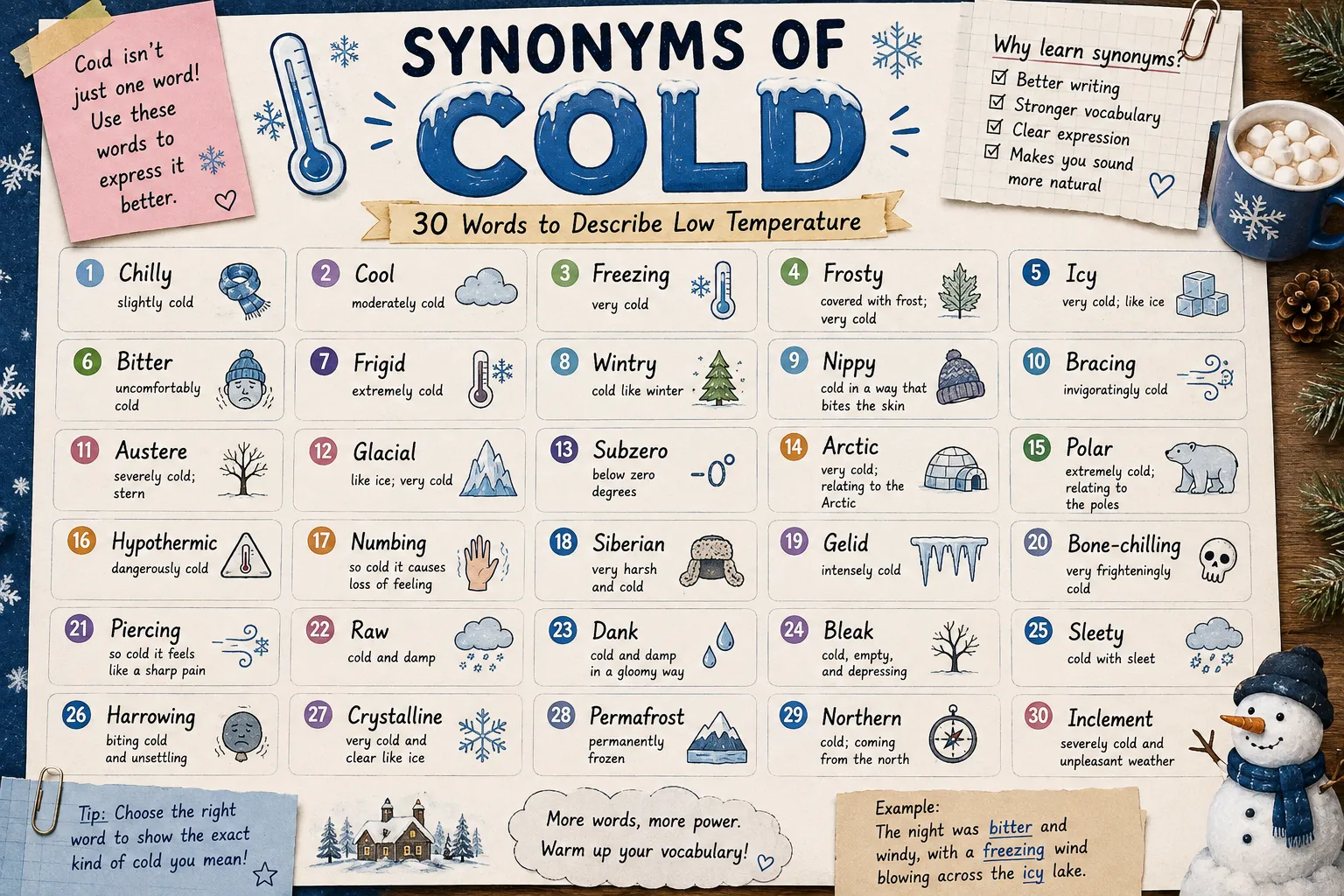
Synonyms of Cold
1. Chilly (adjective) — US /ˈtʃɪli/ | UK /ˈtʃɪli/
Meaning: A little bit cold, mild coldness. Examples:
- It felt chilly outside this morning.
- She grabbed a sweater for the chilly evening.
2. Icy (adjective) — US /ˈaɪsi/ | UK /ˈaɪsi/
Meaning: Very cold, often covered with ice. Examples:
- The icy road made driving dangerous.
- His hands felt icy after playing in the snow.
3. Freezing (adjective) — US /ˈfriːzɪŋ/ | UK /ˈfriːzɪŋ/
Meaning: Extremely cold, cold enough to make ice. Examples:
- It was freezing outside last night.
- Her fingers were freezing without gloves.
4. Frosty (adjective) — US /ˈfrɔːsti/ | UK /ˈfrɒsti/
Meaning: Cold enough to leave frost on surfaces. Examples:
- The frosty grass crunched under their feet.
- They woke up to a frosty morning.
5. Frigid (adjective) — US /ˈfrɪdʒɪd/ | UK /ˈfrɪdʒɪd/
Meaning: Extremely cold, often harsh. Examples:
- The frigid wind cut through his coat.
- They faced frigid temperatures on the trip.
6. Cool (adjective) — US /kuːl/ | UK /kuːl/
Meaning: Slightly cold, refreshing rather than harsh. Examples:
- A cool breeze came through the window.
- She enjoyed a cool glass of water.
7. Wintry (adjective) — US /ˈwɪntri/ | UK /ˈwɪntri/
Meaning: Cold like winter weather. Examples:
- A wintry chill filled the air that day.
- The wintry scene looked like a postcard.
8. Bitter (adjective) — US /ˈbɪtər/ | UK /ˈbɪtə/
Meaning: Extremely cold, harsh and hard to bear. Examples:
- The bitter cold kept everyone indoors.
- A bitter wind blew across the empty field.
9. Nippy (adjective) — US /ˈnɪpi/ | UK /ˈnɪpi/
Meaning: A little cold, sharp but not extreme, used casually. Examples:
- It’s a bit nippy this morning, isn’t it?
- She wore a scarf on the nippy walk to school.
10. Arctic (adjective) — US /ˈɑːrktɪk/ | UK /ˈɑːktɪk/
Meaning: Extremely cold, like the North Pole. Examples:
- Arctic winds swept through the town.
- The cabin felt arctic without heat.
11. Glacial (adjective) — US /ˈɡleɪʃəl/ | UK /ˈɡleɪsiəl/
Meaning: Very cold, like ice or a glacier. Examples:
- The glacial lake water felt like ice.
- A glacial wind blew down from the mountains.
12. Bleak (adjective) — US /bliːk/ | UK /bliːk/
Meaning: Cold, gray, and unwelcoming, often describing weather. Examples:
- The bleak winter sky matched their mood.
- It was a bleak, cold day at the coast.
13. Raw (adjective) — US /rɔː/ | UK /rɔː/
Meaning: Cold and damp, uncomfortable to be outside in. Examples:
- The raw morning air made her shiver.
- It was a raw, windy day at the beach.
14. Brisk (adjective) — US /brɪsk/ | UK /brɪsk/
Meaning: Cold and fresh, often in a pleasant way. Examples:
- They enjoyed a brisk walk in the fall air.
- A brisk wind kept the beach cool.
15. Numbing (adjective) — US /ˈnʌmɪŋ/ | UK /ˈnʌmɪŋ/
Meaning: So cold that it makes you lose feeling. Examples:
- The numbing cold made her fingers hurt.
- He felt a numbing chill after the swim.
16. Piercing (adjective) — US /ˈpɪrsɪŋ/ | UK /ˈpɪəsɪŋ/
Meaning: Cold in a sharp, painful way. Examples:
- The piercing wind stung their faces.
- A piercing chill went through the empty hall.
17. Biting (adjective) — US /ˈbaɪtɪŋ/ | UK /ˈbaɪtɪŋ/
Meaning: Sharp and cold, like something biting your skin. Examples:
- The biting cold made them rush inside.
- A biting wind blew off the sea.
18. Chilling (adjective) — US /ˈtʃɪlɪŋ/ | UK /ˈtʃɪlɪŋ/
Meaning: Cold enough to cause a shiver. Examples:
- A chilling breeze passed through the tent.
- The chilling rain soaked them completely.
19. Polar (adjective) — US /ˈpoʊlər/ | UK /ˈpəʊlə/
Meaning: Extremely cold, like the North or South Pole. Examples:
- Polar temperatures froze the entire lake.
- The polar air made her breath turn white.
20. Ice-cold (adjective) — US /ˈaɪs koʊld/ | UK /ˈaɪs kəʊld/
Meaning: As cold as ice, often used for drinks or water. Examples:
- She drank an ice-cold glass of lemonade.
- The ice-cold water shocked him at first.
21. Frozen (adjective) — US /ˈfroʊzən/ | UK /ˈfrəʊzən/
Meaning: So cold that something has turned to ice. Examples:
- The frozen pond was safe to skate on.
- His frozen hands could barely hold the pencil.
22. Crisp (adjective) — US /krɪsp/ | UK /krɪsp/
Meaning: Cold and fresh, often describing clean, clear air. Examples:
- The crisp autumn air felt refreshing.
- They took a walk on a crisp winter day.
23. Sharp (adjective) — US /ʃɑːrp/ | UK /ʃɑːp/
Meaning: strongly cold. Examples:
- A sharp chill filled the room overnight.
- The sharp cold caught them off guard.
24. Keen (adjective) — US /kiːn/ | UK /kiːn/
Meaning: Very cold and sharp, especially describing wind. Examples:
- A keen wind blew across the open field.
- The keen cold cut through his jacket.
25. Shivery (adjective) — US /ˈʃɪvəri/ | UK /ˈʃɪvəri/
Meaning: Cold enough to make you shiver. Examples:
- She felt shivery waiting for the bus.
- The shivery night made them light a fire.
26. Gelid (adjective) — US /ˈdʒɛlɪd/ | UK /ˈdʒɛlɪd/
Meaning: Extremely cold, a formal or literary word. Examples:
- The gelid stream numbed his feet.
- Gelid winds swept across the frozen plain.
27. Hyperborean (adjective) — US /ˌhaɪpərˈbɔːriən/ | UK /ˌhaɪpəbɔːˈriːən/
Meaning: Extremely cold, related to the far north, a poetic word. Examples:
- The story described a hyperborean land of ice.
- A hyperborean chill filled the ancient tale.
28. Cutting (adjective) — US /ˈkʌtɪŋ/ | UK /ˈkʌtɪŋ/
Meaning: Sharp and cold, feels like it cuts through you. Examples:
- A cutting wind blew off the mountain.
- The cutting cold made her eyes water.
29. Stone-cold (adjective) — US /ˈstoʊn koʊld/ | UK /ˈstəʊn kəʊld/
Meaning: Completely cold, with no warmth left. Examples:
- The coffee was stone-cold by the time she drank it.
- His hands felt stone-cold after the walk.
30. Subzero (adjective) — US /ˌsʌbˈzɪroʊ/ | UK /ˌsʌbˈzɪərəʊ/
Meaning: Below zero degrees, extremely cold. Examples:
- The subzero temperatures froze the pipes.
- They wore heavy coats in the subzero weather.
Prototype Meaning
When people hear the word “cold,” they usually picture winter weather, snow, or something that feels icy to the touch. It brings to mind shivering, thick coats, and cold air on your skin. This simple, physical picture sits at the center of the word. Other synonyms add detail, showing how mild, sharp, or extreme the cold feels.
Prototype Categorization
- Mild coldness: chilly, cool, nippy, brisk, crisp
- Strong coldness: icy, frosty, freezing, wintry, frozen, ice-cold
- Extreme coldness: frigid, arctic, glacial, polar, subzero, gelid, hyperborean
- Sharp, painful coldness: bitter, piercing, biting, cutting, keen, sharp, numbing
- Coldness with a feeling of shivering: shivery, chilling, raw
- Complete or total coldness: stone-cold, bleak
Antonyms of Cold
hot, warm, mild, heated, sweltering
Short Questions and Answers
- What does “cold” mean? It means having a low temperature; not warm or hot.
- When should “cold” be used? Use it to describe weather, food, drinks, or anything with a low temperature.
- Is “cold” positive or negative? It depends on the situation. It can feel refreshing, or harsh and uncomfortable.
- How is it different from similar words? “Cold” is simple and general. “Freezing” shows a much stronger level of cold. “Cool” is milder and often pleasant. “Bitter” shows a harsh, hard-to-bear cold.
Conclusion
Synonyms for cold will help your English grow strong. Each word shows a different level of cold, from a mild “chilly” day to a harsh “frigid” winter. Synonyms for cold help your writing sound clear and full of detail, not repeated. They also help you describe weather and feelings with more color. Anyone learning English can use synonyms for cold to speak and write with more confidence. Try to learn one new word each day. Use it in a sentence about the weather around you. Over time, this small habit will make your English much stronger.