Slow means not moving fast, or taking a long time. Think about a turtle crossing a garden path. It moves one small step at a time, taking forever to reach the other side. That is slow.
People use this word every day. They use it for traffic, for work, for people, and even for the internet. It shows up whenever something takes longer than expected.
But saying “slow” again and again can make writing feel dull. English learners and writers need synonyms of slow too. Synonyms of slow help show different kinds of slowness, like a calm, easy pace or a tired, heavy one. They also help your writing sound more natural and clear.
This article looks at the word “slow” in a simple way. You will learn what it means, how to say it, where it came from, and how to use it. Then you will learn 30 other words that mean almost the same thing.
Meaning of Slow
Definition
Slow (adjective): Not moving or happening fast; taking a long time.
Examples
- The traffic was slow during rush hour.
- He walked at a slow pace after his long day.
Connotative Meaning
- Positive tone: “Slow” can feel calm and peaceful, like a slow walk in the park.
- Negative tone: “Slow” often feels annoying or frustrating, like a slow internet connection.
- Neutral tone: In science or facts, “slow” can describe speed, like “the turtle moves slow.”
Etymology
- “Slow” comes from the Old English word slaw, which meant dull, sluggish, or lazy.
- This word came from an old Germanic root, related to words in Old Saxon and Old Norse that also meant dull or blunt.
- The word has kept a similar meaning for over a thousand years: not moving with speed.
Short History
- Old English (450–1100): “Slaw” was a common word. It described both slow-moving things and dull or lazy people.
- Middle English (1100–1500): The word became “slow.” It kept its meaning of low speed and began to describe machines, weather, and events, not j people.
- Modern English (1500–Present): “Slow” kept its core meaning. It is now used for traffic, technology, work, and almost anything that takes longer than expected.
Pronunciation (US & UK – IPA)
- US: /sloʊ/
- UK: /sləʊ/
Syllables
slow (one syllable)
Affixation Pattern of Slow
- Root: slow
- Prefix: none common
- Suffix: -ly (makes the adverb “slowly”), -ness (makes the noun “slowness”), -er/-est (makes “slower” and “slowest”)
Word formation: This root gives us several words. “Slow” works as both an adjective and a verb, as in “to slow down.” “Slowly” is an adverb. “Slowness” is a noun that means the state of being slow. “Slower” and “slowest” are the comparative and superlative forms.
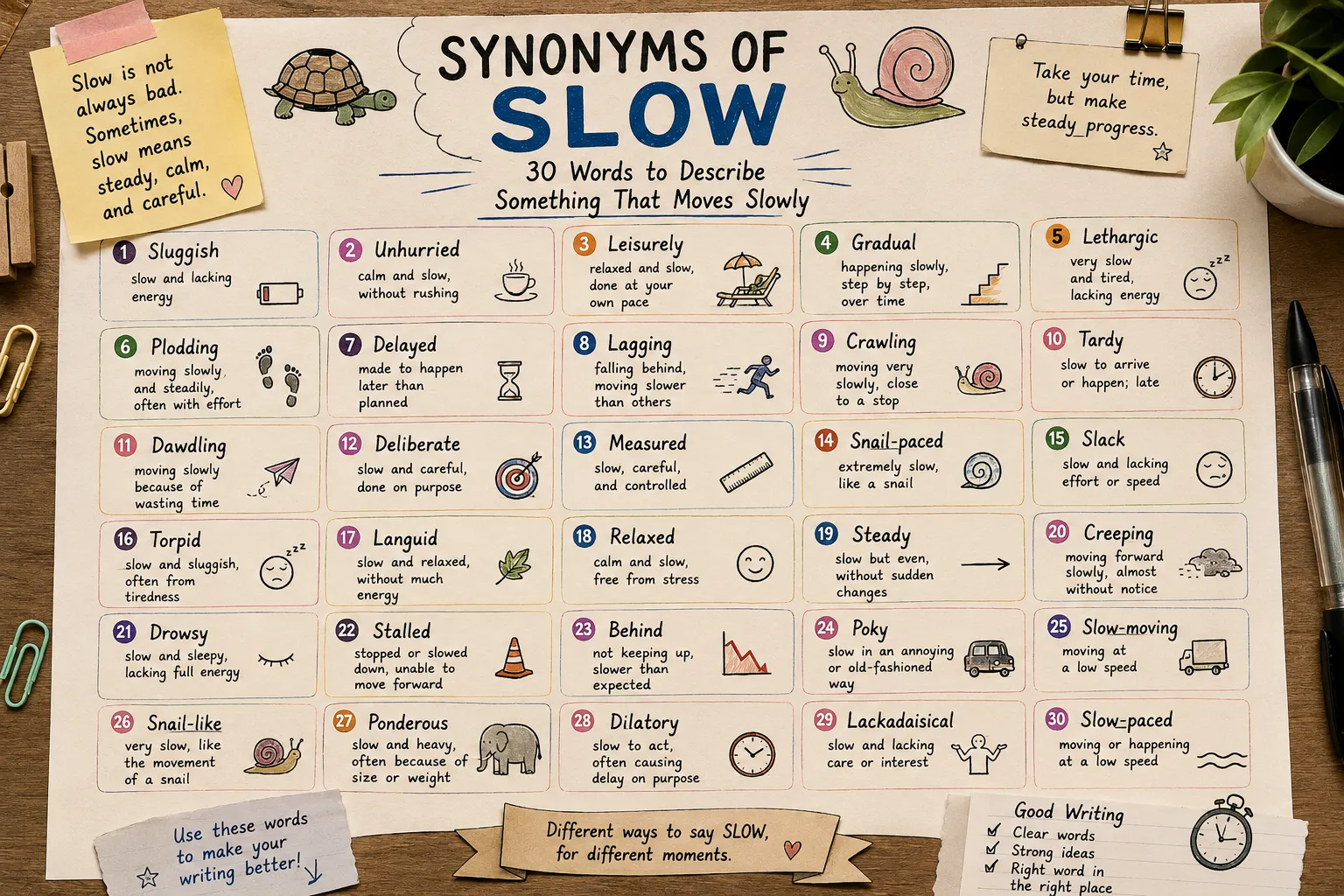
Synonyms of Slow
1. Sluggish (adjective) — US /ˈslʌɡɪʃ/ | UK /ˈslʌɡɪʃ/
Meaning: Slow and lacking energy. Examples:
- The sluggish computer took forever to load.
- She felt sluggish after her long flight.
2. Unhurried (adjective) — US /ʌnˈhɜːrid/ | UK /ʌnˈhʌrid/
Meaning: Calm and slow, without rushing. Examples:
- They enjoyed an unhurried breakfast on vacation.
- He walked at an unhurried pace through the park.
3. Leisurely (adjective) — US /ˈliːʒərli/ | UK /ˈlɛʒəli/
Meaning: Relaxed and slow, done at your own pace. Examples:
- They took a leisurely walk along the beach.
- She enjoys a leisurely morning on weekends.
4. Gradual (adjective) — US /ˈɡrædʒuəl/ | UK /ˈɡrædʒuəl/
Meaning: Happening slowly, step by step, over time. Examples:
- The changes were gradual but noticeable.
- Her improvement was gradual but steady.
5. Lethargic (adjective) — US /ləˈθɑːrdʒɪk/ | UK /lɪˈθɑːdʒɪk/
Meaning: Very slow and tired, lacking energy. Examples:
- He felt lethargic after eating a big lunch.
- The hot weather made everyone lethargic.
6. Plodding (adjective) — US /ˈplɑːdɪŋ/ | UK /ˈplɒdɪŋ/
Meaning: Moving slowly and steadily, often with effort. Examples:
- The plodding horse pulled the heavy cart.
- His plodding pace still got him to the finish line.
7. Delayed (adjective) — US /dɪˈleɪd/ | UK /dɪˈleɪd/
Meaning: Made to happen later than planned. Examples:
- The delayed flight left three hours late.
- Their delayed reply worried the team.
8. Lagging (adjective) — US /ˈlæɡɪŋ/ | UK /ˈlæɡɪŋ/
Meaning: Falling behind, moving slower than others. Examples:
- The lagging runner tried to catch up.
- Sales were lagging behind last year’s numbers.
9. Crawling (adjective) — US /ˈkrɔːlɪŋ/ | UK /ˈkrɔːlɪŋ/
Meaning: Moving very slowly, close to a stop. Examples:
- Traffic was crawling on the highway.
- The line was crawling toward the entrance.
10. Tardy (adjective) — US /ˈtɑːrdi/ | UK /ˈtɑːdi/
Meaning: Slow to arrive or happen; late. Examples:
- He was tardy for his morning class again.
- Her tardy reply came after the deadline.
11. Dawdling (adjective) — US /ˈdɔːdlɪŋ/ | UK /ˈdɔːdlɪŋ/
Meaning: Moving slowly because of wasting time. Examples:
- The dawdling child made them late for school.
- He was dawdling instead of finishing his chores.
12. Deliberate (adjective) — US /dɪˈlɪbərət/ | UK /dɪˈlɪbərət/
Meaning: Slow and careful, done on purpose. Examples:
- She spoke in a slow, deliberate voice.
- His deliberate steps showed he was thinking hard.
13. Measured (adjective) — US /ˈmɛʒərd/ | UK /ˈmɛʒəd/
Meaning: Slow, careful, and controlled. Examples:
- He gave a measured response to the question.
- Her measured pace helped her save energy.
14. Snail-paced (adjective) — US /ˈsneɪl peɪst/ | UK /ˈsneɪl peɪst/
Meaning: Extremely slow, like a snail. Examples:
- The snail-paced service annoyed the customers.
- Work moved at a snail-paced speed that week.
15. Slack (adjective) — US /slæk/ | UK /slæk/
Meaning: Slow and lacking effort or speed. Examples:
- Business was slack during the winter months.
- His slack pace worried his coach.
16. Torpid (adjective) — US /ˈtɔːrpɪd/ | UK /ˈtɔːpɪd/
Meaning: Slow and sluggish, often from tiredness. Examples:
- The bear stayed torpid through the winter.
- She felt torpid after the long, hot day.
17. Languid (adjective) — US /ˈlæŋɡwɪd/ | UK /ˈlæŋɡwɪd/
Meaning: Slow and relaxed, without much energy. Examples:
- They spent a languid afternoon by the pool.
- His languid movements showed he was in no rush.
18. Relaxed (adjective) — US /rɪˈlækst/ | UK /rɪˈlækst/
Meaning: Calm and slow, free from stress. Examples:
- They had a relaxed dinner with no plans after.
- Her relaxed attitude helped calm the room.
19. Steady (adjective) — US /ˈstɛdi/ | UK /ˈstɛdi/
Meaning: Slow but even, without sudden changes. Examples:
- He kept a steady pace during the long race.
- The steady growth pleased the whole team.
20. Creeping (adjective) — US /ˈkriːpɪŋ/ | UK /ˈkriːpɪŋ/
Meaning: Moving forward slowly, almost without notice. Examples:
- The creeping fog covered the whole valley.
- Prices showed a creeping rise over the year.
21. Drowsy (adjective) — US /ˈdraʊzi/ | UK /ˈdraʊzi/
Meaning: Slow and sleepy, lacking full energy. Examples:
- The warm room made him feel drowsy.
- Her drowsy replies showed she needed rest.
22. Stalled (adjective) — US /stɔːld/ | UK /stɔːld/
Meaning: Stopped or slowed down, unable to move forward. Examples:
- The stalled car blocked the road.
- Talks between the two sides remained stalled.
23. Behind (adjective) — US /bɪˈhaɪnd/ | UK /bɪˈhaɪnd/
Meaning: Not keeping up, slower than expected. Examples:
- He felt behind on his homework all week.
- The project was behind schedule by two days.
24. Poky (adjective) — US /ˈpoʊki/ | UK /ˈpəʊki/
Meaning: Slow in an annoying or old-fashioned way, used casually. Examples:
- The poky old bus took ages to arrive.
- She called the service poky and outdated.
25. Slow-moving (adjective) — US /ˈsloʊ ˈmuːvɪŋ/ | UK /ˈsləʊ ˈmuːvɪŋ/
Meaning: Moving at a low speed. Examples:
- The slow-moving river calmed everyone down.
- They got stuck behind a slow-moving truck.
26. Snail-like (adjective) — US /ˈsneɪl laɪk/ | UK /ˈsneɪl laɪk/
Meaning: Very slow, like the movement of a snail. Examples:
- Progress felt snail-like during the delay.
- The snail-like pace tested everyone’s patience.
27. Ponderous (adjective) — US /ˈpɑːndərəs/ | UK /ˈpɒndərəs/
Meaning: Slow and heavy, often because of size or weight. Examples:
- The ponderous elephant moved across the field.
- His ponderous speech felt long and slow.
28. Dilatory (adjective) — US /ˈdɪlətɔːri/ | UK /ˈdɪlətəri/
Meaning: Slow to act, often causing delay on purpose. Examples:
- The company faced criticism for its dilatory response.
- His dilatory habits annoyed his coworkers.
29. Lackadaisical (adjective) — US /ˌlækəˈdeɪzɪkəl/ | UK /ˌlækəˈdeɪzɪkəl/
Meaning: Slow and lacking care or interest. Examples:
- His lackadaisical effort disappointed the coach.
- The lackadaisical service made customers unhappy.
30. Slow-paced (adjective) — US /ˈsloʊ peɪst/ | UK /ˈsləʊ peɪst/
Meaning: Moving or happening at a low speed. Examples:
- The slow-paced movie tested their patience.
- Life in the small town felt slow-paced and calm.
Prototype Meaning
When people hear the word “slow,” they usually picture something that takes longer than expected, like heavy traffic. It brings to mind low speed and, often, a feeling of waiting. This simple picture sits at the center of the word. Other synonyms add detail, showing whether the slowness feels calm, tired, careful, or annoying.
Prototype Categorization
You can group these synonyms by the feeling they add to “slow”:
- Calm and relaxed slowness: unhurried, leisurely, relaxed, languid
- Tired or low-energy slowness: sluggish, lethargic, drowsy, torpid
- Slowness that causes delay: delayed, tardy, lagging, stalled, behind, dilatory
- Careful, on-purpose slowness: deliberate, measured, steady
- Very slow movement: crawling, plodding, snail-paced, snail-like, slow-moving, ponderous
- Slowness caused by low effort: dawdling, slack, poky, lackadaisical
Antonyms of Slow
fast, quick, speedy, rapid, swift, brisk
Short Questions and Answers
- What does “slow” mean? It means not moving fast, or taking a long time to happen.
- When should “slow” be used? Use it to describe anything that moves or happens at a low speed, from traffic to a slow walk.
- Is “slow” positive or negative? It depends on the situation. It can feel calm and nice, or frustrating and annoying.
- How is it different from similar words? “Slow” is simple and general. “Leisurely” shows a calm, relaxed pace. “Sluggish” shows tiredness. “Delayed” focuses on being late, not slow movement.
Conclusion
Synonyms for slow will help your English grow strong. Each word shows a different kind of slowness, from a calm “leisurely” walk to a tired “sluggish” feeling. Speaking words help your writing sound clear and full of detail, not repeated. synonyms of slow also help you say exactly what kind of slow you mean, whether it feels calm, tired, or annoying. Anyone learning English can use synonyms of slow to speak and write with more color. Try to learn one new word each day. Use it in a sentence about your own day. Over time, this small habit will make your English much stronger.