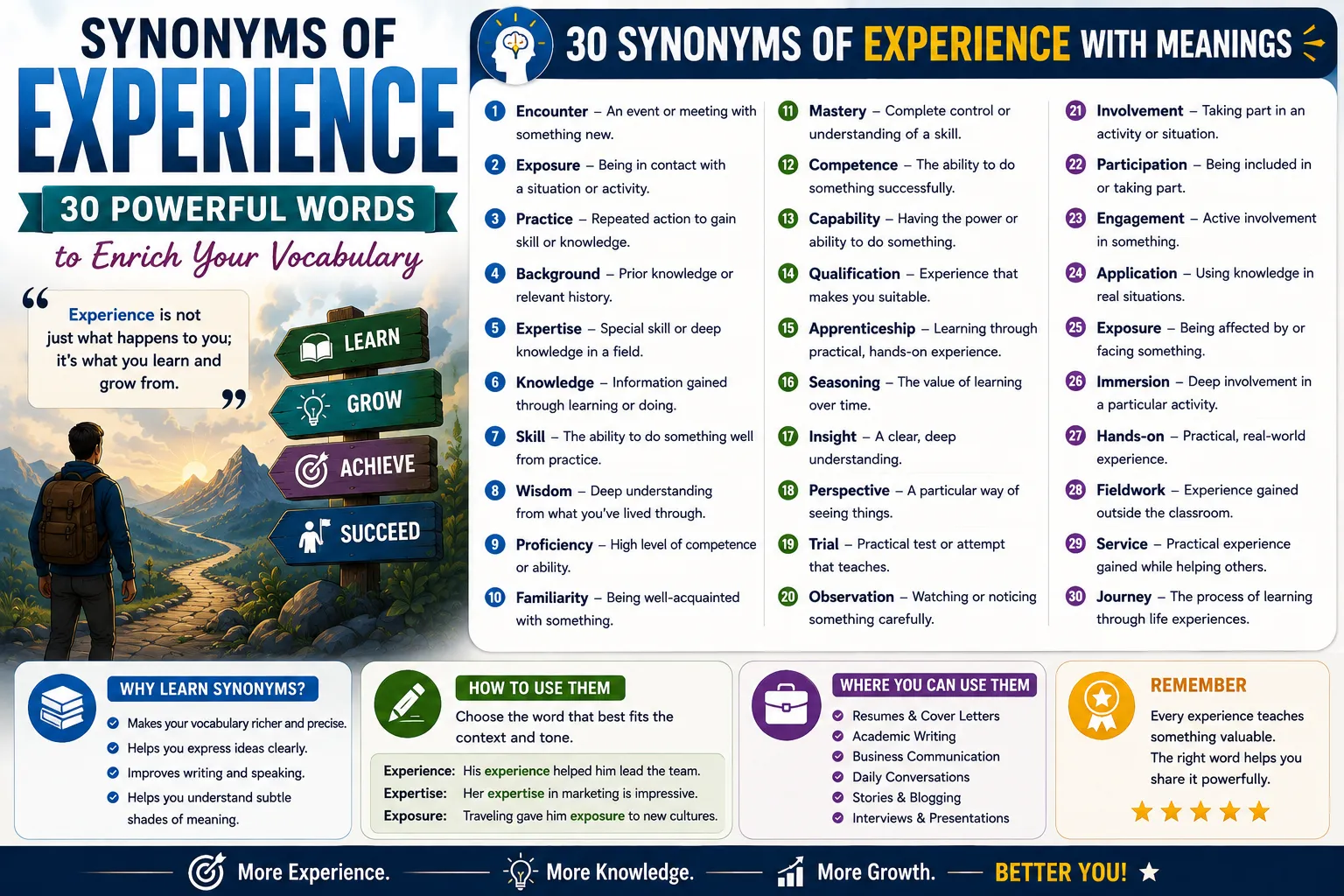
The word experience means practical knowledge or skills gained from living through events. Imagine hiking up a steep mountain for the first time. Your legs feel tired, but reaching the summit fills you with joy and teaches you something new. This word is very common because it describes daily life, job skills, and life events. However, repeating the same word makes your speaking and writing boring over time. Learning synonyms of experience is necessary for English learners and content writers who want to build a rich vocabulary. Synonyms of experience help you describe exact feelings and keep your audience engaged. This guide discusses the full meaning, grammar, history, pronunciation, and categories of experience. Along with thirty useful synonyms with example sentences written in smooth prose.
Meaning of Experience
Definition
Experience (Noun / Verb): Practical knowledge, skill, or observation gained through involvement in events over time.
Examples
She has ten years of work experience in teaching.
We want to experience new cultures when we travel.
Connotative Meaning
- Positive tone: Represents growth, wisdom, skill, adventure, and personal achievement.
- Negative tone: Can describe hardships, painful life lessons, or stressful events.
- Neutral tone: Refers to basic facts, routines, background history, or general workplace qualifications.
Etymology
- Source language: Comes from Latin experientia, which meant trial, proof, or knowledge gained by testing.
- Old English (450–1100): Native Old English used words like fandung (testing) before French influence.
- Middle English (1100–1500): Adopted as experience from Old French to mean direct observation or trial.
- Modern English (1500–Present):Synonyms of experience expanded to describe personal events, build up skill and active involvement.
Pronunciation
- US: /ɪkˈspɪriəns/
- UK: /ɪkˈspɪəriəns/
Syllables
ex-pe-ri-ence
Affixation Pattern of Experience
- Root: Experience
- Prefix: None (Base form)
- Suffix: None (Base form)
- Word Formation:
- Adjective: Experienced, Experiential
- Verb: Experience
- Noun: Inexperience (Opposite)
Synonyms of Experience
1. Practice (Noun) — US: /ˈpræktɪs/ | UK: /ˈpræktɪs/
Meaning: Repeated action done to gain skill and knowledge over time.
Examples:
Daily practice helps you master playing the piano.
Her medical practice gave her confidence in the clinic.
2. Knowledge (Noun) — US: /ˈnɑːlɪdʒ/ | UK: /ˈnɒlɪdʒ/
Meaning: Information and understanding gained through study or living.
Examples:
He shares his vast knowledge of history with students.
Books build your knowledge of the world.
3. Skill (Noun) — US: /skɪl/ | UK: /skɪl/
Meaning: An ability to do something well because of training.
Examples:
Cooking requires patience and hand skill.
She showed great skill in fixing the computer.
4. Background (Noun) — US: /ˈbækˌɡraʊnd/ | UK: /ˈbækɡraʊnd/
Meaning: A person’s past work, education, and life events.
Examples:
His tech background helped him land the new job.
People from every background enjoyed the festival.
5. Event (Noun) — US: /ɪˈvɛnt/ | UK: /ɪˈvent/
Meaning: A thing that happens, especially something important.
Examples:
Graduation was a memorable event in her life.
The city held a grand music event on Sunday.
6. Incident (Noun) — US: /ˈɪnsədənt/ | UK: /ˈɪnsɪdənt/
Meaning: An individual occurrence or event in daily life.
Examples:
The police recorded every detail of the incident.
A small incident delayed our morning train trip.
7. Episode (Noun) — US: /ˈɛpəˌsoʊd/ | UK: /ˈepɪsəʊd/
Meaning: An event or period in a larger sequence of events.
Examples:
Moving to a new city was an exciting episode.
He recalled a funny episode from his childhood.
8. Adventure (Noun) — US: /ædˈvɛntʃɚ/ | UK: /ədˈventʃə/
Meaning: An exciting or risky event that brings new feelings.
Examples:
Camping in the forest was a true adventure.
They set off on a new travel adventure together.
9. Trial (Noun) — US: /ˈtraɪəl/ | UK: /ˈtraɪəl/
Meaning: A test of quality or a difficult life test.
Examples:
Facing hard work was a true trial for the team.
They learned valuable lessons through trial and error.
10. Understanding (Noun) — US: /ˌʌndɚˈstændɪŋ/ | UK: /ˌʌndəˈstændɪŋ/
Meaning: Knowledge and insight about how something works.
Examples:
She has a clear understanding of market trends.
Travel gives you a deeper understanding of people.
11. Expertise (Noun) — US: /ˌɛkstɚˈtiːz/ | UK: /ˌekspɜːˈtiːz/
Meaning: High-level skill or expert knowledge in a field.
Examples:
We value his technical expertise in software design.
She was hired for her design expertise.
12. Familiarity (Noun) — US: /fəˌmɪliˈærətɪ/ | UK: /fəˌmɪliˈærəti/
Meaning: Good knowledge of a topic gained from close contact.
Examples:
His familiarity with the city helped us find food fast.
Her familiarity with the rules made the test easy.
13. Insight (Noun) — US: /ˈɪnˌsaɪt/ | UK: /ˈɪnsaɪt/
Meaning: Deep understanding of a complex situation or person.
Examples:
The mentor offered helpful insight into career choices.
Her research provides deep insight into nature.
14. Mastery (Noun) — US: /ˈmæstəri/ | UK: /ˈmɑːstəri/
Meaning: Complete control or thorough knowledge of a subject.
Examples:
His mastery of Spanish impressed every traveler.
Years of work led to her mastery of painting.
15. Wisdom (Noun) — US: /ˈwɪzdəm/ | UK: /ˈwɪzdəm/
Meaning: Good judgment gained through life learning and age.
Examples:
Grandmother shared her wisdom with the young children.
Time brings wisdom to those who reflect.
16. Maturity (Noun) — US: /məˈtʃʊrətɪ/ | UK: /məˈtʃʊərəti/
Meaning: The state of being fully grown or mentally developed.
Examples:
He handled the problem with great maturity.
Life challenges build emotional maturity.
17. Training (Noun) — US: /ˈtreɪnɪŋ/ | UK: /ˈtreɪnɪŋ/
Meaning: Process of learning skills needed for a job or activity.
Examples:
New workers receive three weeks of paid training.
His safety training prevented a fire at work.
18. Involvement (Noun) — US: /ɪnˈvɑːlvmənt/ | UK: /ɪnˈvɒlvmənt/
Meaning: The fact of taking part in an activity or event.
Examples:
Her involvement in community projects helped many.
Active class involvement leads to top grades.
19. Exposure (Noun) — US: /ɪkˈspoʊʒɚ/ | UK: /ɪkˈspəʊʒə/
Meaning: State of experiencing or being introduced to something new.
Examples:
Early exposure to music helps young minds grow.
Travel gives students exposure to new ideas.
20. Lesson (Noun) — US: /ˈlɛsən/ | UK: /ˈlesn/
Meaning: Something learned from an event, test, or mistake.
Examples:
Failure taught him an important business lesson.
Each mistake offers a lesson for the future.
21. History (Noun) — US: /ˈhɪstəri/ | UK: /ˈhɪstri/
Meaning: A record of past events or personal background.
Examples:
The doctor reviewed the patient’s medical history.
Our company has a long history of success.
22. Habit (Noun) — US: /ˈhæbət/ | UK: /ˈhæbɪt/
Meaning: A settled routine gained through regular practice.
Examples:
Reading every night became a healthy habit.
Good work habits lead to fast progress.
23. Routine (Noun) — US: /ruːˈtiːn/ | UK: /ruːˈtiːn/
Meaning: Regular sequence of actions followed over time.
Examples:
Exercise is a key part of her daily routine.
Morning walk became a pleasant routine.
24. Observation (Noun) — US: /ˌɑːbzɚˈveɪʃən/ | UK: /ˌɒbzəˈveɪʃn/
Meaning: The act of watching something to gain knowledge.
Examples:
Careful observation helped the scientist find the answer.
Learning often starts with simple observation.
25. Occurrence (Noun) — US: /əˈkɝːəns/ | UK: /əˈkʌrəns/
Meaning: An event that happens in a particular setting.
Examples:
Rain is a frequent occurrence in spring.
Snow was a rare occurrence in the valley.
26. Reality (Noun) — US: /riˈælətɪ/ | UK: /riˈæləti/
Meaning: The actual state of things rather than ideas or dreams.
Examples:
Facing reality helped them fix the budget.
The reality of hard work hit him.
27. Sensation (Noun) — US: /sɛnˈseɪʃən/ | UK: /senˈseɪʃn/
Meaning: A physical or emotional feeling caused by an event.
Examples:
Riding the roller coaster created a wild sensation.
A warm sensation filled her hands by the fire.
28. Encounter (Noun) — US: /ɪnˈkaʊntɚ/ | UK: /ɪnˈkaʊntə/
Meaning: An unexpected meeting or personal event with someone.
Examples:
A brief encounter with the author inspired his book.
She enjoyed her brief encounter with nature.
29. Test (Noun) — US: /tɛst/ | UK: /test/
Meaning: A critical event that challenges your skills or strength.
Examples:
The storm was a tough test for the small boat.
The long hike served as a test of endurance.
30. Capability (Noun) — US: /ˌkeɪpəˈbɪləti/ | UK: /ˌkeɪpəˈbɪləti/
Meaning: Power or ability developed through training and action.
Examples:
This job expanded her technical capability.
The team proved their capability under pressure.
Prototype Meaning
When people hear the word experience, they imagine a person gaining hands-on skill or living through a real moment. It represents active participation in life, work, or travel.
Prototype Categorization
- Skills and Knowledge: Practice, Knowledge, Skill, Expertise, Mastery, Familiarity, Capability.
- Personal Growth and Wisdom: Wisdom, Maturity, Insight, Understanding, Lesson, Background.
- Life Events and Incidents: Event, Incident, Episode, Occurrence, Reality, History.
- Actions and Learning: Adventure, Trial, Exposure, Training, Involvement, Observation, Test, Encounter.
- Feelings and Routines: Sensation, Habit, Routine.
Antonyms of Experience
- Inexperience
- Ignorance
- Immaturity
- Unfamiliarity
- Inability
- Theory
- Innocence
Short Questions and Answers
- What does “experience” mean?
“Experience” means knowledge, skill, gained through living or doing things over time. - When should “experience” be used?
Use “experience” when talking about job skills, personal background, or living through events. - Is “experience” positive or negative?
“Experience” is mostly positive or neutral, though it can describe hard life trials. - How is it different from similar words?
“Experience” means hands-on learning, while “knowledge” can come purely from reading books.
CONCLUSION
Synonyms of experience improves your English vocabulary. Relying on one word limits your expression and lowers writing quality. Learning synonyms of experience allows you to describe specific skills, events, and insights with high precision. Choosing exact synonyms of experience like expertise for jobs or adventure for travel eliminates repetitive text, and builds lasting confidence in your English communication. Make a plan to practice a few new terms each day in your reading, writing, and conversations.