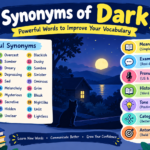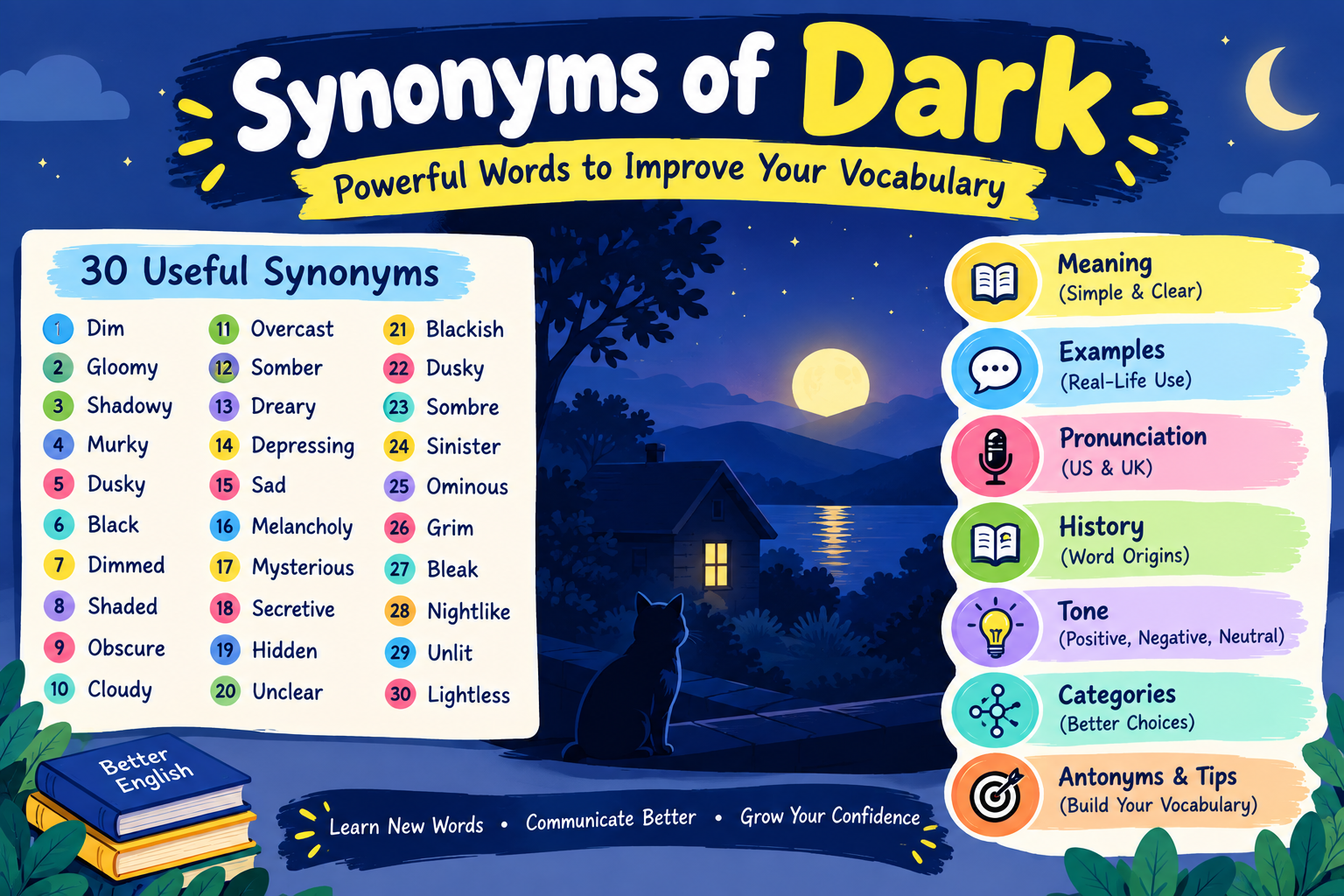
synonyms of dark means having little or no light. Imagine walking into a room after the lights go out. The room becomes dark, and you may need a flashlight to see. The word dark is common in daily English because we use it to talk about places, colors, weather, feelings, hair, and even ideas. Learning synonyms of dark can help English learners use more exact words in speaking and writing. For example, dim can describe weak light, while gloomy can describe a sad mood. Content writers can also use different words to make their writing clear and avoid repeating dark many times. In this article, we will learn the meaning of dark, its synonyms, examples, pronunciation, grammar, history, word forms, tone, and useful meaning groups.
Meaning of Dark
Definition
Dark (Adjective): Having little or no light; also used to describe something with a deep color, a sad mood, or a serious and unpleasant quality.
Examples
- The room was dark after the lights went out.
- She wore a dark blue dress.
Connotative Meaning
- Positive tone: Dark can sometimes suggest beauty, mystery, style, or elegance, such as a dark blue dress or dark chocolate.
- Negative tone: Dark can suggest sadness, fear, danger, evil, or something unpleasant.
- Neutral tone: Dark can simply describe a place with little light or a color with little brightness.
Also read more about https://myprayerss.com/synonyms-of-enemy-2/
Etymology
- Source: The word dark comes from Old English deorc.
- Original meaning: It meant “without light,” “obscure,” or “not bright.”
- The word is related to similar words in other Germanic languages.
- Over time, dark gained other meanings connected with sadness, secrecy, danger, evil, and deep colors.
Short History of Dark
Old English (450–1100):
The word appeared as deorc in Old English. It mainly described something without light or something that was not bright.
Middle English (1100–1500):
The spelling slowly changed into forms closer to the modern word dark. The word was used for places without light and also began to have wider meanings.
Modern English (1500–Present):
Today, dark has many uses. It can describe low light, deep colors, sad moods, serious topics, and frightening or unpleasant ideas.
Pronunciation (US & UK – IPA)
- US: /dɑːrk/
- UK: /dɑːk/
Syllables
dark
Affixation Pattern of Dark
Root:
dark is the main root word.
Prefix:
None
Suffix:
None
Word Formation
- Dark — adjective
- Darkness — noun
- Darken — verb
- Darkened — adjective/past participle
- Darkly — adverb
- Darker — comparative adjective
- Darkest — superlative adjective
Synonyms of Dark
1. Dim (Adjective) — US /dɪm/ | UK /dɪm/
Meaning: Having weak or low light.
Examples:
- The room was dim in the evening.
- A dim light came from the window.
2. Gloomy (Adjective) — US /ˈɡluːmi/ | UK /ˈɡluːmi/
Meaning: Dark and often sad or depressing.
Examples:
- The sky looked gloomy before the rain.
- It was a gloomy afternoon.
3. Shadowy (Adjective) — US /ˈʃædoʊi/ | UK /ˈʃædəʊi/
Meaning: Full of shadows or partly dark.
Examples:
- We walked through a shadowy street.
- A shadowy figure stood near the door.
4. Murky (Adjective) — US /ˈmɝːki/ | UK /ˈmɜːki/
Meaning: Dark, unclear, or difficult to see through.
Examples:
- The water looked murky.
- We could not see clearly in the murky room.
5. Dusky (Adjective) — US /ˈdʌski/ | UK /ˈdʌski/
Meaning: Slightly dark, especially around evening.
Examples:
- We walked home in the dusky light.
- The sky became dusky after sunset.
6. Black (Adjective) — US /blæk/ | UK /blæk/
Meaning: Having the darkest color.
Examples:
- He wore a black shirt.
- The cat has black fur.
7. Dimmed (Adjective) — US /dɪmd/ | UK /dɪmd/
Meaning: Made less bright or less clear.
Examples:
- The lights were dimmed during the movie.
- The screen looked dimmed.
8. Shaded (Adjective) — US /ˈʃeɪdɪd/ | UK /ˈʃeɪdɪd/
Meaning: Made darker by blocking some light.
Examples:
- We sat in a shaded area.
- The tree gave us a shaded place to rest.
9. Obscure (Adjective) — US /əbˈskjʊr/ | UK /əbˈskjʊə/
Meaning: Difficult to see, understand, or know.
Examples:
- The meaning of the message was obscure.
- The building was hidden in an obscure corner.
10. Cloudy (Adjective) — US /ˈklaʊdi/ | UK /ˈklaʊdi/
Meaning: Full of clouds and often lacking bright light.
Examples:
- It was a cloudy morning.
- The sky became cloudy before the storm.
11. Overcast (Adjective) — US /ˈoʊvərkæst/ | UK /ˈəʊvəkɑːst/
Meaning: Covered with clouds, making the sky look dark.
Examples:
- The day was overcast and cool.
- The overcast sky made the park look gray.
12. Somber (Adjective) — US /ˈsɑːmbər/ | UK /ˈsɒmbə/
Meaning: Serious, sad, and without much happiness.
Examples:
- The room had a somber mood.
- Everyone was quiet and somber.
13. Dreary (Adjective) — US /ˈdrɪri/ | UK /ˈdrɪəri/
Meaning: Dull, sad, and lacking brightness.
Examples:
- It was a dreary winter day.
- The old house looked dreary in the rain.
14. Depressing (Adjective) — US /dɪˈpresɪŋ/ | UK /dɪˈpresɪŋ/
Meaning: Making someone feel sad or unhappy.
Examples:
- The movie had a depressing ending.
- The empty room felt depressing.
15. Sad (Adjective) — US /sæd/ | UK /sæd/
Meaning: Feeling unhappy or showing little happiness.
Examples:
- She felt sad after the news.
- He had a sad look on his face.
16. Melancholy (Adjective) — US /ˈmelənkɑːli/ | UK /ˈmelənkɒli/
Meaning: Having a quiet and thoughtful sadness.
Examples:
- The song has a melancholy sound.
- The story has a melancholy mood.
17. Mysterious (Adjective) — US /mɪˈstɪriəs/ | UK /mɪˈstɪəriəs/
Meaning: Difficult to understand or explain.
Examples:
- A mysterious sound came from outside.
- The old house had a mysterious feeling.
18. Secretive (Adjective) — US /ˈsiːkrətɪv/ | UK /ˈsiːkrətɪv/
Meaning: Keeping information hidden from others.
Examples:
- He was very secretive about his plans.
- Her secretive behavior made people curious.
19. Hidden (Adjective) — US /ˈhɪdən/ | UK /ˈhɪdən/
Meaning: Kept out of sight or difficult to find.
Examples:
- The key was hidden under the table.
- We found a hidden room behind the wall.
20. Unclear (Adjective) — US /ˌʌnˈklɪr/ | UK /ˌʌnˈklɪə/
Meaning: Difficult to understand or see clearly.
Examples:
- The instructions were unclear.
- The picture looked unclear in the low light.
21. Blackish (Adjective) — US /ˈblækɪʃ/ | UK /ˈblækɪʃ/
Meaning: Somewhat black or close to black.
Examples:
- The walls were blackish gray.
- He noticed a blackish mark on the paper.
22. Dusky (Adjective) — US /ˈdʌski/ | UK /ˈdʌski/
Meaning: Dark or partly dark, especially at the end of the day.
Examples:
- The garden looked dusky at sunset.
- We watched the birds in the dusky sky.
23. Sombre (Adjective) — US /ˈsɑːmbər/ | UK /ˈsɒmbə/
Meaning: Serious, dark, or sad in mood.
Examples:
- The meeting had a sombre mood.
- She wore a sombre dress.
24. Sinister (Adjective) — US /ˈsɪnɪstər/ | UK /ˈsɪnɪstə/
Meaning: Suggesting that something bad or dangerous may happen.
Examples:
- The story had a sinister ending.
- He heard a sinister sound outside.
25. Ominous (Adjective) — US /ˈɑːmənəs/ | UK /ˈɒmɪnəs/
Meaning: Making you feel that something bad may happen.
Examples:
- Dark clouds gave an ominous warning.
- The silence felt ominous.
26. Grim (Adjective) — US /ɡrɪm/ | UK /ɡrɪm/
Meaning: Serious, sad, or unpleasant.
Examples:
- The news was grim.
- He gave us a grim warning.
27. Bleak (Adjective) — US /bliːk/ | UK /bliːk/
Meaning: Cold, empty, and without hope or happiness.
Examples:
- The landscape looked bleak in winter.
- The future seemed bleak at that time.
28. Nightlike (Adjective) — US /ˈnaɪtlaɪk/ | UK /ˈnaɪtlaɪk/
Meaning: Looking or feeling like nighttime.
Examples:
- The room had a nightlike appearance.
- The storm made the afternoon feel nightlike.
29. Unlit (Adjective) — US /ʌnˈlɪt/ | UK /ʌnˈlɪt/
Meaning: Not provided with light.
Examples:
- We walked along an unlit road.
- The hallway was completely unlit.
30. Lightless (Adjective) — US /ˈlaɪtləs/ | UK /ˈlaɪtləs/
Meaning: Having no light.
Examples:
- They entered a lightless room.
- The cave was completely lightless.
Prototype Meaning
The most typical meaning of dark is having little or no light. When people hear this word, they often imagine a room with the lights off, a night sky, or a place where it is hard to see. The word can also describe deep colors, such as dark blue or dark green. In other situations, dark can describe a sad mood, a secret, or something frightening or unpleasant.
Prototype Categorization
- Low or weak light: dim, dimmed, shadowy, dusky, unlit, lightless
- Dark weather or sky: cloudy, overcast, gloomy, dreary
- Deep or black color: black, blackish, shaded
- Sad or serious mood: somber, sombre, sad, melancholy, depressing, grim
- Unclear or hard to understand: obscure, unclear, murky
- Hidden or secret: hidden, secretive
- Mysterious feeling: mysterious
- Dangerous or frightening: sinister, ominous, grim
- Without hope: blea
Antonyms of Dark
- Bright — full of light
- Light — having plenty of light
- Clear — easy to see or understand
- Sunny — full of sunlight
- Brilliant — very bright
- Cheerful — happy and positive
- Colorful — full of bright colors
- Hopeful — showing hope
- Open — not hidden or secret
- Transparent — easy to see through or understand
Short Questions and Answers
- What does dark mean?
Dark means having little or no light. It can also describe a deep color, sad mood, or unpleasant idea. - When should dark be used?
Use dark when you talk about low light, deep colors, serious moods, or something hidden or unpleasant. - Is dark positive or negative?
It depends on the situation. Dark can be neutral when talking about light or color. It can have a negative meaning when talking about sadness, fear, or danger. It can also have a positive meaning when describing style or mystery. - How is dark different from similar words?
Dim usually means weak light. Gloomy often describes a sad or dark mood. Black describes a very dark color. Murky means dark or unclear. Ominous suggests that something bad may happen.
Conclusion
Synonyms of dark can make your English vocabulary stronger and more flexible. Words such as dim, gloomy, shadowy, and murky help you describe different kinds of darkness. Some words describe low light, while others describe color, sadness, mystery, or danger. Learning synonyms of dark can make your writing clearer and more interesting. These synonyms of dark are useful for students, English learners, bloggers, storytellers, and content writers. They also help you avoid using dark many times in the same text. Try to learn two or three new synonyms of dark each day. By using these synonyms of dark in simple sentences, you can improve your vocabulary and speaking skills. With regular practice, you can write better sentences, speak with confidence, and express your ideas more clearly.