synonyms of enemy means a person or group that strongly opposes or wants to harm someone. Imagine two people in a story who always fight and try to stop each other. One person may call the other an enemy. The word is common in daily speech, books, movies, history, and news. Learning synonyms of enemy helps English learners use stronger and more exact words. It also helps content writers avoid using the same word many times. Words such as foe, rival, adversary, opponent, and antagonist can show different types of conflict. In this article, we will learn the meaning of enemy, its grammar, history, pronunciation, word forms, and emotional tone. We will also learn 30 synonyms and close alternatives with simple meanings and examples. Finally, we will group these words by meaning so you can choose the best word for each situation.
Meaning of Enemy
Definition
Enemy (Noun):
A person, group, or country that strongly opposes or wants to harm another person or group.
Examples
- The soldiers fought against the enemy.
- He saw his old enemy across the room.
Connotative Meaning
- Positive tone: Enemy is usually not positive, but it can show courage when someone stands against an enemy.
- Negative tone: Enemy has a strong negative feeling because it suggests conflict, hate, danger, or harm.
- Neutral tone: In history or military writing, enemy can simply name the opposing side without showing the speaker’s personal feelings.
Also read more about https://myprayerss.com/synonyms-for-however-2/
Etymology
- Source: English enemy came through Anglo-French and Old French enemi.
- Old French: enemi meant an enemy or hostile person.
- Latin: It came from inimicus, meaning “unfriendly” or “enemy.”
- Latin parts: in- meant “not,” and amicus meant “friend.”
- So, the old idea behind enemy was basically “not a friend.”
Short History of Enemy
Old English (450–1100):
The modern word enemy was not common in Old English. English speakers often used feond, meaning an enemy or hostile person.
Middle English (1100–1500):
After the Norman Conquest, French words entered English. Enemy came into Middle English from French forms such as enemi. It was used for a person who hated or opposed another person.
Modern English (1500–Present):
The spelling enemy became standard in Modern English. Today, it can mean a personal enemy, political enemy, military enemy, or opposing group.
Pronunciation (US & UK – IPA)
US: /ˈen.ə.mi/
UK: /ˈen.ə.mi/
Syllables
en-e-my
Affixation Pattern of Enemy
- Root: enemy is a borrowed word from French and Latin.
- Prefix: No productive English prefix in the modern English word.
- Suffix: No productive English suffix in the modern word.
- Historical structure: Latin inimicus was made from in- “not” + amicus “friend.”
- Word formation: The common inflected forms are enemy, enemies, enemy’s, and enemies’.
- Main grammatical category: Noun.
- Related word: enmity is a related noun meaning strong hatred or hostility.
Synonyms of Enemy
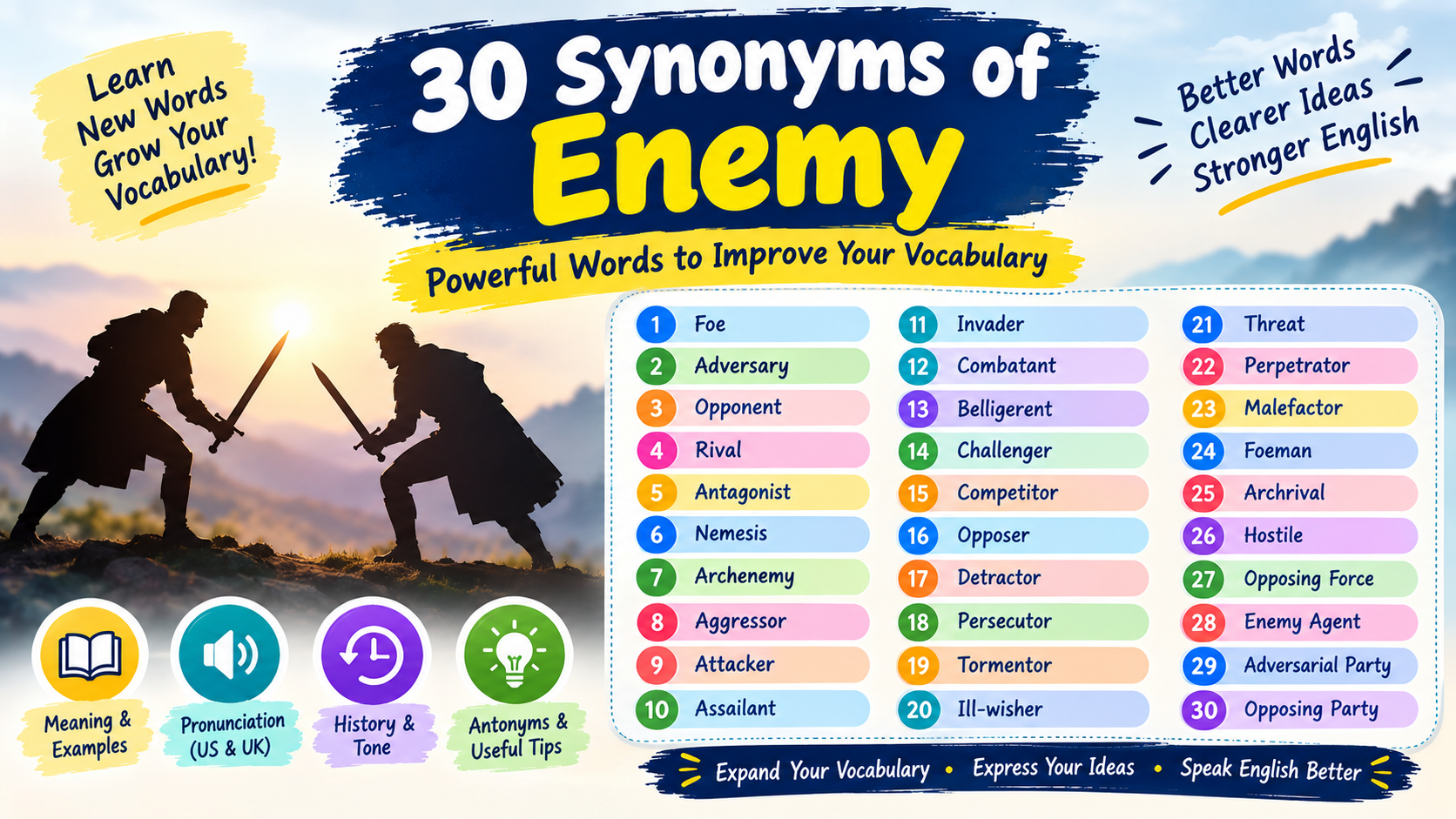
The words below include direct synonyms and close alternatives. Some words are best for special situations, such as war, competition, personal conflict, or strong opposition.
1. Foe (Noun) — /foʊ/ | /fəʊ/
Meaning: A person or group that is an enemy.
Examples:
- The hero defeated his old foe.
- The two foes met on the field.
2. Adversary (Noun) — /ˈæd.vɚ.ser.i/ | /ˈæd.və.sər.i/
Meaning: A person or group that you strongly oppose.
Examples:
- The player faced a strong adversary.
- He respected his old adversary.
3. Opponent (Noun) — /əˈpoʊ.nənt/ | /əˈpəʊ.nənt/
Meaning: A person or team that competes or fights against you.
Examples:
- Our team beat its opponent.
- She studied her opponent carefully.
4. Rival (Noun) — /ˈraɪ.vəl/ | /ˈraɪ.vəl/
Meaning: A person or group that competes with another.
Examples:
- The two companies are rivals.
- He faced his main rival in the final.
5. Antagonist (Noun) — /ænˈtæɡ.ə.nɪst/ | /ænˈtæɡ.ən.ɪst/
Meaning: A person who strongly opposes another person.
Examples:
- The hero fought the main antagonist.
- The story has a powerful antagonist.
6. Nemesis (Noun) — /ˈnem.ə.sɪs/ | /ˈnem.ə.sɪs/
Meaning: A person who is a very difficult and lasting enemy.
Examples:
- The hero finally defeated his nemesis.
- His old rival became his nemesis.
7. Archenemy (Noun) — /ˌɑːrtʃˈen.ə.mi/ | /ˌɑːtʃˈen.ə.mi/
Meaning: A person’s main or most important enemy.
Examples:
- The hero faced his archenemy again.
- The two characters are archenemies.
8. Hostile (Noun) — /ˈhɑː.stəl/ | /ˈhɒs.taɪl/
Meaning: A person or group that is unfriendly or opposed.
Examples:
- The soldiers watched the hostiles closely.
- The hostiles moved toward the border.
9. Aggressor (Noun) — /əˈɡres.ɚ/ | /əˈɡres.ə/
Meaning: A person or group that starts an attack.
Examples:
- The country was seen as the aggressor.
- The police arrested the aggressor.
10. Attacker (Noun) — /əˈtæk.ɚ/ | /əˈtæk.ə/
Meaning: A person who attacks another person or group.
Examples:
- The attacker ran away.
- The soldiers stopped the attacker.
11. Assailant (Noun) — /əˈseɪ.lənt/ | /əˈseɪ.lənt/
Meaning: A person who attacks someone.
Examples:
- The assailant left the area quickly.
- The police searched for the assailant.
12. Invader (Noun) — /ɪnˈveɪ.dɚ/ | /ɪnˈveɪ.də/
Meaning: A person or group that enters a place by force.
Examples:
- The army fought the invaders.
- The invaders entered the city.
13. Combatant (Noun) — /ˈkɑːm.bə.tənt/ | /ˈkɒm.bə.tənt/
Meaning: A person who takes part in fighting.
Examples:
- The combatants stopped fighting.
- Each combatant carried a weapon.
14. Belligerent (Noun) — /bəˈlɪdʒ.ɚ.ənt/ | /bəˈlɪdʒ.ər.ənt/
Meaning: A person or group that is fighting or acting aggressively.
Examples:
- The belligerents agreed to talk.
- Both belligerents wanted peace.
15. Challenger (Noun) — /ˈtʃæl.ən.dʒɚ/ | /ˈtʃæl.ən.dʒə/
Meaning: A person who challenges another person.
Examples:
- The champion faced a new challenger.
- The challenger trained every day.
16. Competitor (Noun) — /kəmˈpet̬.ə.t̬ɚ/ | /kəmˈpet.ɪ.tə/
Meaning: A person or group that competes against another.
Examples:
- Our biggest competitor launched a new product.
- She is a strong competitor.
17. Opposer (Noun) — /əˈpoʊ.zɚ/ | /əˈpəʊ.zə/
Meaning: A person who is against someone or something.
Examples:
- He became a strong opposer of the plan.
- The opposers spoke during the meeting.
18. Detractor (Noun) — /dɪˈtræk.tɚ/ | /dɪˈtræk.tə/
Meaning: A person who speaks against someone or something.
Examples:
- The writer has a few detractors.
- His detractors criticized his work.
19. Persecutor (Noun) — /ˈpɝː.sə.kjuː.tɚ/ | /ˈpɜː.sɪ.kjuː.tə/
Meaning: A person who treats someone badly over a long time.
Examples:
- The victim escaped from her persecutor.
- The story tells of a cruel persecutor.
20. Tormentor (Noun) — /tɔːrˈmen.tɚ/ | /tɔːˈmen.tə/
Meaning: A person who causes another person pain or fear.
Examples:
- The boy stood up to his tormentor.
- The hero escaped from his tormentor.
21. Ill-wisher (Noun) — /ˌɪlˈwɪʃ.ɚ/ | /ˌɪlˈwɪʃ.ə/
Meaning: A person who wishes bad things for someone.
Examples:
- She did not listen to her ill-wishers.
- His success upset some ill-wishers.
22. Threat (Noun) — /θret/ | /θret/
Meaning: A person or thing that may cause harm.
Examples:
- The enemy was a serious threat.
- The storm became a threat to the town.
23. Perpetrator (Noun) — /ˈpɝː.pəˌtreɪ.t̬ɚ/ | /ˈpɜː.pəˌtreɪ.tə/
Meaning: A person who commits a harmful or illegal act.
Examples:
- The police found the perpetrator.
- The perpetrator was taken to court.
24. Persecutor (Noun) — /ˈpɝː.sə.kjuː.tɚ/ | /ˈpɜː.sɪ.kjuː.tə/
Meaning: A person who repeatedly harms or troubles another person.
Examples:
- The persecutor tried to control him.
- She moved away from her persecutor.
25. Malefactor (Noun) — /ˈmæl.əˌfæk.tɚ/ | /ˈmæl.ɪˌfæk.tə/
Meaning: A person who does something wrong or harmful.
Examples:
- The police caught the malefactor.
- The old story describes a dangerous malefactor.
26. Foeman (Noun) — /ˈfoʊ.mən/ | /ˈfəʊ.mən/
Meaning: An enemy, especially in old or literary language.
Examples:
- The knight faced his foeman.
- The poem tells of a brave warrior and his foeman.
27. Antagonist (Noun) — /ænˈtæɡ.ə.nɪst/ | /ænˈtæɡ.ən.ɪst/
Meaning: A person who acts against another person.
Examples:
- The antagonist tried to stop the hero.
- The book has a clever antagonist.
28. Foe (Noun) — /foʊ/ | /fəʊ/
Meaning: An enemy or opponent.
Examples:
- The warrior defeated his foe.
- The two foes met again.
29. Adversary (Noun) — /ˈæd.vɚ.ser.i/ | /ˈæd.və.sər.i/
Meaning: Someone who is against another person.
Examples:
- She faced a powerful adversary.
- The two adversaries finally agreed to talk.
30. Enemy Agent (Noun) — /ˈen.ə.mi ˈeɪ.dʒənt/ | /ˈen.ə.mi ˈeɪ.dʒənt/
Meaning: A person who secretly works for an enemy group or country.
Examples:
- The army searched for an enemy agent.
- The enemy agent was discovered.
Prototype Meaning
The most typical meaning of enemy is a person, group, or country that is against another person or group. People often imagine two sides in a conflict. An enemy may want to defeat, hurt, stop, or weaken the other side. The word is often linked with war, fighting, hate, danger, or strong disagreement. However, an enemy does not always mean someone in a physical fight. It can also describe a person who strongly works against another person.
Prototype Categorization
- General enemy: foe, adversary, antagonist
- Competition: rival, opponent, competitor, challenger
- War and fighting: combatant, belligerent, attacker, aggressor
- Military conflict: invader, hostile, enemy agent, foe
- Strong personal conflict: nemesis, archenemy, tormentor
- People who act against others: opposer, detractor, persecutor
- Harmful people: assailant, perpetrator, malefactor
- Negative feelings or wishes: ill-wisher, detractor
Antonyms of Enemy
- Friend — a person who cares about you.
- Ally — a person or group that supports you.
- Supporter — a person who agrees with and helps you.
- Companion — a person who spends time with you.
- Partner — a person who works with you.
- Helper — a person who gives you help.
- Friendship — a friendly relationship.
- Peacemaker — a person who tries to create peace.
- Protector — a person who keeps someone safe.
- Well-wisher — a person who wants good things for you.
Short Questions and Answers
- What does enemy mean?
Enemy means a person, group, or country that strongly opposes or wants to harm another. - When should enemy be used?
Use enemy when talking about a strong opponent, especially in conflict, war, personal disagreement, or history. - Is enemy positive or negative?
Enemy usually has a negative meaning because it suggests opposition, danger, hate, or conflict. - How is enemy different from similar words?
Enemy is a broad word. Rival often means a competitor. Opponent means someone on the other side of a contest. Foe is a direct and often literary synonym. Adversary is more formal. Nemesis means a very difficult or lasting enemy.
Conclusion
synonyms of enemy can make your English vocabulary stronger. Words such as foe, adversary, rival, opponent, antagonist, and nemesis help you understand the synonyms of enemy and describe different kinds of conflict. Some synonyms of enemy are useful for war, while others work better for sports, stories, business, or personal problems. Knowing these small differences helps you choose the right word when using the synonyms of enemy. It also makes your writing and speaking clearer and more interesting. Using the synonyms of enemy can stop you from repeating the word enemy many times in one text. This is useful for English learners, students, and content writers. Try to learn two or three new words each day. Make simple sentences with them. With regular practice, you can build a stronger vocabulary, speak with more confidence, and express your ideas more clearly..