Help means to make something easier for someone. Imagine your friend has a heavy box. You pick up one side and carry it with them. You are giving help. We use the word help every day at home, school, work, and in social life. We also use it when we give advice, support, money, care, or useful information. Learning synonyms of help is useful for English learners because it gives them more ways to express simple ideas. It also helps content writers make their writing clear and less repetitive. In this article, you will learn the meaning of help and 30 useful synonyms. You will also see simple examples, grammar, history, pronunciation, word forms, emotional tone, semantic groups, and antonyms. These ideas will help you choose the right word for each situation.
Meaning of Help
Definition
Help (Verb/Noun): To make something easier for someone or to give support, advice, or assistance.
Examples
- Can you help me with my homework?
- My sister gave me help when I was sick.
Connotative Meaning
- Positive tone: Help often gives a feeling of kindness, care, support, and teamwork.
- Negative tone: Help can sometimes suggest that a person is weak or needs support, but this depends on the situation.
- Neutral tone: Help can simply mean giving assistance or making something easier.
Etymology
The word help is very old in English.
- Old English: helpan meant “to help, support, benefit, or make better.”
- Proto-Germanic: helpanan is the older Germanic source of the verb.
- Old English noun: help or helpe meant “assistance” or “support.”
- The exact deeper origin of the Germanic word is uncertain
Also read more about https://myprayerss.com/synonyms-for-however-2/
Short History of Help
Old English (450–1100):
The verb helpan was used for giving support, doing good, helping, and making something better. The noun help also meant assistance.
Middle English (1100–1500):
The word continued to be used for aid and support. By about the early 13th century, help could mean giving aid or assistance. The noun also developed the sense of an assistant or supporter.
Modern English (1500–Present):
Today, help is one of the most common English words. It can be a verb, noun, or exclamation. It is used for physical help, advice, money, support, care, and many other kinds of assistance.
Pronunciation of Help (US & UK – IPA)
- US: /help/
- UK: /help/
Cambridge gives the same IPA pronunciation for US and UK English.
Syllables
help
It is a one-syllable word.
Affixation Pattern of Help
- Root: help
- Prefix: None
- Suffix: None in the basic word
- Word formation: The base word help can form several related words.
- help — verb/noun
- helped — verb
- helping — verb/noun
- helper — noun
- helpful — adjective
- helpless — adjective
- helpfully — adverb
- helplessly — adverb
- helpfulness — noun
- helplessness — noun
The related words helper and helping have long histories in English.
Synonyms of Help
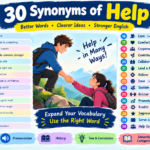
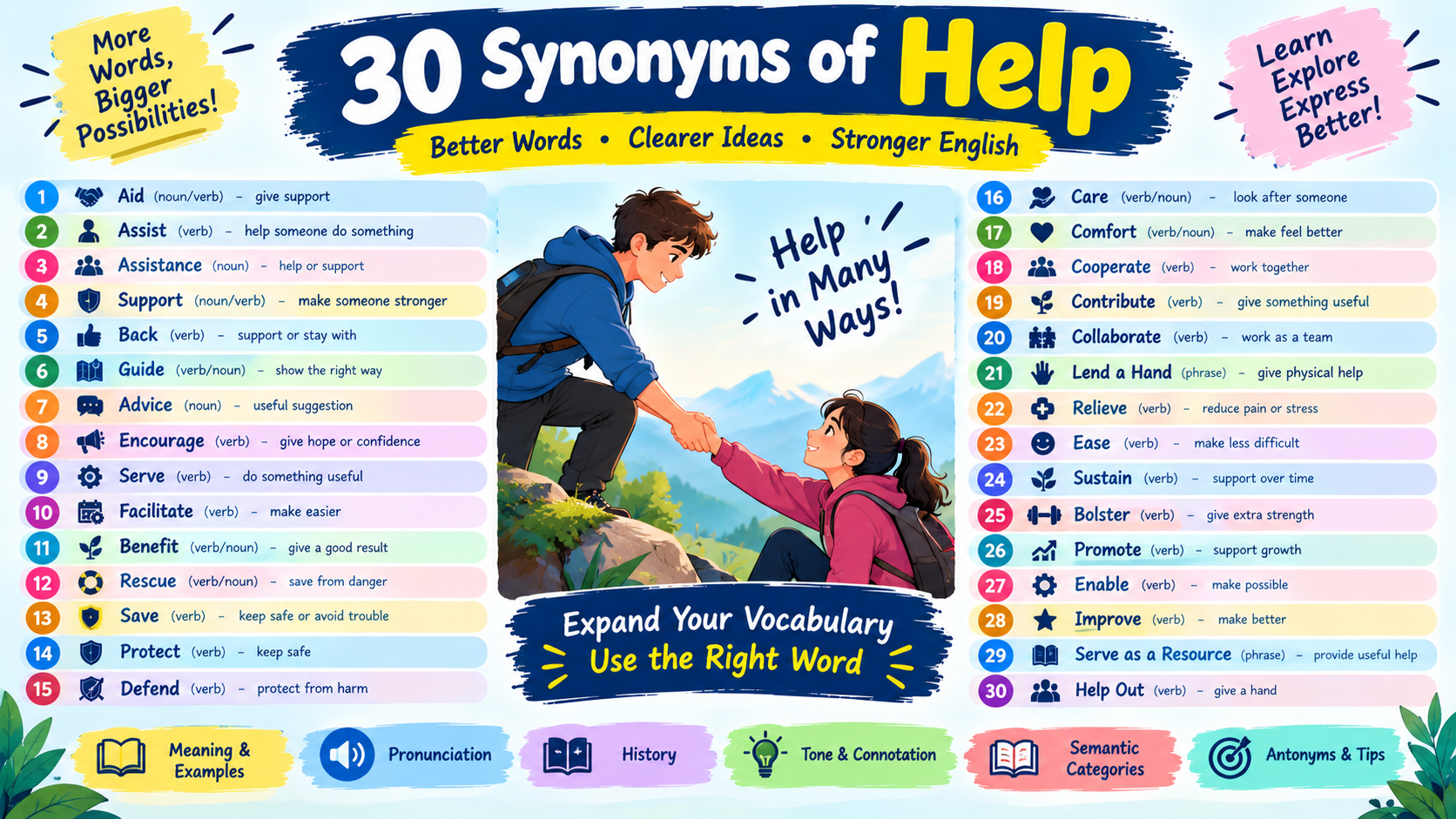
The following 30 words are useful synonyms or close alternatives for help. Some are best used for people, while others fit advice, support, problems, or specific situations.
1. Aid (Noun/Verb) — US /eɪd/ | UK /eɪd/
Meaning: Aid means help or support given to someone.
Examples:
- The doctor gave aid to the patient.
- The charity gave aid to poor families.
2. Assist (Verb) — US /əˈsɪst/ | UK /əˈsɪst/
Meaning: Assist means to help someone do something.
Examples:
- Can you assist me with this task?
- The nurse assisted the doctor.
3. Assistance (Noun) — US /əˈsɪstəns/ | UK /əˈsɪstəns/
Meaning: Assistance means help given to someone.
Examples:
- Thank you for your assistance.
- We need assistance with the project.
4. Support (Noun/Verb) — US /səˈpɔːrt/ | UK /səˈpɔːt/
Meaning: Support means help that makes someone stronger or more able to continue.
Examples:
- My family gave me great support.
- She supported her friend during a hard time.
5. Back (Verb) — US /bæk/ | UK /bæk/
Meaning: Back means to support a person, plan, or idea.
Examples:
- I will back you in this plan.
- Her parents backed her decision.
6. Aid (Verb) — US /eɪd/ | UK /eɪd/
Meaning: To aid means to help someone or something.
Examples:
- The medicine can aid recovery.
- Volunteers aided the families.
7. Guide (Verb/Noun) — US /ɡaɪd/ | UK /ɡaɪd/
Meaning: Guide means to help someone by showing them what to do.
Examples:
- My teacher guided me through the lesson.
- She gave me a guide for the project.
8. Advice (Noun) — US /ədˈvaɪs/ | UK /ədˈvaɪs/
Meaning: Advice is an idea or suggestion that helps someone make a good choice.
Examples:
- My father gave me good advice.
- She asked her teacher for advice.
9. Encourage (Verb) — US /ɪnˈkɝːɪdʒ/ | UK /ɪnˈkʌrɪdʒ/
Meaning: Encourage means to give someone hope or confidence to do something.
Examples:
- My teacher encouraged me to read more.
- Her friends encouraged her before the test.
10. Serve (Verb) — US /sɝːv/ | UK /sɜːv/
Meaning: Serve can mean to help someone by doing something useful for them.
Examples:
- This tool serves a useful purpose.
- The worker served the customers well.
11. Facilitate (Verb) — US /fəˈsɪləteɪt/ | UK /fəˈsɪlɪteɪt/
Meaning: Facilitate means to make something easier to do.
Examples:
- The new system facilitates online learning.
- Good planning can facilitate the work.
12. Benefit (Verb/Noun) — US /ˈbenəfɪt/ | UK /ˈbenɪfɪt/
Meaning: Benefit means to help someone or give them a good result.
Examples:
- Exercise can benefit your health.
- The new plan will benefit students.
13. Rescue (Verb/Noun) — US /ˈreskjuː/ | UK /ˈreskjuː/
Meaning: Rescue means to save someone from danger or trouble.
Examples:
- The firefighters rescued the child.
- The rescue came just in time.
14. Save (Verb) — US /seɪv/ | UK /seɪv/
Meaning: Save can mean to help someone avoid danger, loss, or trouble.
Examples:
- The doctor saved his life.
- This tip can save you time.
15. Protect (Verb) — US /prəˈtekt/ | UK /prəˈtekt/
Meaning: Protect means to help keep someone or something safe.
Examples:
- Parents protect their children.
- This cover protects the phone.
16. Defend (Verb) — US /dɪˈfend/ | UK /dɪˈfend/
Meaning: Defend means to protect someone or something from harm or attack.
Examples:
- The lawyer defended his client.
- The team defended its goal.
17. Care (Verb/Noun) — US /ker/ | UK /keər/
Meaning: Care means to look after someone or show concern for them.
Examples:
- She cares for her grandmother.
- The nurse gave good care to the patient.
18. Comfort (Verb/Noun) — US /ˈkʌmfərt/ | UK /ˈkʌmfət/
Meaning: Comfort means to make someone feel less sad, worried, or afraid.
Examples:
- I tried to comfort my friend.
- Her words gave me comfort.
19. Cooperate (Verb) — US /koʊˈɑːpəreɪt/ | UK /kəʊˈɒpəreɪt/
Meaning: Cooperate means to work together to help reach a goal.
Examples:
- We must cooperate to finish the work.
- The students cooperated with their teacher.
20. Contribute (Verb) — US /kənˈtrɪbjuːt/ | UK /kənˈtrɪbjuːt/
Meaning: Contribute means to give something that helps a person, group, or project.
Examples:
- Everyone contributed to the project.
- She contributed money to the charity.
21. Collaborate (Verb) — US /kəˈlæbəreɪt/ | UK /kəˈlæbəreɪt/
Meaning: Collaborate means to work with others to achieve something.
Examples:
- The writers collaborated on the book.
- We collaborated on the school project.
22. Lend a Hand (Phrase) — US /lend ə hænd/ | UK /lend ə hænd/
Meaning: Lend a hand means to give someone help.
Examples:
- Can you lend me a hand?
- My brother lent me a hand with the boxes.
23. Relieve (Verb) — US /rɪˈliːv/ | UK /rɪˈliːv/
Meaning: Relieve means to make pain, stress, or trouble less strong.
Examples:
- This medicine can relieve pain.
- Her kind words relieved my worry.
24. Ease (Verb) — US /iːz/ | UK /iːz/
Meaning: Ease means to make something less difficult, painful, or stressful.
Examples:
- The medicine eased his pain.
- A short break can ease stress.
25. Sustain (Verb) — US /səˈsteɪn/ | UK /səˈsteɪn/
Meaning: Sustain means to support something and help it continue.
Examples:
- The food sustained him during the trip.
- The money helped sustain the project.
26. Bolster (Verb) — US /ˈboʊlstər/ | UK /ˈbəʊlstə/
Meaning: Bolster means to give extra support or strength.
Examples:
- The good news bolstered her confidence.
- The team needs new players to bolster its strength.
27. Promote (Verb) — US /prəˈmoʊt/ | UK /prəˈməʊt/
Meaning: Promote can mean to support or encourage the growth of something.
Examples:
- The school promotes healthy habits.
- The program promotes better learning.
28. Enable (Verb) — US /ɪˈneɪbəl/ | UK /ɪˈneɪbəl/
Meaning: Enable means to make it possible for someone to do something.
Examples:
- The new app enables students to learn online.
- This tool enables us to work faster.
29. Improve (Verb) — US /ɪmˈpruːv/ | UK /ɪmˈpruːv/
Meaning: Improve means to make something better.
Examples:
- Practice can improve your English.
- This exercise will improve your writing.
30. Serve as a Resource (Phrase) — US /sɝːv æz ə ˈriːsɔːrs/ | UK /sɜːv æz ə ˈriːsɔːs/
Meaning: Serve as a resource means to be useful and provide help or information.
Examples:
- This book serves as a resource for students.
- The website serves as a useful resource for writers.
Prototype Meaning of Help
The most common meaning of help is giving support to someone who needs it. When people hear the word help, they may imagine a person carrying a heavy box, a teacher explaining a lesson, a friend giving advice, or a doctor caring for a patient. The main idea is making something easier or better for someone.
Prototype Categorization of Help
The synonyms of help can be grouped by their use. These groups make it easier to choose the right word.
- General help: help, aid, assistance, support
- Advice and direction: advice, guide, guidance
- Emotional help: comfort, encourage, care
- Safety and danger: rescue, save, protect, defend
- Making things easier: facilitate, ease, enable, improve
- Working together: cooperate, collaborate, contribute
- Giving strength: support, bolster, sustain
- Practical help: assist, serve, lend a hand
- Health and pain: relieve, care, comfort
- Positive results: benefit, improve
Antonyms of Help
Here are some common antonyms or opposite ideas of help:
- Hinder
- Harm
- Hurt
- Block
- Prevent
- Oppose
- Discourage
- Damage
- Obstruct
- Interfere
Short Questions and Answers
- What does help mean?
Help means to make something easier or to give support to someone. - When should help be used?
Use help when you talk about giving support, advice, care, or assistance. - Is help positive or negative?
Help is usually positive because it is linked to support and kindness. However, the feeling can depend on the situation. - How is help different from similar words?
Help is a general word. Assist sounds more formal, aid often means practical support, guide means showing someone what to do, and rescue means saving someone from danger.
Conclusion
synonyms of help can make your English vocabulary stronger. Words such as aid, assist, support, guide, encourage, rescue, protect, comfort, and cooperate help you express different kinds of help. Learning the synonyms of help can also help you understand the different uses of these words. Some synonyms of help are better for school and work, while others are useful in daily conversation. Knowing the synonyms of help can make your writing clearer and help you avoid repeating the word help many times. Using different synonyms of help can also make your speaking more natural and interesting. English learners, students, and content writers can all benefit from learning the synonyms of help. Try to learn two or three new words each day. Make simple sentences with them and use them in real conversations. With regular practice, you can build confidence and express your ideas more clearly.