Important means having great value, meaning, or effect. Imagine a student getting ready for an exam. The student knows that studying every day is important because it can help them get better results. We use the word important very often in daily English, school, work, and writing. It helps us show that a person, thing, idea, or event has great value or needs attention. However, using the same word again and again can make writing less interesting. Learning synonyms gives English learners more words to express the same basic idea in different ways. Content writers can also use synonyms to make their writing clear and avoid repetition. In this article, we will learn the meaning of important, its synonyms, examples, grammar, history, pronunciation, word formation, tone, and useful synonym categories.
Meaning of Important
Definition
Important (Adjective): Having great value, meaning, effect, or influence; something that needs attention or matters a lot.
Examples
- Education is important for every child.
- This is an important meeting, so please be on time.
Connotative Meaning
- Positive tone: Important can suggest value, success, respect, or great worth.
- Negative tone: In some situations, important can suggest that someone thinks too highly of themselves.
- Neutral tone: Important can simply mean that something has great value, effect, or meaning.
Etymology
- Source: The word important came into English through French and is linked to Medieval Latin importantem.
- Latin root: It comes from Latin importare, meaning “to bring in” or “to convey.”
- The Latin parts are linked to in-, meaning “into,” and portare, meaning “to carry.”
- In English, important developed the meaning “significant” or “of great consequence” in the mid-15th century.
Also read more about https://myprayerss.com/synonyms-of-help-2/
Short History of Important
Old English (450–1100):
The modern word important was not part of Old English. English speakers used other words to express ideas such as value, worth, need, and significance.
Middle English (1100–1500):
English changed greatly during this period because of French and Latin influence. The word important entered English around the middle of the 15th century with the sense of being significant or having great weight.
Modern English (1500–Present):
The word became common in English and gained several uses. Today, important can describe something valuable, necessary, influential, serious, or meaningful. Modern dictionaries also show its common use for people, decisions, events, ideas, and things.
Pronunciation (US & UK – IPA)
- US: /ɪmˈpɔːr.tənt/
- UK: /ɪmˈpɔː.tənt/
Syllables
im-por-tant
Affixation Pattern of Important
Root:
The word is connected to the Latin root port, meaning “carry.”
Prefix:
im- is part of the Latin word history. It comes from in-, meaning “into.”
Suffix:
-ant forms an adjective and is connected to the Latin present-participle ending.
Word Formation
- Important — adjective
- Importance — noun
- Importantly — adverb
- Import — noun and verb
- Unimportant — adjective
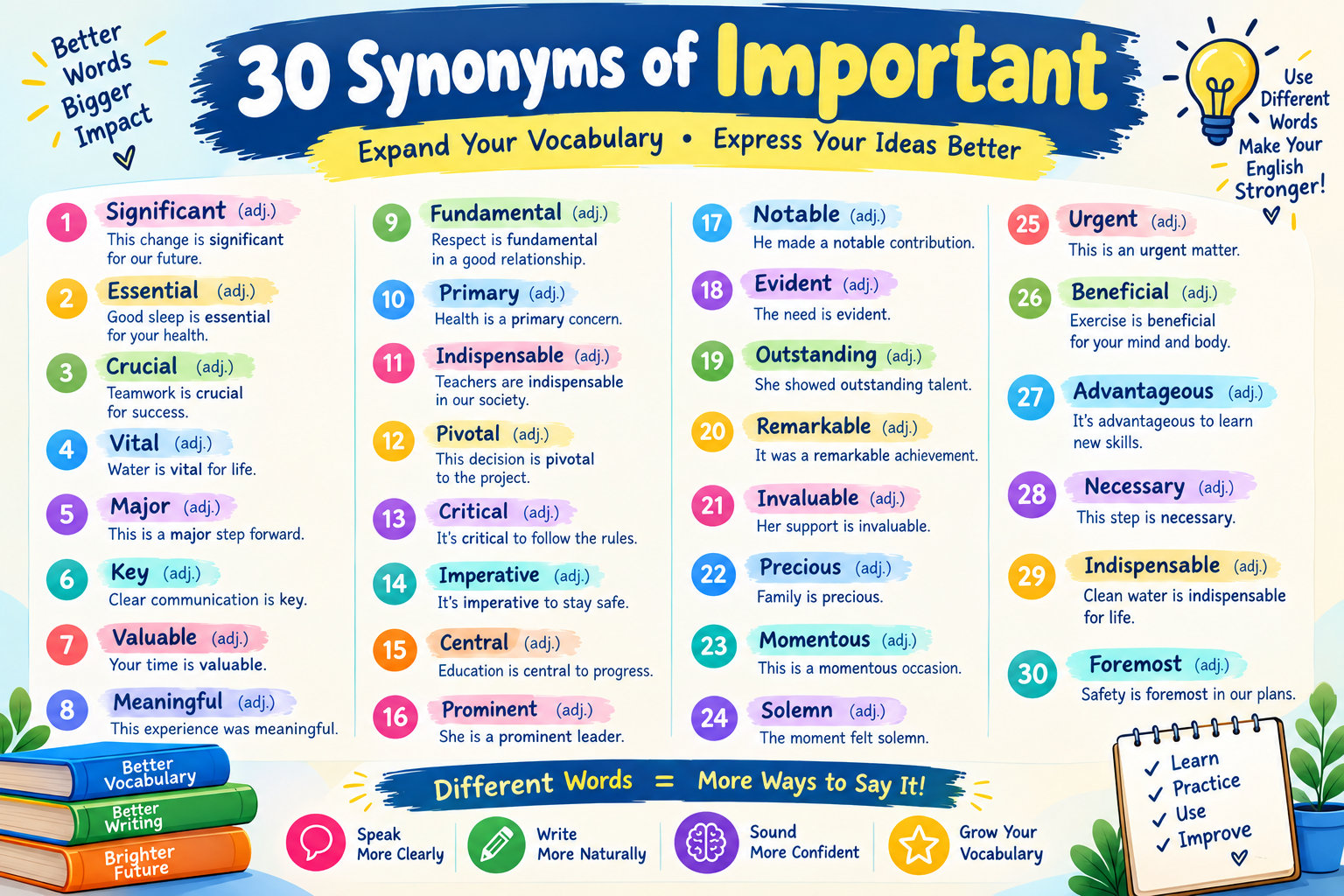
Synonyms of Important
1. Significant (Adjective) — US /sɪɡˈnɪfɪkənt/ | UK /sɪɡˈnɪfɪkənt/
Meaning: Having a clear and important effect or meaning.
Examples:
- The study found a significant change.
- Her work made a significant difference.
2. Essential (Adjective) — US /ɪˈsenʃəl/ | UK /ɪˈsenʃəl/
Meaning: Very necessary and needed.
Examples:
- Water is essential for life.
- Good sleep is essential for health.
3. Crucial (Adjective) — US /ˈkruːʃəl/ | UK /ˈkruːʃəl/
Meaning: Extremely important for success or a result.
Examples:
- Good planning is crucial for the project.
- This is a crucial part of the test.
4. Vital (Adjective) — US /ˈvaɪtəl/ | UK /ˈvaɪtəl/
Meaning: Extremely important or necessary.
Examples:
- Fresh water is vital to life.
- Trust is vital in a friendship.
5. Major (Adjective) — US /ˈmeɪdʒər/ | UK /ˈmeɪdʒə/
Meaning: Very large, serious, or important.
Examples:
- She made a major decision.
- The company faced a major problem.
6. Key (Adjective) — US /kiː/ | UK /kiː/
Meaning: Very important for understanding or success.
Examples:
- Practice is a key part of learning.
- Communication is a key skill at work.
7. Critical (Adjective) — US /ˈkrɪtɪkəl/ | UK /ˈkrɪtɪkəl/
Meaning: Extremely important, especially in a difficult situation.
Examples:
- Quick action was critical.
- Sleep is critical before a long exam.
8. Meaningful (Adjective) — US /ˈmiːnɪŋfəl/ | UK /ˈmiːnɪŋfəl/
Meaning: Having value or a strong meaning.
Examples:
- She gave me a meaningful gift.
- We had a meaningful conversation.
9. Valuable (Adjective) — US /ˈvæljuəbəl/ | UK /ˈvæljuəbəl/
Meaning: Worth a lot or very useful.
Examples:
- Your advice is valuable to me.
- She has valuable experience.
10. Notable (Adjective) — US /ˈnoʊtəbəl/ | UK /ˈnoʊtəbəl/
Meaning: Worth noticing because it is special or important.
Examples:
- The book received notable praise.
- She made a notable contribution.
11. Noteworthy (Adjective) — US /ˈnoʊtˌwɝːði/ | UK /ˈnəʊtˌwɜːði/
Meaning: Important or interesting enough to notice.
Examples:
- The report contains a noteworthy result.
- His progress is noteworthy.
12. Influential (Adjective) — US /ˌɪnfluˈenʃəl/ | UK /ˌɪnfluˈenʃəl/
Meaning: Having the power to affect people or events.
Examples:
- She is an influential writer.
- His ideas were influential in the field.
13. Consequential (Adjective) — US /ˌkɑːnsəˈkwenʃəl/ | UK /ˌkɒnsɪˈkwenʃəl/
Meaning: Having an important effect or result.
Examples:
- It was a consequential decision.
- The change had consequential effects.
14. Substantial (Adjective) — US /səbˈstænʃəl/ | UK /səbˈstænʃəl/
Meaning: Large or important in amount, size, or effect.
Examples:
- The project needs substantial support.
- She made a substantial improvement.
15. Considerable (Adjective) — US /kənˈsɪdərəbəl/ | UK /kənˈsɪdərəbəl/
Meaning: Large or important enough to notice.
Examples:
- The job requires considerable skill.
- He has considerable experience.
16. Central (Adjective) — US /ˈsentrəl/ | UK /ˈsentrəl/
Meaning: Very important to a subject, plan, or situation.
Examples:
- Trust is central to a good friendship.
- This idea is central to the lesson.
17. Primary (Adjective) — US /ˈpraɪmeri/ | UK /ˈpraɪməri/
Meaning: First or most important.
Examples:
- Safety is our primary concern.
- Her primary goal is to learn English.
18. Chief (Adjective) — US /tʃiːf/ | UK /tʃiːf/
Meaning: Most important or main.
Examples:
- Our chief goal is customer safety.
- His chief concern was his family.
19. Leading (Adjective) — US /ˈliːdɪŋ/ | UK /ˈliːdɪŋ/
Meaning: Most important or successful in a group or field.
Examples:
- She is a leading expert in science.
- The company is a leading brand.
20. Prominent (Adjective) — US /ˈprɑːmənənt/ | UK /ˈprɒmɪnənt/
Meaning: Well known, noticeable, or important.
Examples:
- He is a prominent writer.
- The building has a prominent place in the city.
21. Serious (Adjective) — US /ˈsɪriəs/ | UK /ˈsɪəriəs/
Meaning: Important and needing careful attention.
Examples:
- This is a serious problem.
- We need to have a serious talk.
22. Urgent (Adjective) — US /ˈɝːdʒənt/ | UK /ˈɜːdʒənt/
Meaning: Very important and needing quick action.
Examples:
- The doctor said it was urgent.
- We received an urgent message.
23. Pressing (Adjective) — US /ˈpresɪŋ/ | UK /ˈpresɪŋ/
Meaning: Very important and needing attention soon.
Examples:
- We have a pressing problem to solve.
- Money is a pressing concern for the family.
24. Fundamental (Adjective) — US /ˌfʌndəˈmentəl/ | UK /ˌfʌndəˈmentəl/
Meaning: Basic and very important.
Examples:
- Trust is fundamental to friendship.
- Reading is a fundamental skill.
25. Indispensable (Adjective) — US /ˌɪndɪˈspensəbəl/ | UK /ˌɪndɪˈspensəbəl/
Meaning: So important that it cannot be done without.
Examples:
- Water is indispensable for life.
- Her help was indispensable to the team.
26. Necessary (Adjective) — US /ˈnesəseri/ | UK /ˈnesəsəri/
Meaning: Needed for a purpose or result.
Examples:
- A passport is necessary for the trip.
- Good planning is necessary for success.
27. Momentous (Adjective) — US /moʊˈmentəs/ | UK /məʊˈmentəs/
Meaning: Very important because it can change the future.
Examples:
- It was a momentous day for the family.
- They made a momentous decision.
28. Pivotal (Adjective) — US /ˈpɪvətəl/ | UK /ˈpɪvətəl/
Meaning: Very important because it can change what happens next.
Examples:
- She played a pivotal role in the project.
- This was a pivotal moment in his career.
29. Relevant (Adjective) — US /ˈreləvənt/ | UK /ˈreləvənt/
Meaning: Directly connected to the subject or situation.
Examples:
- Please give only relevant information.
- His experience is relevant to the job.
30. Weighty (Adjective) — US /ˈweɪti/ | UK /ˈweɪti/
Meaning: Very important and serious.
Examples:
- She had to make a weighty decision.
- The meeting covered several weighty issues.
Prototype Meaning
The most common meaning of important is something that has great value, meaning, or effect. When people hear this word, they often think about something that needs attention or should not be ignored. For example, an important exam, important meeting, important person, or important decision can have a strong effect on what happens next. The word can describe things, people, ideas, events, and actions.
Prototype Categorization
- Very necessary: essential, vital, indispensable, necessary
- Very important: crucial, critical, momentous, pivotal
- Main or first: primary, chief, central, key
- Large or strong effect: significant, substantial, consequential, considerable
- Well known or respected: prominent, leading, influential, notable
- Needs quick attention: urgent, pressing, serious
- Useful or valuable: valuable, meaningful
- Connected to the topic: relevant
- Basic and important: fundamental
- Worth noticing: noteworthy, notable
- Important because of value or effect: weighty, conseque
Antonyms of Important
- Unimportant — not important
- Insignificant — having little importance
- Minor — less important
- Trivial — not serious or important
- Irrelevant — not connected to the subject
- Meaningless — having little or no meaning
- Unnecessary — not needed
- Negligible — so small that it is not important
- Secondary — less important than something else
- Inconsequential — having little effect or result
Short Questions and Answers
- What does important mean?
Important means having great value, meaning, effect, or influence. - When should important be used?
Use important when you want to show that a person, thing, idea, event, or action has great value or needs attention. - Is important positive or negative?
Important is usually neutral or positive. However, its meaning can change with the situation. In some contexts, it can describe someone who thinks too highly of themselves. - How is important different from similar words?
Similar words have slightly different uses. Essential means very necessary, urgent means needing quick action, significant means having an important effect or meaning, and valuable focuses on worth or usefulness.
Conclusion
synonyms of important can make your English vocabulary stronger and more useful. Words such as significant, essential, crucial, vital, major, key, and valuable help you express different levels and types of importance. Learning synonyms of important can make your speaking and writing clearer and help you avoid repeating important many times. English learners can use these synonyms of important in school, work, daily conversation, and online writing. Content writers can also use them to make articles more natural and engaging. Try to learn two or three new synonyms of important each day. Using synonyms of important in simple sentences can help you remember them better. With regular practice, you can build confidence, improve your English, and express your ideas more clearly.