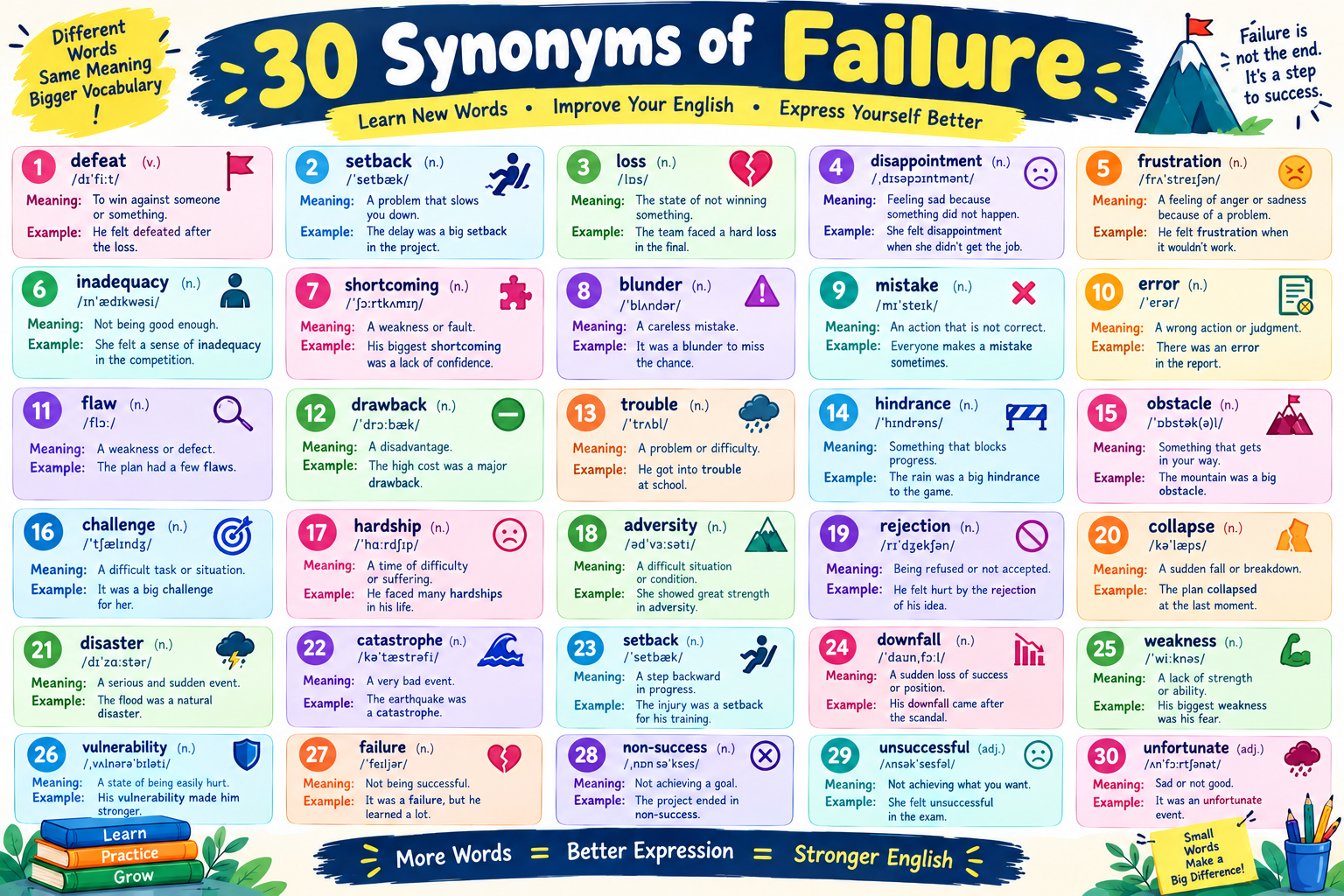
Failure means not getting the result you wanted. For example, a student may study hard but fail a test. A person may also try to start a business, but the business may not work. In both cases, we can use the word failure. This word is common in English because people often talk about mistakes, problems, and goals that were not reached. Learning synonyms for failure helps English learners use more words and express ideas clearly. It also helps content writers avoid using the same word again and again. In this article, you will learn the meaning, examples, grammar, history, pronunciation, and tone of failure. You will also learn 30 useful synonyms with simple examples. The synonyms are grouped into meaning-based categories to help you choose the right word for each situation.
Meaning of Failure
Definition
Failure (Noun): a lack of success or a situation in which something does not work as planned.
Examples
- The project was a failure because it did not reach its goal.
- He learned an important lesson from his failure.
Connotative Meaning
Positive tone:
- Failure can have a positive tone when it helps someone learn and improve.
- It can show that a person tried something new.
Negative tone:
- Failure often has a negative tone because it can mean loss, defeat, or disappointment.
- It may make a person feel sad or discouraged.
Neutral tone:
- Failure can be neutral when it simply describes a result that did not work.
Etymology
- Source language: The word failure comes from Old French faillir, meaning “to fail” or “to be lacking.”
- It entered English through Anglo-French and Middle English forms.
- The word is related to the verb fail.
Also read more about https://myprayerss.com/synonyms-of-however/
Short History
Old English (450–1100):
The modern word failure was not used in Old English. English had other words for not succeeding, lacking, or making mistakes.
Middle English (1100–1500):
The word family connected with fail entered English from French. It began to describe a lack of success or a lack of something needed.
Modern English (1500–Present):
Failure became a common noun for an unsuccessful action, event, plan, or person. Today, it is often used for mistakes, failed plans, and goals that were not reached.
Pronunciation (US & UK – IPA)
US: /ˈfeɪljər/
UK: /ˈfeɪljə/
Syllables
fail-ure
Affixation Pattern of Failure
- Root: fail
- Prefix: none
- Suffix: -ure
- Word formation: Failure is formed from the verb fail with the suffix -ure.
Common words in the same word family include:
- fail — verb
- failed — adjective/verb form
- failing — adjective/verb form
- failure — noun
- failures — plural noun
Synonyms of Failure
1. Defeat (Noun) — /dɪˈfiːt/ | /dɪˈfiːt/
Meaning: A defeat is a loss in a contest, fight, or effort.
Examples:
- The team accepted its defeat.
- The election ended in defeat for the candidate.
2. Loss (Noun) — /lɔːs/ | /lɒs/
Meaning: A loss is a situation in which you do not win or do not keep something.
Examples:
- The team suffered a big loss.
- The loss made the players feel sad.
3. Flop (Noun) — /flɑːp/ | /flɒp/
Meaning: A flop is something that fails badly.
Examples:
- The new product was a flop.
- The movie became a box-office flop.
4. Fiasco (Noun) — /fiˈæskoʊ/ | /fiˈæskəʊ/
Meaning: A fiasco is a complete and embarrassing failure.
Examples:
- The event was a complete fiasco.
- Poor planning turned the trip into a fiasco.
5. Mistake (Noun) — /mɪˈsteɪk/ | /mɪˈsteɪk/
Meaning: A mistake is something done wrongly.
Examples:
- I made a mistake in my work.
- The mistake caused the plan to fail.
6. Error (Noun) — /ˈerər/ | /ˈerə/
Meaning: An error is a wrong action, answer, or decision.
Examples:
- There was an error in the report.
- One small error caused a problem.
7. Fault (Noun) — /fɔːlt/ | /fɔːlt/
Meaning: A fault is a mistake or problem that causes something to go wrong.
Examples:
- The computer stopped because of a fault.
- The manager admitted his fault.
8. Blunder (Noun) — /ˈblʌndər/ | /ˈblʌndə/
Meaning: A blunder is a serious or careless mistake.
Examples:
- The player made a major blunder.
- His blunder cost the team the game.
9. Misstep (Noun) — /ˈmɪsstep/ | /ˈmɪsstep/
Meaning: A misstep is a mistake or wrong decision.
Examples:
- The company made a serious misstep.
- One misstep damaged the project.
10. Setback (Noun) — /ˈsetbæk/ | /ˈsetbæk/
Meaning: A setback is a problem that slows progress.
Examples:
- The illness was a setback for her training.
- The team faced a major setback.
11. Disappointment (Noun) — /ˌdɪsəˈpɔɪntmənt/ | /ˌdɪsəˈpɔɪntmənt/
Meaning: Disappointment is the feeling caused when something does not happen as hoped.
Examples:
- The result was a big disappointment.
- He felt disappointment after losing the match.
12. Deficiency (Noun) — /dɪˈfɪʃənsi/ | /dɪˈfɪʃənsi/
Meaning: A deficiency is a lack of something needed.
Examples:
- The plan has a serious deficiency.
- A lack of training caused the deficiency.
13. Breakdown (Noun) — /ˈbreɪkdaʊn/ | /ˈbreɪkdaʊn/
Meaning: A breakdown is a failure of a machine, system, or process.
Examples:
- The car stopped because of a breakdown.
- A system breakdown delayed the work.
14. Collapse (Noun) — /kəˈlæps/ | /kəˈlæps/
Meaning: A collapse is a sudden failure of a system, plan, or organization.
Examples:
- The company faced financial collapse.
- The plan ended in collapse.
15. Rejection (Noun) — /rɪˈdʒekʃən/ | /rɪˈdʒekʃən/
Meaning: Rejection is the act of refusing or not accepting something.
Examples:
- She received a rejection letter.
- The rejection made him try harder.
16. Nonachievement (Noun) — /ˌnɑːnəˈtʃiːvmənt/ | /ˌnɒnəˈtʃiːvmənt/
Meaning: Nonachievement means not reaching a goal or result.
Examples:
- The project ended in nonachievement of its main goal.
- Nonachievement can teach us what to improve.
17. Futility (Noun) — /fjuːˈtɪləti/ | /fjuːˈtɪləti/
Meaning: Futility means that an effort cannot produce a useful result.
Examples:
- He saw the futility of arguing.
- The team understood the futility of the plan.
18. Inadequacy (Noun) — /ɪnˈædəkwəsi/ | /ɪnˈædəkwəsi/
Meaning: Inadequacy means not being good or strong enough.
Examples:
- The test showed the inadequacy of the old system.
- The team faced problems because of the system’s inadequacy.
19. Shortcoming (Noun) — /ˈʃɔːrtkʌmɪŋ/ | /ˈʃɔːtkʌmɪŋ/
Meaning: A shortcoming is a weakness or fault.
Examples:
- The report has several shortcomings.
- He worked hard to fix his shortcomings.
20. Weakness (Noun) — /ˈwiːknəs/ | /ˈwiːknəs/
Meaning: A weakness is a fault or lack of strength.
Examples:
- Poor planning was the project’s weakness.
- The coach helped him improve his weakness.
21. Defeatism (Noun) — /dɪˈfiːtɪzəm/ | /dɪˈfiːtɪzəm/
Meaning: Defeatism is the belief that you will fail before you try.
Examples:
- His defeatism stopped him from trying.
- The coach told the team to avoid defeatism.
22. Frustration (Noun) — /frʌˈstreɪʃən/ | /frʌˈstreɪʃən/
Meaning: Frustration is the feeling you get when you cannot reach a goal.
Examples:
- The failed plan caused frustration.
- She felt frustration after many failed attempts.
23. Disappointment (Noun) — /ˌdɪsəˈpɔɪntmənt/ | /ˌdɪsəˈpɔɪntmənt/
Meaning: Disappointment is sadness caused by an unwanted result.
Examples:
- Losing the final was a disappointment.
- He hid his disappointment after the result.
24. Defeat (Verb) — /dɪˈfiːt/ | /dɪˈfiːt/
Meaning: To defeat someone means to cause them to lose.
Examples:
- The stronger team defeated its rival.
- Our team was defeated in the final.
25. Fail (Verb) — /feɪl/ | /feɪl/
Meaning: To fail means to not succeed.
Examples:
- I failed the test.
- The plan failed because of poor timing.
26. Misfire (Verb) — /ˌmɪsˈfaɪər/ | /ˌmɪsˈfaɪə/
Meaning: To misfire means to fail to produce the expected result.
Examples:
- The plan misfired badly.
- His joke misfired and made the room quiet.
27. Falter (Verb) — /ˈfɔːltər/ | /ˈfɔːltə/
Meaning: To falter means to become weak or less successful.
Examples:
- The team’s progress began to falter.
- Her confidence started to falter.
28. Go Wrong (Verb Phrase) — /ɡoʊ rɔːŋ/ | /ɡəʊ rɒŋ/
Meaning: To go wrong means to fail or develop in a bad way.
Examples:
- Something went wrong with the plan.
- The trip went wrong because of the weather.
29. Underperformance (Noun) — /ˌʌndərpərˈfɔːrməns/ | /ˌʌndəpəˈfɔːməns/
Meaning: Underperformance means performing below the expected level.
Examples:
- The manager was worried about the team’s underperformance.
- Poor training led to underperformance.
30. Deflation (Noun) — /dɪˈfleɪʃən/ | /dɪˈfleɪʃən/
Meaning: Deflation can describe a loss of confidence, energy, or hope after failure.
Examples:
- The loss caused a feeling of deflation.
- There was clear deflation after the team lost.
Prototype Meaning
The most typical meaning of failure is a lack of success. When people hear the word, they often imagine someone trying to reach a goal but not getting the expected result. It may be failing a test, losing a game, making a bad plan, or not finishing a project. Failure does not always mean that a person is bad. It can also be a chance to learn, improve, and try again.
Prototype Categorization
- General failure: failure, defeat, loss, flop, fiasco describe situations where success was not reached.
- Mistakes: mistake, error, fault, blunder, misstep describe actions or decisions that are wrong.
- Problems that slow progress: setback, breakdown, shortcoming, weakness describe problems that make success harder.
- Strong or complete failure: fiasco, collapse, defeat describe serious or major failure.
- Lack of success: nonachievement, inadequacy, underperformance describe results below the expected level.
- Emotional effects: disappointment, frustration, deflation describe feelings caused by failure.
- Giving up or expecting failure: defeatism, futility describe a lack of hope or belief in success.
- Failure as an action: fail, defeat, misfire, falter, go wrong describe how something fails.
Antonyms of Failure
- Success
- Achievement
- Victory
- Triumph
- Accomplishment
- Progress
- Gain
- Improvement
- Completion
- Breakthrough
Short Questions and Answers
- What does failure mean?
Failure means not reaching a goal or not getting the result you wanted. - When should failure be used?
Use failure when talking about a lack of success in an action, plan, project, test, or goal. - Is failure positive or negative?
Failure is usually negative, but it can have a positive meaning when it helps someone learn and improve. - How is it different from similar words?
Failure is a general word. Mistake means something was done wrongly. Defeat usually means losing. Setback means a problem that slows progress. Fiasco means a very bad or embarrassing failure.
Conclusion
Synonyms of failure can make your English stronger. These words help you talk about mistakes, losses, problems, and goals in a clear way. They also help you choose the right word for each situation. Using defeat, setback, mistake, error, disappointment, and fiasco can make your writing more interesting and reduce repetition. Learning synonyms of failure is also useful in daily speaking, school work, business writing, and online content. Remember that not every synonyms of failure has exactly the same meaning, so always check the situation before choosing a word. Regular practice with synonyms of failure can help you remember these words. Try to learn a few synonyms of failure each day, use them in your own sentences, and slowly build your English confidence.