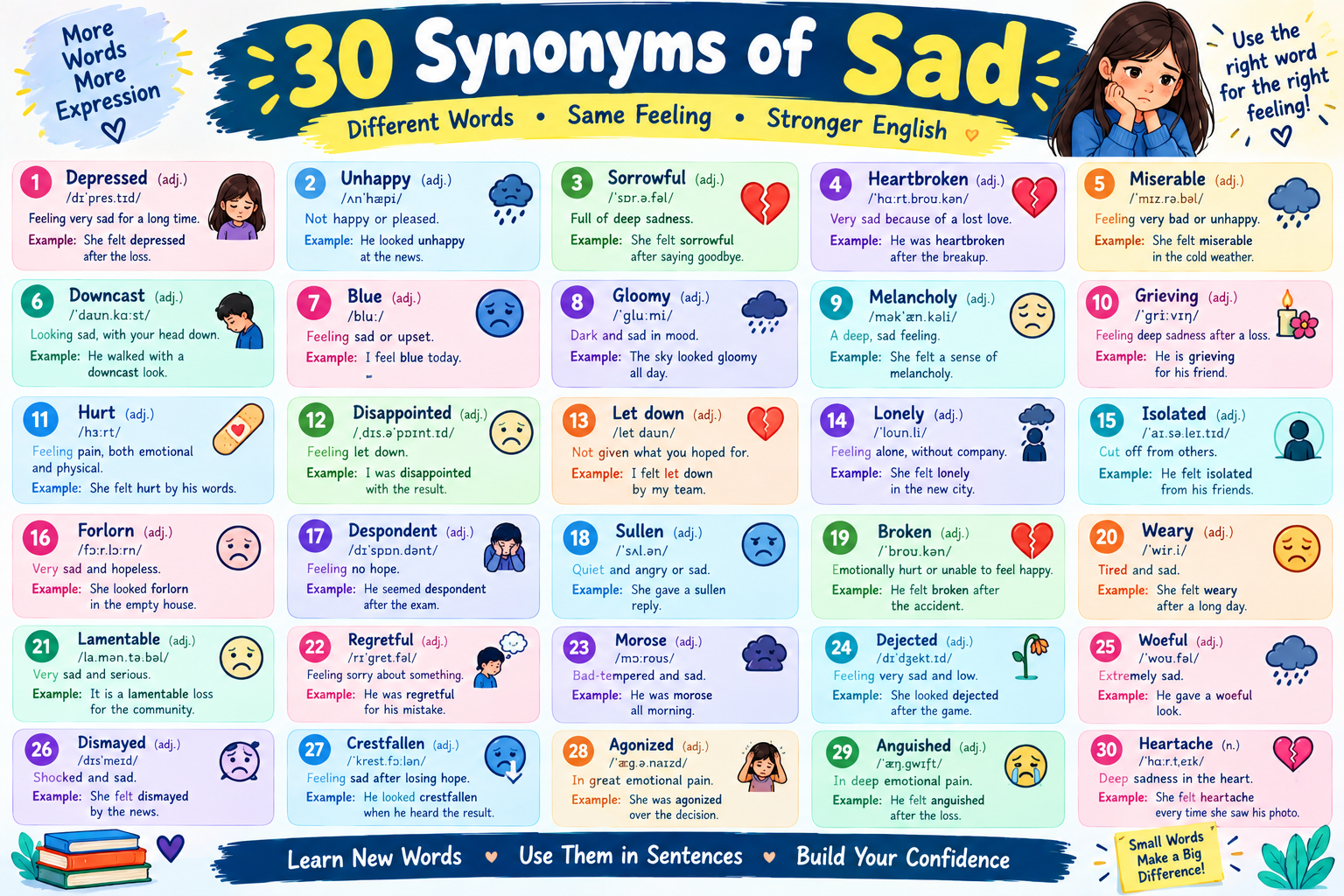
Synonyms of sad means feeling sorrow or unhappiness. Picture this: your best friend moves away to another city. You wave goodbye at the airport, and your chest feels heavy. Tears fill your eyes. You feel sad. This is one of the most natural feelings people share, and almost everyone has felt it at some point in life.
Because sadness is such a common human feeling, the word “sad” appears often in stories, conversations, and articles. Using it too many times in one piece of writing can make the text feel flat. This is why English learners and content writers need synonyms. New words let you show different shades of sadness, from a light disappointment to deep grief. They also help your writing stay fresh instead of repeating “sad” again and again.
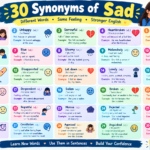
This article covers the meaning of “sad,” its emotional tone, its history, its pronunciation, and its word parts. Then it gives you 30 strong synonyms with clear meanings and example sentences.
Meaning of Sad
Definition
Sad (Adjective): Feeling or showing sorrow, unhappiness, or grief.
Examples
- She felt sad when her pet ran away.
- The sad ending of the movie made everyone quiet.
Connotative Meaning
- Positive tone: rare, but sometimes used to show deep feeling or empathy (“a sad but beautiful song”)
- Negative tone: most common use, showing pain, loss, or low mood (“a sad, lonely night”)
- Neutral tone: simply naming an emotional state without strong judgment (“She looked sad after the meeting”.
Also read more about https://myprayerss.com/synonyms-of-rich/
Etymology
- “Sad” comes from the Old English word sæd, which first meant “full” or “satisfied.”
- This root traces back to the Proto-Germanic word sadaz, related to the Latin word satis, meaning “enough.”
- Over time, “full” shifted to mean “weary” or “worn out,” and later settled into the modern sense of “sorrowful.”
Short History
- Old English (450–1100): “Sæd” meant “full” or “satisfied,” with no link yet to sorrow.
- Middle English (1100–1500): The meaning shifted toward “serious” or “steady,” and slowly began to include feelings of sorrow.
- Modern English (1500–Present): “Sad” settled into its current meaning: feeling unhappy or full of grief.
Pronunciation (US & UK – IPA)
- US: /sæd/
- UK: /sæd/
Syllables
sad (one syllable)
Affixation Pattern of Sad
- Root: sad
- Prefix: none common
- Suffix: -ly, -ness, -den
Word formation
From the root “sad,” English builds several words: sadness (noun), sadly (adverb), sadden (verb), and sadder / saddest (comparative and superlative forms). This shows how one small root grows into many useful words.
Synonyms of Sad
1. Unhappy (Adjective) — US /ʌnˈhæpi/ | UK /ʌnˈhæpi/
Meaning: Not happy; feeling low or upset.
Examples:
- He looked unhappy after the argument.
- She felt unhappy about the delay.
2. Sorrowful (Adjective) — US /ˈsɑroʊfəl/ | UK /ˈsɒrəʊfʊl/
Meaning: Full of sorrow or deep sadness.
Examples:
- The sorrowful music matched the mood.
- Her sorrowful eyes told the whole story.
3. Miserable (Adjective) — US /ˈmɪzərəbəl/ | UK /ˈmɪzərəbl/
Meaning: Very unhappy and uncomfortable.
Examples:
- He felt miserable with the flu.
- The rainy trip left them miserable.
4. Gloomy (Adjective) — US /ˈɡlumi/ | UK /ˈɡluːmi/
Meaning: Dark in mood; sad and without hope.
Examples:
- The gloomy news spread through the office.
- She had a gloomy look on her face.
5. Downcast (Adjective) — US /ˈdaʊnkæst/ | UK /ˈdaʊnkɑːst/
Meaning: Sad and low in spirit, often shown by looking down.
Examples:
- His downcast eyes showed his disappointment.
- She walked away looking downcast.
6. Dejected (Adjective) — US /dɪˈdʒɛktɪd/ | UK /dɪˈdʒɛktɪd/
Meaning: Sad and discouraged after a setback.
Examples:
- The team looked dejected after the loss.
- He felt dejected when his plan failed.
7. Depressed (Adjective) — US /dɪˈprɛst/ | UK /dɪˈprɛst/
Meaning: Feeling very low and without energy or hope.
Examples:
- She felt depressed after the move.
- The gray weather made him feel depressed.
8. Heartbroken (Adjective) — US /ˈhɑrtˌbroʊkən/ | UK /ˈhɑːtˌbrəʊkən/
Meaning: Deeply sad because of loss or disappointment.
Examples:
- She was heartbroken when her dog passed away.
- He felt heartbroken after the breakup.
9. Melancholy (Adjective) — US /ˈmɛlənˌkɑli/ | UK /ˈmɛlənkəli/
Meaning: Quietly sad, often for no clear reason.
Examples:
- A melancholy tune played on the radio.
- He felt a melancholy mood in autumn.
10. Blue (Adjective) — US /blu/ | UK /bluː/
Meaning: A casual word for feeling sad or low.
Examples:
- I’ve been feeling a bit blue lately.
- She looked blue after the news.
11. Mournful (Adjective) — US /ˈmɔrnfəl/ | UK /ˈmɔːnfʊl/
Meaning: Full of sadness, especially over a loss.
Examples:
- The mournful bell rang across the town.
- He gave a mournful look at the empty chair.
12. Woeful (Adjective) — US /ˈwoʊfəl/ | UK /ˈwəʊfʊl/
Meaning: Full of sorrow or misfortune.
Examples:
- She told a woeful tale of her trip.
- His woeful expression said it all.
13. Despondent (Adjective) — US /dɪˈspɑndənt/ | UK /dɪˈspɒndənt/
Meaning: Sad and without hope after a disappointment.
Examples:
- He grew despondent after failing the test.
- The despondent crowd left the stadium quietly.
14. Downhearted (Adjective) — US /ˌdaʊnˈhɑrtɪd/ | UK /ˌdaʊnˈhɑːtɪd/
Meaning: Sad and low in spirit.
Examples:
- Don’t feel downhearted about the setback.
- She seemed downhearted after the review.
15. Glum (Adjective) — US /ɡlʌm/ | UK /ɡlʌm/
Meaning: Sad and silent, showing a low mood.
Examples:
- He sat glum in the corner.
- Her glum face worried her friends.
16. Forlorn (Adjective) — US /fərˈlɔrn/ | UK /fəˈlɔːn/
Meaning: Sad and lonely, often looking abandoned.
Examples:
- The forlorn puppy waited by the door.
- She had a forlorn look after they left.
17. Wretched (Adjective) — US /ˈrɛtʃɪd/ | UK /ˈrɛtʃɪd/
Meaning: Extremely unhappy or unfortunate.
Examples:
- He felt wretched after losing his job.
- The wretched weather ruined their plans.
18. Crestfallen (Adjective) — US /ˈkrɛstˌfɔlən/ | UK /ˈkrɛstˌfɔːlən/
Meaning: Sad and disappointed after a failure.
Examples:
- She looked crestfallen when she saw her grade.
- He was crestfallen after missing the goal.
19. Dismal (Adjective) — US /ˈdɪzməl/ | UK /ˈdɪzməl/
Meaning: Sad and gloomy, lacking any brightness.
Examples:
- The dismal weather kept us indoors.
- He gave a dismal account of the trip.
20. Distressed (Adjective) — US /dɪˈstrɛst/ | UK /dɪˈstrɛst/
Meaning: Sad and troubled by worry or pain.
Examples:
- She sounded distressed on the phone.
- The distressed child looked for his mother.
21. Heavy-hearted (Adjective) — US /ˈhɛvi ˈhɑrtɪd/ | UK /ˈhɛvi ˈhɑːtɪd/
Meaning: Sad and weighed down by sorrow.
Examples:
- He felt heavy-hearted saying goodbye.
- She left the hospital heavy-hearted.
22. Tearful (Adjective) — US /ˈtɪrfəl/ | UK /ˈtɪəfʊl/
Meaning: Close to crying or full of tears.
Examples:
- She gave a tearful speech at the wedding.
- He was tearful after the sad film.
23. Grief-stricken (Adjective) — US /ˈɡrif ˌstrɪkən/ | UK /ˈɡriːf ˌstrɪkən/
Meaning: Overcome with deep sadness, often after a death.
Examples:
- The grief-stricken family held each other close.
- She remained grief-stricken for weeks.
24. Somber (Adjective) — US /ˈsɑmbər/ | UK /ˈsɒmbə/
Meaning: Serious and sad in mood.
Examples:
- The room fell into a somber silence.
- He wore a somber expression at the meeting.
25. Regretful (Adjective) — US /rɪˈɡrɛtfəl/ | UK /rɪˈɡrɛtfʊl/
Meaning: Sad because of something you wish you had done differently.
Examples:
- She felt regretful about the missed chance.
- His regretful tone showed he was sorry.
26. Disheartened (Adjective) — US /dɪsˈhɑrtənd/ | UK /dɪsˈhɑːtənd/
Meaning: Sad and losing hope or courage.
Examples:
- He felt disheartened after the rejection.
- The team was disheartened by the score.
27. Low-spirited (Adjective) — US /ˈloʊ ˈspɪrɪtɪd/ | UK /ˈləʊ ˈspɪrɪtɪd/
Meaning: Sad and lacking energy or cheer.
Examples:
- She felt low-spirited after the long week.
- He seemed low-spirited all morning.
28. Despairing (Adjective) — US /dɪˈspɛrɪŋ/ | UK /dɪˈspeərɪŋ/
Meaning: Sad and without hope.
Examples:
- He gave a despairing sigh.
- Her despairing letter worried her parents.
29. Sullen (Adjective) — US /ˈsʌlən/ | UK /ˈsʌlən/
Meaning: Sad and quiet, often with a hint of anger.
Examples:
- The teenager gave a sullen shrug.
- He sat sullen in the back seat.
30. Doleful (Adjective) — US /ˈdoʊlfəl/ | UK /ˈdəʊlfʊl/
Meaning: Sad and mournful, often shown on the face.
Examples:
- The dog gave a doleful look at the door.
- She wore a doleful expression all day.
Prototype Meaning
When most people hear the word “sad,” they picture a person with a lowered head, quiet voice, and perhaps tears in their eyes. It brings to mind loss, disappointment, or a heavy feeling in the chest. This simple picture is the core meaning of the word. Other uses, like “a sad state of affairs,” grow out of this same basic idea of sorrow or low spirit.
Prototype Categorization
- Mild sadness: unhappy, blue, downcast, downhearted, glum, low-spirited, disheartened
- Deep sadness: miserable, depressed, despondent, wretched, despairing, grief-stricken, heartbroken
- Sadness linked to loss or grief: sorrowful, mournful, woeful, doleful, tearful
- Sad mood or atmosphere: gloomy, melancholy, somber, dismal, forlorn, sullen, crestfallen, distressed, regretful, heavy-hearted
Antonyms of Sad
happy, joyful, cheerful, glad, content, delighted
Short Questions and Answers
- What does “sad” mean?
It means feeling or showing sorrow, unhappiness, or grief. - When should “sad” be used?
Use it to describe a low mood, a feeling of loss, or a disappointing event. - Is “sad” positive or negative?
It is almost always negative, since it points to sorrow or pain. It can carry a gentle, caring tone in some contexts, like describing a touching story. - How is it different from similar words?
“Gloomy” often describes mood or atmosphere, while “heartbroken” points to deep, personal pain from loss. “Blue” is a light, casual word for low mood, and “sad” is the general word that covers all of these smaller shades of sorrow.
Conclusion
Synonyms of sad can make your English vocabulary stronger and more useful. Words like unhappy, sorrowful, gloomy, heartbroken, lonely, and disappointed help you describe different kinds of sadness. These words can make your speaking and writing clearer and more interesting. Learning synonyms of sad also helps you avoid using the same word again and again. For English learners, knowing these synonyms of sad can make it easier to talk about feelings and write better sentences. Try to learn two or three new words each day. Use synonyms of sad in simple sentences and practice them in daily conversations. With regular practice, you can remember new words, improve your writing and speaking, and feel more confident when using English.