Poor means having little money, being of low quality, or not being good at something. Imagine a student who has very little money for school supplies. We may say that the student comes from a poor family. We can also say that a movie was poor if it was not very good. The word poor is common in daily English because it can describe money, quality, results, health, skills, and living conditions. Learning synonyms of poor helps English learners use more exact words. It also helps content writers avoid using the same word many times. In this article, we will learn the meaning of poor, its synonyms, examples, grammar, tone, history, pronunciation, and word forms. We will also group the synonyms into simple meaning categories and learn useful antonyms of poor.
Meaning of Poor
Definition
Poor (Adjective):
Having little money, low quality, weak ability, or a bad result.
Poor (Noun):
People who have very little money.
Examples
- The family was poor, but they worked hard.
- The student received a poor grade on the test.
Connotative Meaning
- Positive tone: The word poor can sometimes show sympathy, kindness, or concern, especially when talking about someone facing trouble.
- Negative tone: It can suggest low quality, weakness, failure, or lack of money.
- Neutral tone: It can simply describe something that has a low level or lacks something.
Etymology
- Source: The word poor comes from Old French povre and Latin pauper.
- Latin meaning: Pauper meant “having little” or “not wealthy.”
- The word entered English through French and changed in spelling and pronunciation over time.
Also read more abouthttps://myprayerss.com/synonyms-of-love-2/
Short history
Old English (450–1100)
The modern word poor was not used in its current form in Old English. English speakers used other words to describe people who had little money or few possessions.
Middle English (1100–1500)
The word came into English through Old French. Forms such as povre and poure were used to describe people who had little wealth.
Modern English (1500–Present)
The spelling poor became common in Modern English. Today, it has several meanings. It can describe a lack of money, low quality, weak performance, or a difficult condition.
Pronunciation (US & UK – IPA)
US: /pʊr/
UK: /pʊə/
Syllables
poor
Affixation Pattern of Poor
- Root: poor
- Prefix: None
- Suffix: None
- Word formation: Poor is a basic adjective. Common related forms include poorly (adverb), poverty (noun), poorness (noun), impoverish (verb), and impoverished (adjective).
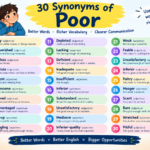
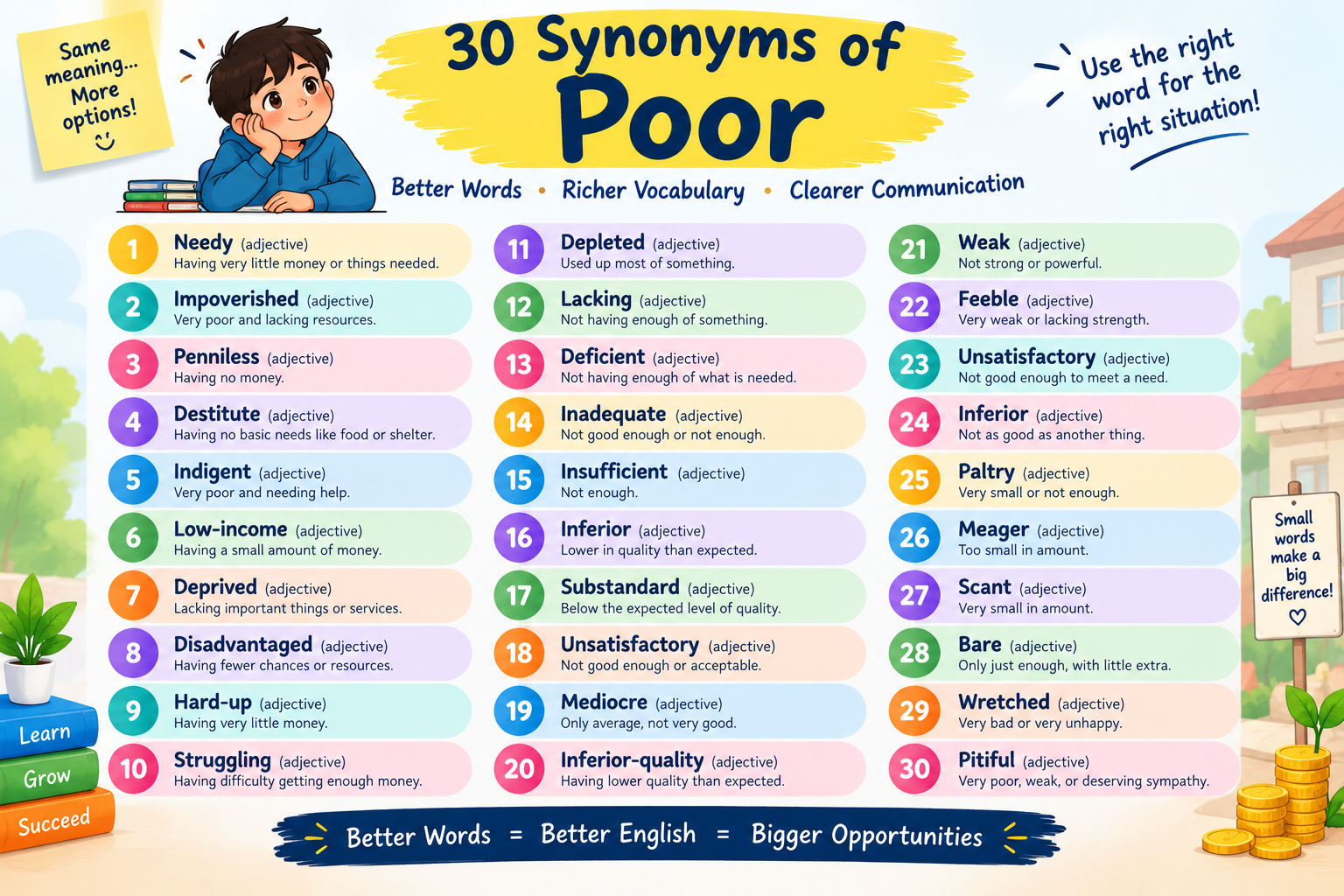
Synonyms of Poor
1. Needy (Adjective) — US /ˈniː.di/ | UK /ˈniː.di/
Meaning: Having very little money or the things needed for life.
Examples:
- The charity helps needy families.
- They gave food to needy children.
2. Impoverished (Adjective) — US /ɪmˈpɑː.vər.ɪʃt/ | UK /ɪmˈpɒv.ər.ɪʃt/
Meaning: Very poor and lacking money or resources.
Examples:
- The program helps impoverished communities.
- Many impoverished families need support.
3. Penniless (Adjective) — US /ˈpen.i.ləs/ | UK /ˈpen.i.ləs/
Meaning: Having no money.
Examples:
- He arrived in the city penniless.
- After the trip, I was almost penniless.
4. Destitute (Adjective) — US /ˈdes.tə.tuːt/ | UK /ˈdes.tɪ.tjuːt/
Meaning: Having no money, food, or other basic needs.
Examples:
- The shelter helps destitute people.
- The war left many families destitute.
5. Indigent (Adjective) — US /ˈɪn.dɪ.dʒənt/ | UK /ˈɪn.dɪ.dʒənt/
Meaning: Very poor and needing help.
Examples:
- The hospital offers free care to indigent patients.
- The group supports indigent families.
6. Low-income (Adjective) — US /ˌloʊ ˈɪn.kʌm/ | UK /ˌləʊ ˈɪn.kʌm/
Meaning: Having a small amount of money from work or other sources.
Examples:
- The program supports low-income families.
- Low-income students can receive free meals.
7. Deprived (Adjective) — US /dɪˈpraɪvd/ | UK /dɪˈpraɪvd/
Meaning: Lacking basic things such as money, food, or good services.
Examples:
- The project helps deprived areas.
- The school works with children from deprived communities.
8. Disadvantaged (Adjective) — US /ˌdɪs.ədˈvæn.tɪdʒd/ | UK /ˌdɪs.ədˈvɑːn.tɪdʒd/
Meaning: Having fewer chances or resources than others.
Examples:
- The charity helps disadvantaged children.
- The program supports disadvantaged students.
9. Hard-up (Adjective) — US /ˌhɑːrd ˈʌp/ | UK /ˌhɑːd ˈʌp/
Meaning: Having very little money.
Examples:
- Many hard-up families need help.
- He was hard-up after losing his job.
10. Struggling (Adjective) — US /ˈstrʌɡ.lɪŋ/ | UK /ˈstrʌɡ.lɪŋ/
Meaning: Having difficulty getting enough money or resources.
Examples:
- The charity helps struggling families.
- She is a struggling student with limited resources.
11. Depleted (Adjective) — US /dɪˈpliː.tɪd/ | UK /dɪˈpliː.tɪd/
Meaning: Having used up most of something.
Examples:
- The country has depleted resources.
- Our food supplies were depleted.
12. Lacking (Adjective) — US /ˈlæk.ɪŋ/ | UK /ˈlæk.ɪŋ/
Meaning: Not having enough of something.
Examples:
- The report is lacking important facts.
- The room is lacking enough light.
13. Deficient (Adjective) — US /dɪˈfɪʃ.ənt/ | UK /dɪˈfɪʃ.ənt/
Meaning: Not having enough of something that is needed.
Examples:
- The diet is deficient in vitamins.
- The plan is deficient in detail.
14. Inadequate (Adjective) — US /ɪnˈæd.ə.kwət/ | UK /ɪnˈæd.ɪ.kwət/
Meaning: Not good enough or not enough for a need.
Examples:
- The food supply was inadequate.
- His answer was inadequate.
15. Insufficient (Adjective) — US /ˌɪn.səˈfɪʃ.ənt/ | UK /ˌɪn.səˈfɪʃ.ənt/
Meaning: Not enough.
Examples:
- We have insufficient time.
- The evidence was insufficient.
16. Inferior (Adjective) — US /ɪnˈfɪr.i.ɚ/ | UK /ɪnˈfɪə.ri.ə/
Meaning: Lower in quality than something else.
Examples:
- This material is inferior to the original.
- The product was made from inferior materials.
17. Substandard (Adjective) — US /ˌsʌbˈstæn.dɚd/ | UK /ˌsʌbˈstæn.dəd/
Meaning: Below the expected level of quality.
Examples:
- The building had substandard materials.
- The customer complained about substandard service.
18. Unsatisfactory (Adjective) — US /ˌʌn.sæt.ɪsˈfæk.tər.i/ | UK /ˌʌn.sæt.ɪsˈfæk.tər.i/
Meaning: Not good enough or not acceptable.
Examples:
- His work was unsatisfactory.
- The test result was unsatisfactory.
19. Mediocre (Adjective) — US /ˌmiː.diˈoʊ.kɚ/ | UK /ˌmiː.diˈəʊ.kə/
Meaning: Only average and not very good.
Examples:
- The movie was mediocre.
- The restaurant served mediocre food.
20. Inferior-quality (Adjective) — US /ɪnˌfɪr.i.ɚ ˈkwɑː.lə.ti/ | UK /ɪnˌfɪə.ri.ə ˈkwɒl.ə.ti/
Meaning: Having lower quality than expected.
Examples:
- The store sold inferior-quality products.
- The machine used inferior-quality parts.
21. Weak (Adjective) — US /wiːk/ | UK /wiːk/
Meaning: Not strong, effective, or powerful.
Examples:
- The team gave a weak performance.
- His argument was weak.
22. Feeble (Adjective) — US /ˈfiː.bəl/ | UK /ˈfiː.bəl/
Meaning: Very weak or lacking strength.
Examples:
- He gave a feeble excuse.
- The plant had feeble growth.
23. Unsatisfactory (Adjective) — US /ˌʌn.sæt.ɪsˈfæk.tər.i/ | UK /ˌʌn.sæt.ɪsˈfæk.tər.i/
Meaning: Not good enough to meet a need or standard.
Examples:
- The service was unsatisfactory.
- The final result was unsatisfactory.
24. Inferior (Adjective) — US /ɪnˈfɪr.i.ɚ/ | UK /ɪnˈfɪə.ri.ə/
Meaning: Not as good as another person or thing.
Examples:
- The second product was inferior.
- They rejected the inferior material.
25. Paltry (Adjective) — US /ˈpɔːl.tri/ | UK /ˈpɔːl.tri/
Meaning: Very small or not enough.
Examples:
- He earned a paltry amount of money.
- They offered a paltry reward.
26. Meager (Adjective) — US /ˈmiː.ɡɚ/ | UK /ˈmiː.ɡə/
Meaning: Too small in amount.
Examples:
- The family lived on a meager income.
- We had a meager supply of food.
27. Scant (Adjective) — US /skænt/ | UK /skænt/
Meaning: Very small in amount.
Examples:
- There was scant evidence.
- They had scant resources.
28. Bare (Adjective) — US /ber/ | UK /beə/
Meaning: Only just enough and with little extra.
Examples:
- They had the bare necessities.
- He survived on the bare minimum.
29. Wretched (Adjective) — US /ˈretʃ.ɪd/ | UK /ˈretʃ.ɪd/
Meaning: Very bad or very unhappy.
Examples:
- They lived in wretched conditions.
- The weather was wretched all day.
30. Pitiful (Adjective) — US /ˈpɪt̬.ə.fəl/ | UK /ˈpɪt.ɪ.fəl/
Meaning: Very poor, weak, or deserving sympathy.
Examples:
- The animal looked pitiful.
- He received a pitiful amount of money.
Prototype Meaning
The most common meaning of poor is having very little money or resources. When people hear the word, they may imagine a person or family who cannot easily afford basic needs such as food, clothes, or a home. However, poor can also mean low quality or weak performance. For example, a student may get a poor grade, or a product may be of poor quality.
Prototype Categor
- Lack of money: needy, impoverished, penniless, destitute, indigent, low-income, hard-up
- Lack of resources: deprived, disadvantaged, depleted, lacking, deficient, insufficient
- Low quality: inferior, substandard, unsatisfactory, mediocre, inferior-quality
- Weak ability or performance: weak, feeble, inadequate
- Small amount: paltry, meager, scant, bare
- Very bad or sad condition: wretched, pitiful
Antonyms of Poor
- Rich
- Wealthy
- Affluent
- Prosperous
- Well-off
- Successful
- Excellent
- Good
- Strong
- High-quality
- Sufficient
- Abundant
Short Questions and Answers
- What does poor mean?
Poor can mean having little money, having low quality, or having a weak result or ability. - When should poor be used?
Use poor when talking about a lack of money, low quality, weak performance, or an unsatisfactory condition. - Is poor positive or negative?
Poor usually has a negative meaning, but it can show sympathy when talking about someone in a difficult situation. - How is poor different from similar words?
Poor is a general word. Penniless means having no money, mediocre means only average in quality, and inferior means lower in quality than something else.
Conclusion
Synonyms of poor can make your English vocabulary stronger. The word poor has several meanings, so it is useful to learn words that show each meaning clearly.Words such as needy, penniless, and destitute describe a lack of money. Words such as inferior, substandard, and mediocre describe low quality. Words such as weak, meager, and scant can describe weakness or a small amount. These synonyms help you choose the right word for each situation and make your English clearer and more natural. These synonyms help you avoid repeating the same word in speaking and writing. They also help you choose words that fit each situation. English learners and content writers can use these words in school, work, articles, and daily conversations. Practice a few synonyms each day. Write simple sentences with them and use them when speaking. Regular practice will build vocabulary, confidence, and better English speaking.