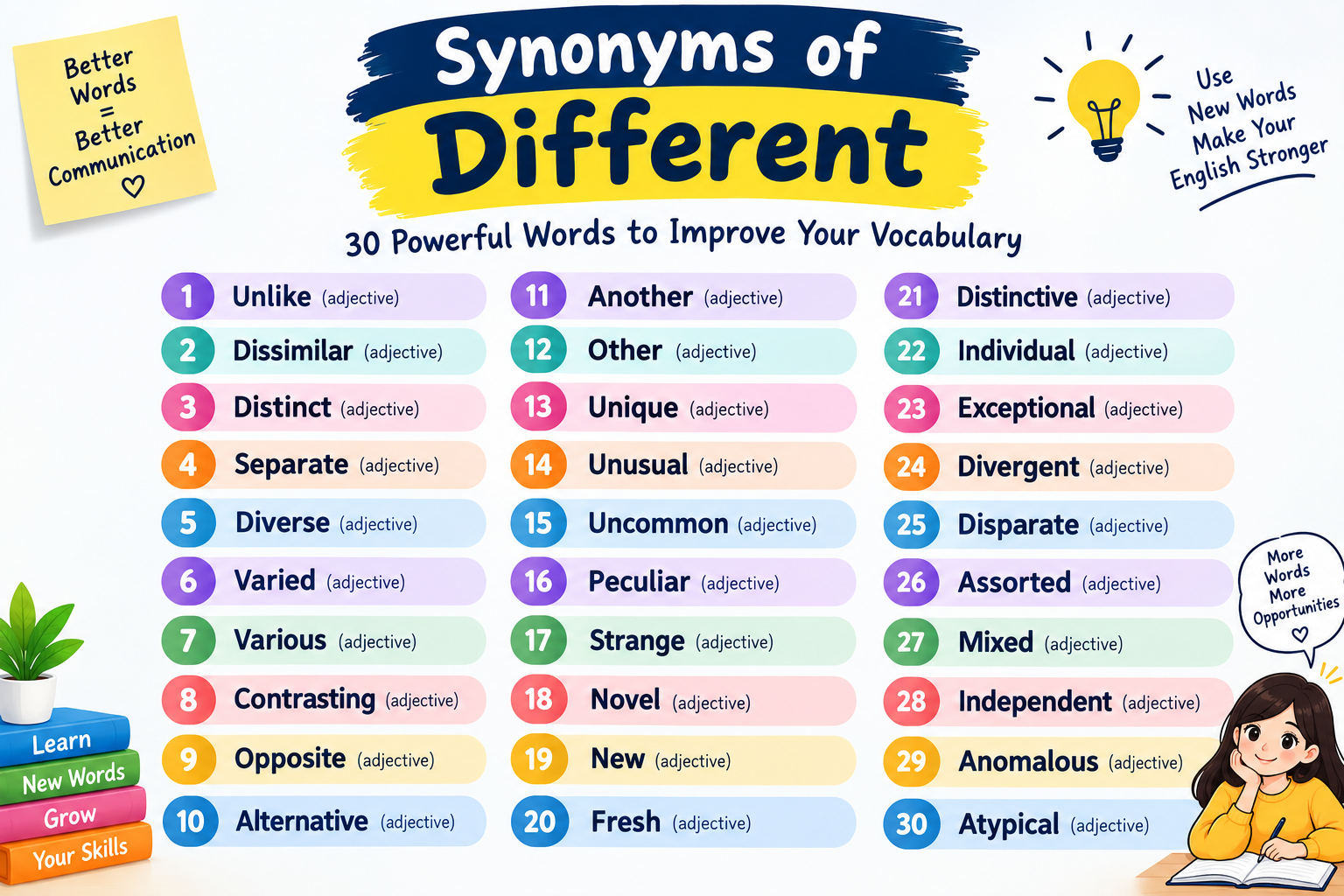
Synonyms of different means not the same as another person or thing. Imagine two students in a class. One student likes football, while the other likes painting. Their interests are different. We use the word “different” very often in daily English because it helps us talk about people, things, ideas, and situations that are not the same. Learning synonyms of different can help English learners use more words and speak with more confidence. It also helps content writers make their writing clear and interesting without using the same word again and again. In this article, we will learn the meaning of different, its synonyms, examples, grammar, tone, history, pronunciation, and word forms. We will also group its synonyms into simple meaning categories and learn their antonyms.
Meaning of Different
Definition
Different (Adjective):
Not the same as another person, thing, idea, or situation.
Examples
- My new school is different from my old school.
- We have different ideas about the project.
Connotative Meaning
- Positive tone: Different can mean special, creative, or unique.
- Negative tone: Different can mean strange or unusual.
- Neutral tone: Different can simply mean not the same.
Also read more about https://myprayerss.com/synonyms-of-bad-2/
Etymology
- Source: The word different comes from Latin differens, meaning “different” or “carrying apart.”
- It passed into English through Old French.
- It is related to the Latin word differre, meaning “to differ” or “to be unlike.”
short history
Old English (450–1100)
The exact modern form different was not common in Old English. English used other words to express ideas such as being unlike or not the same.
Middle English (1100–1500)
The word different entered English through French and Latin influence. It was used to describe things that were not alike.
Modern English (1500–Present)
Different became a common English adjective. Today, it is used in daily speech, school writing, business, media, and online content.
Pronunciation (US & UK – IPA)
US: /ˈdɪf.ər.ənt/
UK: /ˈdɪf.ər.ənt/
Syllables
dif-fer-ent
Affixation Pattern of Different
- Root/Base: differ
- Prefix: None
- Suffix: -ent
- Word formation: Different is an adjective. Related words include differ (verb), difference (noun), differently (adverb), differentiate (verb), and differentiation (noun).
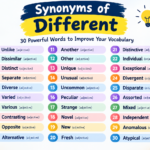
Synonyms of Different
1. Unlike (Adjective) — US /ʌnˈlaɪk/ | UK /ʌnˈlaɪk/
Meaning: Not similar to someone or something else.
Examples:
- My new phone is unlike my old one.
- The two sisters are unlike in many ways.
2. Dissimilar (Adjective) — US /dɪˈsɪm.ə.lɚ/ | UK /dɪˈsɪm.ɪ.lə/
Meaning: Not alike or not similar.
Examples:
- The two designs are dissimilar.
- Their opinions are very dissimilar.
3. Distinct (Adjective) — US /dɪˈstɪŋkt/ | UK /dɪˈstɪŋkt/
Meaning: Clearly different from something else.
Examples:
- The two colors are distinct.
- Each group has a distinct style.
4. Separate (Adjective) — US /ˈsep.ər.ət/ | UK /ˈsep.ər.ət/
Meaning: Not joined or kept apart.
Examples:
- We have separate rooms.
- The teacher gave us separate tasks.
5. Diverse (Adjective) — US /daɪˈvɝːs/ | UK /daɪˈvɜːs/
Meaning: Including many different types.
Examples:
- The city has a diverse population.
- We need a diverse group of ideas.
6. Varied (Adjective) — US /ˈver.id/ | UK /ˈveə.id/
Meaning: Having many different types or forms.
Examples:
- The menu has varied food choices.
- She has varied interests.
7. Various (Adjective) — US /ˈver.i.əs/ | UK /ˈveə.i.əs/
Meaning: Several different kinds.
Examples:
- We discussed various topics.
- She bought various books.
8. Contrasting (Adjective) — US /kənˈtræs.tɪŋ/ | UK /kənˈtrɑː.stɪŋ/
Meaning: Very different from each other.
Examples:
- The room has contrasting colors.
- They have contrasting opinions.
9. Opposite (Adjective) — US /ˈɑː.pə.zɪt/ | UK /ˈɒp.ə.zɪt/
Meaning: Completely different or contrary.
Examples:
- We have opposite views.
- Their answers were opposite.
10. Alternative (Adjective) — US /ɔːlˈtɝː.nə.tɪv/ | UK /ɔːlˈtɜː.nə.tɪv/
Meaning: Different from the usual choice.
Examples:
- We need an alternative plan.
- She found an alternative way to solve the problem.
11. Another (Adjective) — US /əˈnʌð.ɚ/ | UK /əˈnʌð.ə/
Meaning: One more or a different one.
Examples:
- Can I have another book?
- Let’s try another method.
12. Other (Adjective) — US /ˈʌð.ɚ/ | UK /ˈʌð.ə/
Meaning: Not the one already mentioned.
Examples:
- I chose the other dress.
- Do you have any other ideas?
13. Unique (Adjective) — US /juːˈniːk/ | UK /juːˈniːk/
Meaning: Very special or unlike anything else.
Examples:
- She has a unique style.
- This design is unique.
14. Unusual (Adjective) — US /ʌnˈjuː.ʒu.əl/ | UK /ʌnˈjuː.ʒu.əl/
Meaning: Not common or normal.
Examples:
- That is an unusual idea.
- We saw an unusual bird.
15. Uncommon (Adjective) — US /ʌnˈkɑː.mən/ | UK /ʌnˈkɒm.ən/
Meaning: Not often seen or found.
Examples:
- This flower is uncommon.
- It is uncommon to see snow here.
16. Peculiar (Adjective) — US /pɪˈkjuː.li.ɚ/ | UK /pɪˈkjuː.li.ə/
Meaning: Strange or unusual.
Examples:
- He has a peculiar habit.
- There was a peculiar sound outside.
17. Strange (Adjective) — US /streɪndʒ/ | UK /streɪndʒ/
Meaning: Unusual or not normal.
Examples:
- I heard a strange noise.
- That was a strange dream.
18. Novel (Adjective) — US /ˈnɑː.vəl/ | UK /ˈnɒv.əl/
Meaning: New and different.
Examples:
- She had a novel idea.
- The team tried a novel approach.
19. New (Adjective) — US /nuː/ | UK /njuː/
Meaning: Recently made, found, or different from before.
Examples:
- I bought a new bag.
- We need a new plan.
20. Fresh (Adjective) — US /freʃ/ | UK /freʃ/
Meaning: New, different, or full of new ideas.
Examples:
- She gave us a fresh idea.
- The writer used a fresh style.
21. Distinctive (Adjective) — US /dɪˈstɪŋk.tɪv/ | UK /dɪˈstɪŋk.tɪv/
Meaning: Easy to recognize because it is different.
Examples:
- The building has a distinctive design.
- She has a distinctive voice.
22. Individual (Adjective) — US /ˌɪn.dəˈvɪdʒ.u.əl/ | UK /ˌɪn.dɪˈvɪdʒ.u.əl/
Meaning: Belonging to one person rather than a group.
Examples:
- Each student has an individual style.
- We respect individual choices.
23. Exceptional (Adjective) — US /ɪkˈsep.ʃən.əl/ | UK /ɪkˈsep.ʃən.əl/
Meaning: Very unusual or much better than usual.
Examples:
- She showed exceptional talent.
- He did an exceptional job.
24. Divergent (Adjective) — US /daɪˈvɝː.dʒənt/ | UK /daɪˈvɜː.dʒənt/
Meaning: Moving or developing in different ways.
Examples:
- They have divergent opinions.
- The two paths became divergent.
25. Disparate (Adjective) — US /ˈdɪs.pər.ət/ | UK /ˈdɪs.pər.ət/
Meaning: Very different from each other.
Examples:
- The project brought together disparate groups.
- They had disparate ideas.
26. Assorted (Adjective) — US /əˈsɔːr.tɪd/ | UK /əˈsɔː.tɪd/
Meaning: Made up of different kinds.
Examples:
- The box contained assorted chocolates.
- She bought assorted colors.
27. Mixed (Adjective) — US /mɪkst/ | UK /mɪkst/
Meaning: Containing different things together.
Examples:
- The teacher gave us mixed questions.
- The box has mixed fruits.
28. Independent (Adjective) — US /ˌɪn.dɪˈpen.dənt/ | UK /ˌɪn.dɪˈpen.dənt/
Meaning: Separate and not controlled by another.
Examples:
- The group works as an independent team.
- She runs an independent business.
29. Anomalous (Adjective) — US /əˈnɑː.mə.ləs/ | UK /əˈnɒm.ə.ləs/
Meaning: Different from what is normal or expected.
Examples:
- The result was anomalous.
- Scientists noticed an anomalous reading.
30. Atypical (Adjective) — US /eɪˈtɪp.ɪ.kəl/ | UK /eɪˈtɪp.ɪ.kəl/
Meaning: Not typical or usual.
Examples:
- This weather is atypical for summer.
- His answer was atypical for the group.
Prototype Meaning
The most common meaning of different is “not the same.” When people hear this word, they usually think about two or more people, things, ideas, or situations that do not match. For example, two dresses can have different colors, or two people can have different opinions. The word does not always mean good or bad. Its meaning depends on the situation.
Prototype Categorization
- General difference: unlike, dissimilar, distinct, separate
- Many types: diverse, varied, various, assorted, mixed
- Special difference: unique, distinctive, exceptional
- Unusual difference: unusual, uncommon, peculiar, strange, atypical, anomalous
- New or creative: novel, new, fresh, alternative
- Strong difference: opposite, contrasting, disparate
- Personal or separate: individual, independent
- Change or direction: divergent
Antonyms of Different
- Same
- Similar
- Alike
- Identical
- Equal
- Matching
- Like
- Uniform
- Common
- Typical
Short Questions and Answers
- What does different mean?
Different means not the same as another person, thing, idea, or situation. - When should different be used?
Use different when you want to show that two or more things are not the same. - Is different positive or negative?
It can be positive, negative, or neutral. The meaning depends on the context. - How is different different from similar words?
Different is a general word. Words such as unique, unusual, distinct, and opposite give more specific meanings.
Conclusion
Synonyms of different can make your English stronger. The word is simple, common, and useful in daily speaking and writing. Its synonyms can help you explain ideas in a clearer way. Words such as unlike, distinct, unique, unusual, and diverse have slightly different meanings and can make your writing more exact. Using these words also helps you avoid repeating different too often. English learners can use them in school, work, conversations, and online writing. Content writers can use them to make their articles more natural and interesting. Practice one or two new synonyms every day. Write simple sentences with them and use them when you speak. With regular practice, your vocabulary will grow and your English confidence will become stronger.