Rich means having a lot of money, valuable things, or a large amount of something. For example, imagine a person who has a big house, a nice car, and many valuable things. We may say that person is rich. The word rich is very common in daily English. It can also describe food, soil, colors, sounds, and experiences. Learning synonyms for rich helps English learners use better words in speaking and writing. It also helps content writers make their work more clear and interesting. In this article, we will learn the meaning of rich, its synonyms, examples, grammar, history, pronunciation, and word forms. We will also group its synonyms by meaning. This will help you choose the right word for each situation and avoid using the same word again and again.
Meaning of Rich
Definition
Rich (adjective): having a lot of money, valuable things, or a large amount of something.
The word rich has many meanings. It can talk about money, food, soil, colors, sounds, or experiences.
Examples
- She is rich and owns a large house.
- This cake has a rich chocolate taste.
Connotative Meaning.
- Positive tone: Rich can suggest success, comfort, quality, beauty, or abundance.
- Negative tone: Rich can sometimes suggest greed, too much money, or unfair wealth.
- Neutral tone: Rich can simply describe having a lot of money or having a lot of something.
Also read more about https://myprayerss.com/synonyms-of-sad-3/
Etymology
- Source: The word rich comes from Old English rīċe or rice.
- Original meaning: It first meant strong, powerful, great, mighty, or high in rank.
- It later developed the meaning wealthy.
- The word is related to Proto-Germanic forms connected with power and rule. Its history is also linked with Celtic words for a king or ruler.
Short History of Rich
Old English (450–1100):
In Old English, rice could mean strong, powerful, great, mighty, or high in rank. It later came to mean wealthy.
Middle English (1100–1500):
In Middle English, the form of the word was influenced by Old French riche, which meant wealthy, magnificent, or luxurious. The word also gained more meanings.
Modern English (1500–Present):
English continued to add new meanings to rich. It can now describe money, food, colors, sounds, soil, and many other things. The meanings connected with food and colors appeared in the early 14th century, while the soil meaning appeared later.
Pronunciation (US & UK – IPA)
US: /rɪtʃ/
UK: /rɪtʃ/
Syllables
rich
Affixation Pattern of Rich
Root:
rich
Prefix:
None in the basic word.
Suffix:
None in the basic word.
Word Formation
The base word rich is an adjective. Several common words are formed from or related to it:
- rich — adjective
- richly — adverb
- richness — noun
- riches — noun
- richen — verb
- enrich — verb
- enrichment — noun
The word richness uses the suffix -ness, while richly uses -ly. The verb enrich uses the prefix en- to give the idea of making something richer.
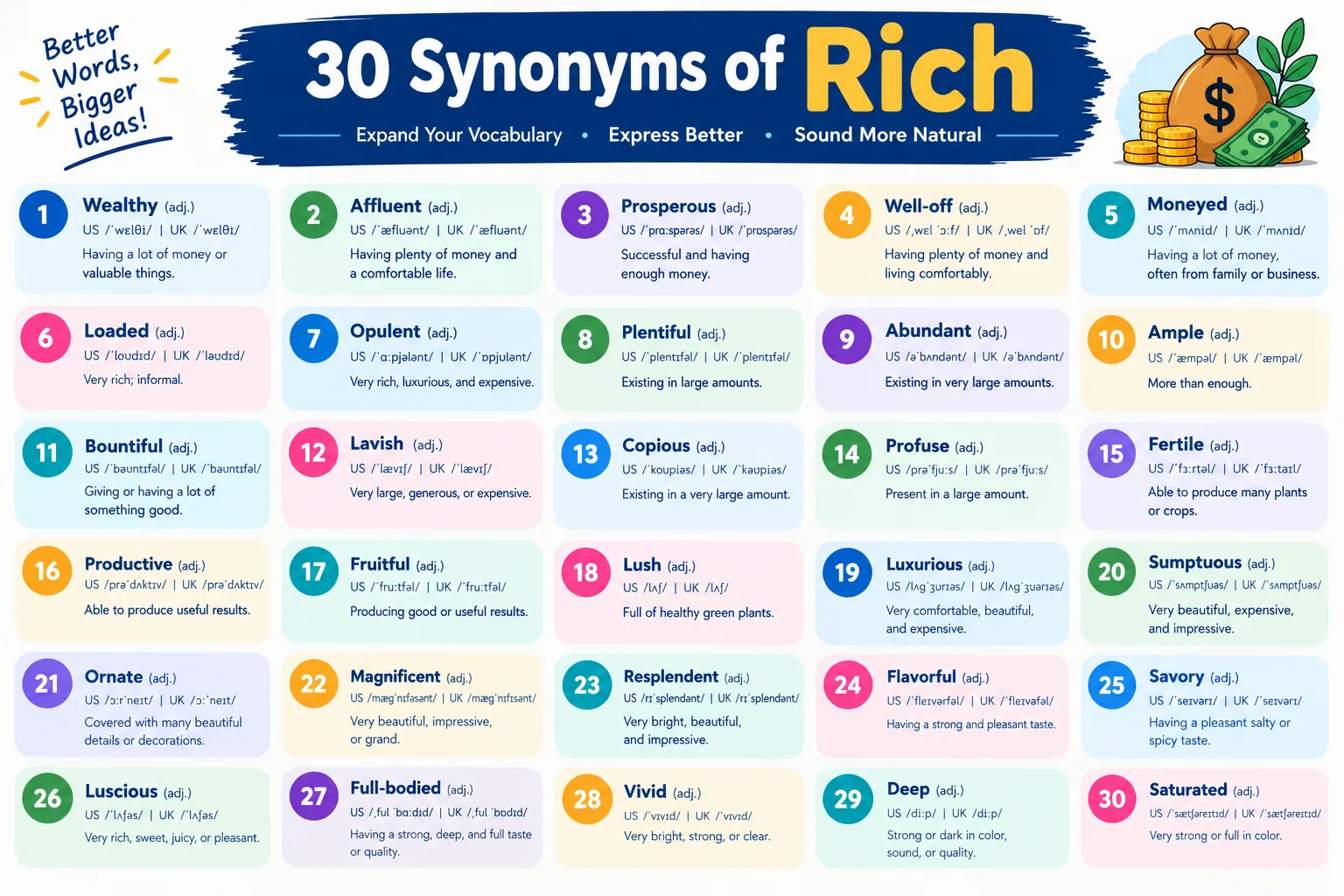
Synonyms of Rich
The word rich has many meanings. So, its best synonym depends on the situation.
1. Wealthy (Adjective) — US /ˈwɛlθi/ | UK /ˈwɛlθi/
Meaning: Having a lot of money or valuable things.
Examples:
- He comes from a wealthy family.
- The wealthy woman gave money to the school.
2. Affluent (Adjective) — US /ˈæfluənt/ | UK /ˈæfluənt/
Meaning: Having plenty of money and a comfortable life.
Examples:
- They live in an affluent area.
- Many affluent families travel abroad.
3. Prosperous (Adjective) — US /ˈprɑːspərəs/ | UK /ˈprɒspərəs/
Meaning: Successful and having enough money.
Examples:
- He runs a prosperous business.
- The town became more prosperous over time.
4. Well-off (Adjective) — US /ˌwɛl ˈɔːf/ | UK /ˌwel ˈɒf/
Meaning: Having plenty of money and living comfortably.
Examples:
- Her family is quite well-off.
- They are well-off, but they live simply.
5. Moneyed (Adjective) — US /ˈmʌnid/ | UK /ˈmʌnid/
Meaning: Having a lot of money, often from family or business.
Examples:
- He grew up in a moneyed family.
- The event attracted many moneyed guests.
6. Loaded (Adjective) — US /ˈloʊdɪd/ | UK /ˈləʊdɪd/
Meaning: Very rich; this is an informal word.
Examples:
- His uncle is loaded.
- She became loaded after selling her company.
7. Opulent (Adjective) — US /ˈɑːpjələnt/ | UK /ˈɒpjʊlənt/
Meaning: Very rich, luxurious, and expensive.
Examples:
- They stayed in an opulent hotel.
- The palace has an opulent interior.
8. Plentiful (Adjective) — US /ˈplentɪfəl/ | UK /ˈplentɪfəl/
Meaning: Existing in large amounts.
Examples:
- Fresh fruit is plentiful in summer.
- Water was plentiful after the rain.
9. Abundant (Adjective) — US /əˈbʌndənt/ | UK /əˈbʌndənt/
Meaning: Existing in very large amounts.
Examples:
- The area has abundant natural resources.
- The garden has abundant flowers.
10. Ample (Adjective) — US /ˈæmpəl/ | UK /ˈæmpəl/
Meaning: More than enough.
Examples:
- We have ample food for everyone.
- The room has ample space for the guests.
11. Bountiful (Adjective) — US /ˈbaʊntɪfəl/ | UK /ˈbaʊntɪfəl/
Meaning: Giving or having a lot of something good.
Examples:
- The farm had a bountiful harvest.
- They enjoyed a bountiful meal.
12. Lavish (Adjective) — US /ˈlævɪʃ/ | UK /ˈlævɪʃ/
Meaning: Very large, generous, or expensive.
Examples:
- They held a lavish wedding.
- The hotel gave us a lavish breakfast.
13. Copious (Adjective) — US /ˈkoʊpiəs/ | UK /ˈkəʊpiəs/
Meaning: Existing in a very large amount.
Examples:
- She took copious notes in class.
- The report contains copious details.
14. Profuse (Adjective) — US /prəˈfjuːs/ | UK /prəˈfjuːs/
Meaning: Present in a large amount.
Examples:
- The plant has profuse flowers.
- He gave profuse thanks to his team.
15. Fertile (Adjective) — US /ˈfɜːrtəl/ | UK /ˈfɜːtaɪl/
Meaning: Able to produce many plants or crops.
Examples:
- The farmers have fertile land.
- This soil is very fertile.
16. Productive (Adjective) — US /prəˈdʌktɪv/ | UK /prəˈdʌktɪv/
Meaning: Able to produce a lot of useful results.
Examples:
- The farm has productive soil.
- We had a very productive day.
17. Fruitful (Adjective) — US /ˈfruːtfəl/ | UK /ˈfruːtfəl/
Meaning: Producing good or useful results.
Examples:
- We had a fruitful meeting.
- Their discussion was very fruitful.
18. Lush (Adjective) — US /lʌʃ/ | UK /lʌʃ/
Meaning: Full of healthy green plants.
Examples:
- We walked through a lush forest.
- The valley has lush green fields.
19. Luxurious (Adjective) — US /lʌɡˈʒʊriəs/ | UK /lʌɡˈʒʊəriəs/
Meaning: Very comfortable, beautiful, and expensive.
Examples:
- They stayed at a luxurious hotel.
- The car has a luxurious interior.
20. Sumptuous (Adjective) — US /ˈsʌmptʃuəs/ | UK /ˈsʌmptʃuəs/
Meaning: Very beautiful, expensive, and impressive.
Examples:
- They enjoyed a sumptuous dinner.
- The room had sumptuous furniture.
21. Ornate (Adjective) — US /ɔːrˈneɪt/ | UK /ɔːˈneɪt/
Meaning: Covered with many beautiful details or decorations.
Examples:
- The building has an ornate door.
- We admired the ornate design.
22. Magnificent (Adjective) — US /mæɡˈnɪfəsənt/ | UK /mæɡˈnɪfɪsənt/
Meaning: Very beautiful, impressive, or grand.
Examples:
- They saw a magnificent palace.
- The garden looked magnificent at night.
23. Resplendent (Adjective) — US /rɪˈsplendənt/ | UK /rɪˈsplendənt/
Meaning: Very bright, beautiful, and impressive.
Examples:
- She looked resplendent in her dress.
- The hall was resplendent with gold decorations.
24. Flavorful (Adjective) — US /ˈfleɪvərfəl/ | UK /ˈfleɪvəfəl/
Meaning: Having a strong and pleasant taste.
Examples:
- This soup is very flavorful.
- We ate a flavorful rice dish.
25. Savory (Adjective) — US /ˈseɪvəri/ | UK /ˈseɪvəri/
Meaning: Having a pleasant salty or spicy taste.
Examples:
- I ordered a savory meal.
- The sauce has a savory taste.
26. Luscious (Adjective) — US /ˈlʌʃəs/ | UK /ˈlʌʃəs/
Meaning: Very rich, sweet, juicy, or pleasant.
Examples:
- The cake had a luscious chocolate filling.
- We enjoyed the luscious fruit.
27. Full-bodied (Adjective) — US /ˌfʊl ˈbɑːdid/ | UK /ˌfʊl ˈbɒdid/
Meaning: Having a strong, deep, and full taste or quality.
Examples:
- This coffee has a full-bodied flavor.
- We enjoyed the full-bodied taste of the drink.
28. Vivid (Adjective) — US /ˈvɪvɪd/ | UK /ˈvɪvɪd/
Meaning: Very bright, strong, or clear.
Examples:
- The painting uses vivid colors.
- She wore a vivid red dress.
29. Deep (Adjective) — US /diːp/ | UK /diːp/
Meaning: Strong or dark in color, sound, or quality.
Examples:
- The artist used deep blue paint.
- The room had a deep red color.
30. Saturated (Adjective) — US /ˈsætʃəreɪtɪd/ | UK /ˈsætʃəreɪtɪd/
Meaning: Very strong or full in color.
Examples:
- The photo has saturated colors.
- The designer chose saturated blue for the poster.
Prototype Meaning
The most common meaning of rich is having a lot of money or valuable things. When people hear rich, they often imagine a person with a large house, expensive items, or a successful business. But rich can also mean having a lot of something, such as rich soil, rich food, or rich colors. The exact meaning depends on the sentence.
Prototype Categorization
- Having a lot of money: wealthy, affluent, prosperous, well-off, moneyed, loaded, opulent.
- Having a large amount: plentiful, abundant, ample, bountiful, lavish, copious, profuse.
- Good for growing: fertile, productive, fruitful, lush.
- Luxury and beauty: luxurious, sumptuous, ornate, magnificent, resplendent.
- Strong taste or quality: flavorful, savory, luscious, full-bodied.
- Strong colors: vivid, deep, saturated..
Antonyms of Rich
Some common antonyms of rich are:
- Poor — having little money.
- Needy — lacking basic things or money.
- Impoverished — very poor.
- Barren — unable to produce much, especially when talking about land.
- Scarce — available in a small amount.
- Limited — not available in a large amount.
- Plain — simple and not luxurious.
Short Questions and Answers
- What does rich mean?
Rich usually means having a lot of money or valuable things. It can also mean having a lot of something, such as flavor, color, or nutrients. - When should rich be used?
Use rich when talking about wealth, abundance, strong taste, deep colors, fertile soil, or other things with a strong quality. - Is rich positive or negative?
It can be positive, negative, or neutral. It may suggest success and comfort, but it can also suggest greed or too much wealth. - How is rich different from similar words?
Wealthy mainly describes money. Abundant describes a large amount. Luxurious describes comfort and high quality. Flavorful describes food, while fertile describes land or soil.
Conclusion
Synonyms of rich can make your English vocabulary stronger. The word rich has many meanings, so learning synonyms of rich helps you choose the right word for each situation. Words like wealthy, affluent, abundant, fertile, luxurious, flavorful, and vivid can make your writing more clear and exact. Learning synonyms of rich can also help you avoid repeating the word rich many times. These synonyms of rich are useful in school writing, daily speaking, blogs, articles, and other content. Try to learn a few synonyms of rich each day. Write simple sentences with them and use them when you speak. With regular practice, synonyms of rich can help you improve your vocabulary, write better sentences, speak with more confidence, and express your ideas more clearly.