However means “but” or “in spite of this.” It is used when we want to show a contrast between two ideas. For example, you may want to go outside because the weather is nice. However, it starts to rain, so you stay home. The word is very common in English. People use it in daily speech, school writing, emails, essays, and articles. Learning synonyms of however can help English learners understand different ways to show contrast. It also helps content writers make their writing smooth and clear without using the same word many times. In this article, we will learn the meaning of however, its synonyms, examples, grammar, history, pronunciation, and word forms. We will also group its synonyms by meaning so you can choose the right word for each situation.
Meaning of However
Definition
However (Adverb): Used to show that one idea is different from or contrasts with another idea.
However (Adverb): It can also mean “no matter how” when used before an adjective or adverb.
Examples
- I wanted to go; however, I was too tired.
- However hard she tried, she could not open the door.
Connotative Meaning.
- Positive tone: However can create a fair and balanced tone by showing another side of an idea.
- Negative tone: It may make a sentence sound formal or may show a problem or setback.
- Neutral tone: Most often, however is a neutral word used to show contrast.
Also read more about https://myprayerss.com/synonyms-for-beautiful/
Etymology
- Source: However comes from Middle English.
- Original parts: It was formed from how and ever.
- Original idea: It carried the sense of “in whatever way” or “by whatever means.”
- Over time, it also developed its common modern use for showing contrast.
Short History of “However”
Old English (450–1100):
The modern word however was not used in its present form. Old English had separate words and phrases that expressed ideas such as “in whatever way.”
Middle English (1100–1500):
Forms made from how and ever began to appear. The word developed meanings related to “in whatever way” and later “nevertheless.”
Modern English (1500–Present):
However became a common word for showing contrast. Today, it is widely used in speech and writing.
Pronunciation (US & UK – IPA)
US: /haʊˈɛvər/
UK: /haʊˈevə/
Syllables
how-ev-er
It has three syllables.
Affixation Pattern of However
Root: how + ever
Prefix: None
Suffix: None
Word Formation
However is a compound word made from how + ever.
Its main grammatical category is:
- However — adverb
The word also appears in fixed structures such as however much, however hard, and however long. It is not normally changed into many new English words by adding prefixes or suffixes.
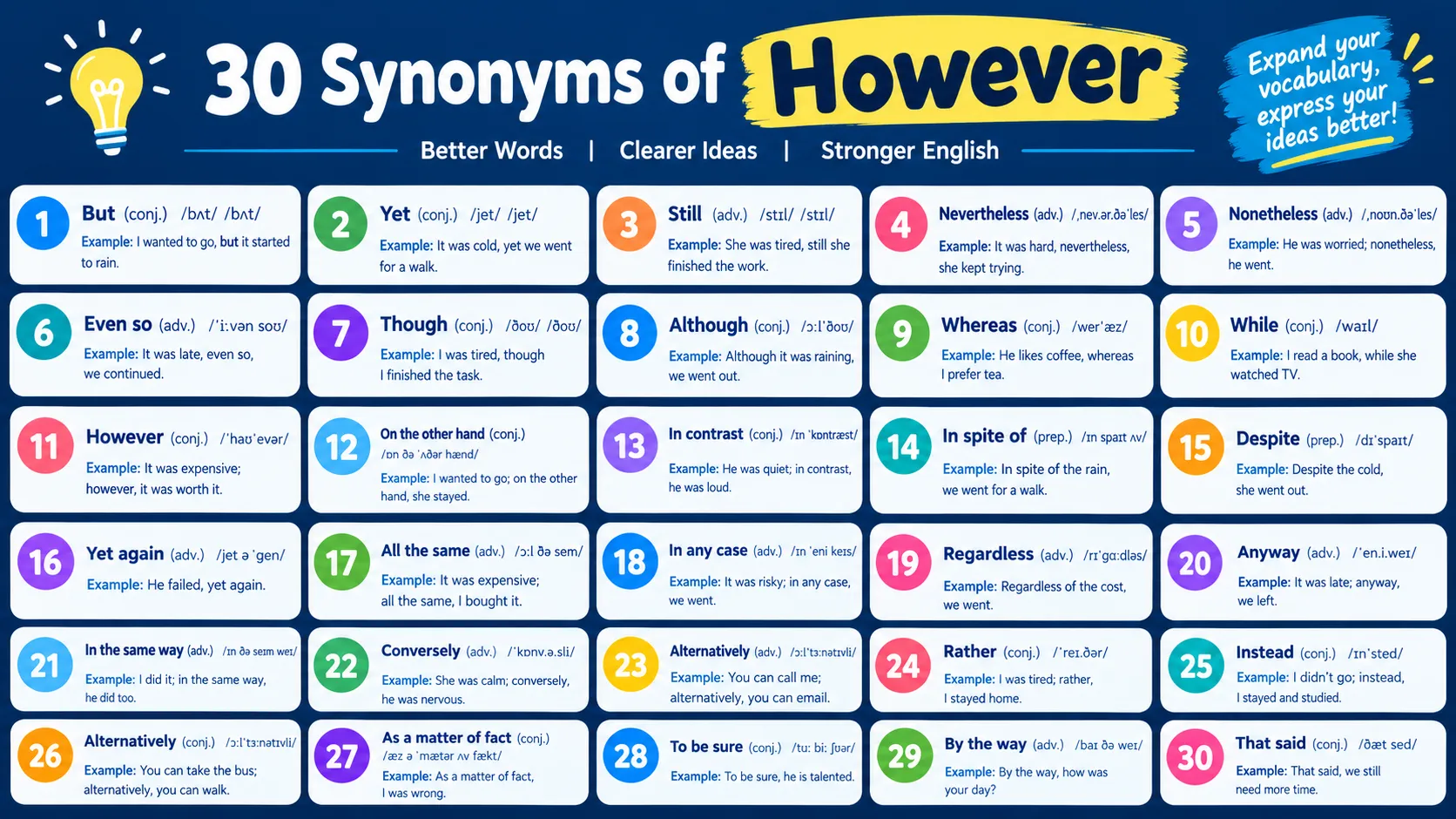
Synonyms of However
1. But (Conjunction) — US /bʌt/ | UK /bʌt/
Meaning: Used to show a contrast between two ideas.
Examples:
- I wanted to go, but I was sick.
- The bag is small, but it is strong.
2. Nevertheless (Adverb) — US /ˌnɛvərðəˈlɛs/ | UK /ˌnevəðəˈles/
Meaning: Used to say that something is true despite what was just said.
Examples:
- It was raining. Nevertheless, we went outside.
- The task was hard; nevertheless, she finished it.
3. Nonetheless (Adverb) — US /ˌnʌnðəˈlɛs/ | UK /ˌnʌnðəˈles/
Meaning: Used to show that something remains true despite another fact.
Examples:
- The test was hard. Nonetheless, I passed.
- He was tired; nonetheless, he kept working.
4. Yet (Adverb) — US /jɛt/ | UK /jet/
Meaning: Used to show an unexpected contrast.
Examples:
- It was cold, yet she went swimming.
- He is young, yet he is very wise.
5. Still (Adverb) — US /stɪl/ | UK /stɪl/
Meaning: Used to say that something continues or remains true despite another fact.
Examples:
- It was late, but she still worked.
- The road was rough. Still, we continued.
6. Though (Adverb) — US /ðoʊ/ | UK /ðəʊ/
Meaning: Used to add an idea that contrasts with what came before.
Examples:
- I liked the movie. It was long, though.
- The meal was simple, though it was tasty.
7. Although (Conjunction) — US /ɔːlˈðoʊ/ | UK /ɔːlˈðəʊ/
Meaning: Used to introduce an idea that contrasts with another idea.
Examples:
- Although it was cold, we went out.
- Although he was tired, he kept working.
8. Even So (Adverbial Phrase) — US /ˈiːvən soʊ/ | UK /ˈiːvən səʊ/
Meaning: Used to show that something remains true despite another fact.
Examples:
- The plan was risky. Even so, we tried it.
- She was nervous. Even so, she spoke clearly.
9. All the Same (Adverbial Phrase) — US /ˌɔːl ðə ˈseɪm/ | UK /ˌɔːl ðə ˈseɪm/
Meaning: Used to show that something is true despite another fact.
Examples:
- It was expensive. All the same, I bought it.
- He made mistakes. All the same, he did well.
10. In Spite of This (Adverbial Phrase) — US /ɪn spaɪt əv ðɪs/ | UK /ɪn spaɪt əv ðɪs/
Meaning: Used to show that something happened despite a previous fact.
Examples:
- The road was bad. In spite of this, we arrived on time.
- She was tired. In spite of this, she helped us.
11. Despite This (Adverbial Phrase) — US /dɪˈspaɪt ðɪs/ | UK /dɪˈspaɪt ðɪs/
Meaning: Used to show that something happened even though another fact might stop it.
Examples:
- The job was hard. Despite this, he enjoyed it.
- It was raining. Despite this, they played outside.
12. On the Other Hand (Adverbial Phrase) — US /ɑːn ði ˈʌðər hænd/ | UK /ɒn ði ˈʌðə hænd/
Meaning: Used to introduce a different or opposite point.
Examples:
- The house is small. On the other hand, it is cheap.
- The job is hard. On the other hand, it pays well.
13. By Contrast (Adverbial Phrase) — US /baɪ ˈkɑːntræst/ | UK /baɪ ˈkɒntrɑːst/
Meaning: Used to show a clear difference between two things.
Examples:
- John is quiet. By contrast, Tom is very loud.
- The first room was dark. By contrast, the second was bright.
14. In Contrast (Adverbial Phrase) — US /ɪn ˈkɑːntræst/ | UK /ɪn ˈkɒntrɑːst/
Meaning: Used to show how one thing is different from another.
Examples:
- The old car was slow. In contrast, the new one is fast.
- She is shy. In contrast, her sister is very friendly.
15. Conversely (Adverb) — US /ˈkɑːnvɜːrsli/ | UK /ˈkɒnvɜːsli/
Meaning: Used to introduce an opposite idea or result.
Examples:
- Some people like noise. Conversely, others prefer silence.
- Higher prices can reduce sales. Conversely, lower prices may increase them.
16. Alternatively (Adverb) — US /ɔːlˈtɜːrnətɪvli/ | UK /ɔːlˈtɜːnətɪvli/
Meaning: Used to introduce another choice or possibility.
Examples:
- We can take the bus. Alternatively, we can walk.
- You can call me. Alternatively, you can send an email.
17. Instead (Adverb) — US /ɪnˈstɛd/ | UK /ɪnˈsted/
Meaning: Used to say that one thing happens in place of another.
Examples:
- I did not drive. Instead, I took the train.
- She did not buy a cake. Instead, she made one.
18. Rather (Adverb) — US /ˈræðər/ | UK /ˈrɑːðə/
Meaning: Used to introduce a different or preferred choice.
Examples:
- I would rather stay home.
- He did not walk. Rather, he ran.
19. Otherwise (Adverb) — US /ˈʌðərwaɪz/ | UK /ˈʌðəwaɪz/
Meaning: Used to show what happens if a different condition is not met.
Examples:
- Hurry up; otherwise, we will be late.
- Study well. Otherwise, you may fail.
20. Instead of That (Phrase) — US /ɪnˈstɛd əv ðæt/ | UK /ɪnˈsted əv ðæt/
Meaning: Used to introduce a different action or idea.
Examples:
- Do not worry about the past. Instead of that, focus on today.
- We did not stay home. Instead of that, we went out.
21. At the Same Time (Adverbial Phrase) — US /æt ðə ˈseɪm taɪm/ | UK /ət ðə ˈseɪm taɪm/
Meaning: Used to show that another fact is also true.
Examples:
- The work is hard. At the same time, it is useful.
- She is strict. At the same time, she is kind.
22. Even Then (Adverbial Phrase) — US /ˈiːvən ðɛn/ | UK /ˈiːvən ðen/
Meaning: Used to show that something remains true despite a situation.
Examples:
- He knew the risk. Even then, he continued.
- It was very late. Even then, she did not leave.
23. For All That (Adverbial Phrase) — US /fər ˈɔːl ðæt/ | UK /fə ˈɔːl ðæt/
Meaning: Used to show that something is true despite another fact.
Examples:
- The plan had problems. For all that, it worked.
- He was young. For all that, he was very skilled.
24. That Said (Discourse Marker) — US /ðæt sɛd/ | UK /ðæt sed/
Meaning: Used to introduce a different point after making another statement.
Examples:
- The book is long. That said, it is easy to read.
- The job is hard. That said, I enjoy it.
25. Having Said That (Discourse Marker) — US /ˈhævɪŋ sɛd ðæt/ | UK /ˈhævɪŋ sed ðæt/
Meaning: Used to introduce a different point after a previous statement.
Examples:
- The plan is costly. Having said that, it may save money later.
- He made mistakes. Having said that, he worked hard.
26. Be That as It May (Adverbial Phrase) — US /biː ðæt æz ɪt meɪ/ | UK /biː ðæt æz ɪt meɪ/
Meaning: Used to accept a fact but then make a different point.
Examples:
- The task is difficult. Be that as it may, we must try.
- The price is high. Be that as it may, the product is useful.
27. Notwithstanding (Preposition/Adverb) — US /ˌnɑːtwɪðˈstændɪŋ/ | UK /ˌnɒtwɪðˈstændɪŋ/
Meaning: Used to say that something is true despite another fact.
Examples:
- Notwithstanding the rain, the match continued.
- The plan worked, notwithstanding the problems.
28. Regardless (Adverb) — US /rɪˈɡɑːrdləs/ | UK /rɪˈɡɑːdləs/
Meaning: Used to say that something does not change because of another fact.
Examples:
- It may rain. Regardless, we will go.
- She was tired. Regardless, she finished the work.
29. Against This (Adverbial Phrase) — US /əˈɡɛnst ðɪs/ | UK /əˈɡeɪnst ðɪs/
Meaning: Used to present an idea that differs from a previous point.
Examples:
- The plan looks simple. Against this, the cost is very high.
- The first report was positive. Against this, the second report showed problems.
30. In Opposition (Adverbial Phrase) — US /ɪn ˌɑːpəˈzɪʃən/ | UK /ɪn ˌɒpəˈzɪʃən/
Meaning: Used to show that one idea or position is different from another.
Examples:
- One group supported the plan. In opposition, another group rejected it.
- The first view was positive. In opposition, the second view was negative.
Prototype Meaning
The most typical meaning of however is “but” or “despite this.” When people hear however, they usually expect a change, difference, or contrast between two ideas. For example, “The food was good. However, it was expensive.” The first idea is positive, while the second idea gives a different point. This simple contrast is the main use of however in modern English.
Prototype Categorization
Synonyms and related expressions for however can be grouped into useful categories:
- Simple contrast: but, yet, though, still.
- Strong contrast: nevertheless, nonetheless, even so, all the same.
- Formal contrast: notwithstanding, conversely, by contrast.
- Different viewpoint: on the other hand, in contrast, that said.
- Alternative or replacement: instead, alternatively, rather.
- Condition or result: otherwise, regardless.
- Formal or literary expressions: for all that, be that as it may.
Antonyms of However
Because however is a contrast marker, it does not have one exact opposite. Depending on the context, useful opposite ideas include:
- Similarly
- Likewise
- Therefore
- Thus
- Consequently
- Also
- Furthermore
- Moreover
- In addition
- Likewise
These words usually add, support, or connect ideas instead of showing contrast.
Short Questions and Answers
- What does however mean?
However usually means “but,” “nevertheless,” or “despite this.” It shows a contrast between ideas. - When should however be used?
Use however when you want to connect two ideas that are different or unexpected. It is common in both speaking and writing. - Is however positive or negative?
However is normally neutral. The feeling comes from the ideas around it, not from the word itself. - How is however different from similar words?
However is an adverb and often shows contrast between sentences or clauses. But is a conjunction. Nevertheless and nonetheless are more formal ways to show a similar contrast.
Conclusion
Synonyms for However can greatly improve your English vocabulary. Words such as but, yet, still, nevertheless, nonetheless, and even so are some useful Synonyms for However that help you show contrast in different ways. They can make your speaking and writing clearer and more natural. Learning Synonyms for However also helps you avoid repeating however again and again. This is especially useful for students, bloggers, essay writers, and content writers who want to use Synonyms for However in their work. When you understand the small differences between these words, you can choose the best Synonyms for However for each sentence. Try to learn two or three new words each day. Read them, say them, and write simple sentences with them. With regular practice, you can build stronger vocabulary, improve your writing and speaking, and feel more confident when using English. Learning Synonyms for However can make your English more clear and natural.