Cold means having a low temperature. Imagine walking outside on a winter morning. The air feels cold, your hands feel cold, and you quickly put on a warm jacket. We use the word cold very often in daily English. It can talk about weather, water, food, people, feelings, and even illness. Learning synonyms of cold can help English learners use better and more exact words. It can also help content writers make their writing more interesting and avoid using the same word again and again. In this article, we will learn the meaning of cold and explore 30 useful synonyms with simple examples. We will also look at grammar, connotation, history, pronunciation, word formation, and meaning groups. These groups will help you choose the right word for each situation.
Meaning of Cold
Definition
Cold (adjective): Having a low temperature and not being warm or hot.
Cold can also be a noun. As a noun, it can mean low temperature or a common illness.
Examples
- The water is very cold.
- I wore a warm coat because it was cold outside.
Connotative Meaning
- Positive tone: Cold can feel fresh, clean, or pleasant when talking about cool water or a cool drink.
- Negative tone: Cold can suggest discomfort, loneliness, or an unfriendly person.
- Neutral tone: Cold can simply describe a low temperature without showing a feeling.
Also read more about https://myprayerss.com/synonyms-for-beautiful/
Etymology
- Source: Old English cald and ceald.
- Proto-Germanic: It came from the Proto-Germanic form *kaldjon.
- Older root: It is linked to the Indo-European root *gel-, meaning “cold” or “to freeze.”
Short History of Cold
Old English (450–1100):
The word appeared as cald and ceald. It described something that caused a strong feeling of low temperature. It could also describe a person who was not moved by strong feelings.
Middle English (1100–1500):
The spelling and use of cold became more like modern English. By the Middle English period, the word was commonly used for low temperature. It also gained other meanings, including the sense of being dead.
Modern English (1500–Present):
The word cold gained many wider uses. It can now describe weather, food, people, feelings, colors, illnesses, and other ideas. Phrases such as cold front, cold sweat, and cold call also developed over time.
Pronunciation (US & UK – IPA)
US: /koʊld/
UK: /kəʊld/
Syllables
cold
Affixation Pattern of Cold
Root: cold / cald / ceald
Prefix: None
Suffix: None
Word formation
Cold is a basic root word. Many related words and forms can be made from it, such as colder, coldest, coldness, coldly, coldish, cold-hearted, and cold-blooded.
These forms can work as different grammatical categories:
- Adjective: cold, colder, coldest, coldish
- Noun: cold, coldness
- Adverb: coldly
- Compound adjective: cold-hearted, cold-blooded
Synonyms of Cold
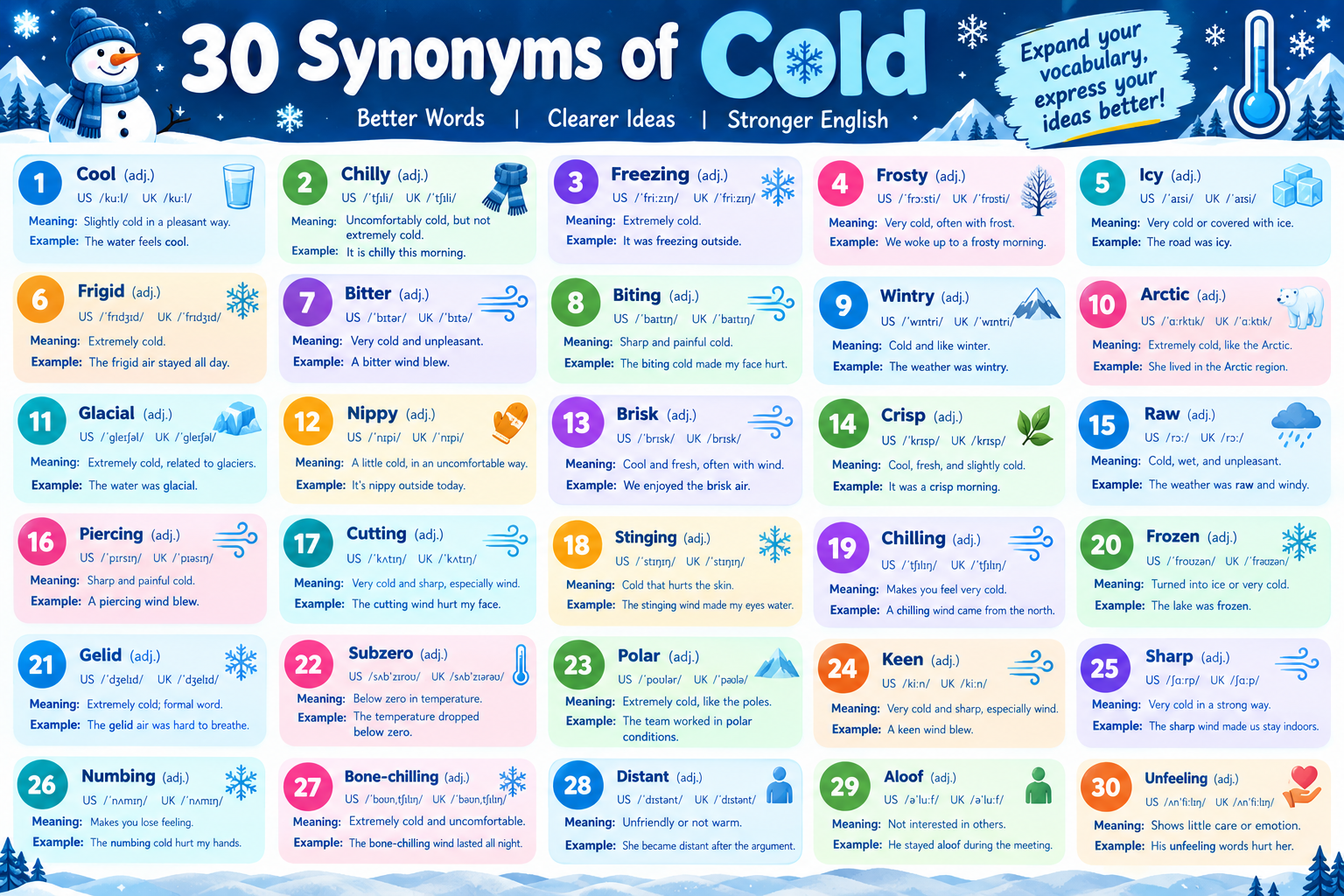
The following words are useful synonyms of cold. Some describe temperature, while others describe strong cold, weather, or an unfriendly attitude.
1. Cool (Adjective) — US /kuːl/ | UK /kuːl/
Meaning: Slightly cold in a comfortable or pleasant way.
Examples:
- The water feels cool.
- We enjoyed a cool evening outside.
2. Chilly (Adjective) — US /ˈtʃɪli/ | UK /ˈtʃɪli/
Meaning: Uncomfortably cold but not extremely cold.
Examples:
- It is chilly this morning.
- I felt chilly, so I put on a sweater.
3. Freezing (Adjective) — US /ˈfriːzɪŋ/ | UK /ˈfriːzɪŋ/
Meaning: Extremely cold.
Examples:
- It was freezing outside.
- My hands are freezing.
4. Frosty (Adjective) — US /ˈfrɔːsti/ | UK /ˈfrɒsti/
Meaning: Very cold and often covered with frost.
Examples:
- We woke up to a frosty morning.
- The grass looked white on the frosty day.
5. Icy (Adjective) — US /ˈaɪsi/ | UK /ˈaɪsi/
Meaning: Extremely cold or covered with ice.
Examples:
- An icy wind blew through the trees.
- The water was icy cold.
6. Frigid (Adjective) — US /ˈfrɪdʒɪd/ | UK /ˈfrɪdʒɪd/
Meaning: Extremely cold.
Examples:
- The frigid air made us stay indoors.
- It was a frigid winter night.
7. Bitter (Adjective) — US /ˈbɪtər/ | UK /ˈbɪtə/
Meaning: Extremely cold and unpleasant.
Examples:
- A bitter wind was blowing.
- The morning was bitter and dark.
8. Biting (Adjective) — US /ˈbaɪtɪŋ/ | UK /ˈbaɪtɪŋ/
Meaning: Very cold in a sharp and painful way.
Examples:
- A biting wind hit my face.
- We walked through the biting cold.
9. Wintry (Adjective) — US /ˈwɪntri/ | UK /ˈwɪntri/
Meaning: Cold and like winter.
Examples:
- The weather was wintry and wet.
- We had a cold, wintry afternoon.
10. Arctic (Adjective) — US /ˈɑːrktɪk/ | UK /ˈɑːktɪk/
Meaning: Extremely cold like the Arctic region.
Examples:
- We faced Arctic winds.
- The temperature felt Arctic.
11. Glacial (Adjective) — US /ˈɡleɪʃəl/ | UK /ˈɡleɪʃəl/
Meaning: Extremely cold or related to a glacier.
Examples:
- The water was glacial.
- A glacial wind came from the mountains.
12. Nippy (Adjective) — US /ˈnɪpi/ | UK /ˈnɪpi/
Meaning: A little cold in an uncomfortable way.
Examples:
- It is nippy outside today.
- The nippy air made me wear a coat.
13. Brisk (Adjective) — US /brɪsk/ | UK /brɪsk/
Meaning: Cool and fresh, often with some wind.
Examples:
- We went for a walk in the brisk air.
- A brisk wind came from the sea.
14. Crisp (Adjective) — US /krɪsp/ | UK /krɪsp/
Meaning: Cool, fresh, and slightly cold.
Examples:
- It was a crisp autumn morning.
- We enjoyed the crisp morning air.
15. Raw (Adjective) — US /rɔː/ | UK /rɔː/
Meaning: Very cold, wet, and unpleasant, especially when describing weather.
Examples:
- The weather was raw and windy.
- We stayed inside because of the raw weather.
16. Piercing (Adjective) — US /ˈpɪrsɪŋ/ | UK /ˈpɪəsɪŋ/
Meaning: Very cold in a sharp and painful way.
Examples:
- A piercing wind came through the door.
- The piercing cold made my face hurt.
17. Cutting (Adjective) — US /ˈkʌtɪŋ/ | UK /ˈkʌtɪŋ/
Meaning: Very cold and sharp, especially about wind.
Examples:
- A cutting wind blew all night.
- The cutting cold made walking difficult.
18. Stinging (Adjective) — US /ˈstɪŋɪŋ/ | UK /ˈstɪŋɪŋ/
Meaning: Very cold in a way that hurts the skin.
Examples:
- The stinging wind made my eyes water.
- We felt the stinging cold on our faces.
19. Chilling (Adjective) — US /ˈtʃɪlɪŋ/ | UK /ˈtʃɪlɪŋ/
Meaning: Making you feel very cold.
Examples:
- A chilling wind came from the north.
- The chilling air filled the room.
20. Frozen (Adjective) — US /ˈfroʊzən/ | UK /ˈfrəʊzən/
Meaning: Turned into ice or made extremely cold.
Examples:
- The lake was frozen.
- My fingers felt frozen after the walk.
21. Gelid (Adjective) — US /ˈdʒelɪd/ | UK /ˈdʒelɪd/
Meaning: Extremely cold; this is a more formal word.
Examples:
- The gelid air made the trip hard.
- We walked through the gelid winter air.
22. Subzero (Adjective) — US /sʌbˈzɪroʊ/ | UK /sʌbˈzɪərəʊ/
Meaning: Below zero in temperature.
Examples:
- The city had subzero temperatures.
- The animals survived the subzero weather.
23. Polar (Adjective) — US /ˈpoʊlər/ | UK /ˈpəʊlə/
Meaning: Extremely cold like the regions near the North or South Pole.
Examples:
- Strong polar winds reached the town.
- The team worked in polar conditions.
24. Keen (Adjective) — US /kiːn/ | UK /kiːn/
Meaning: Very cold and sharp, especially when describing wind.
Examples:
- A keen wind blew across the field.
- The keen air made us walk faster.
25. Sharp (Adjective) — US /ʃɑːrp/ | UK /ʃɑːp/
Meaning: Very cold in a strong and unpleasant way.
Examples:
- A sharp wind blew outside.
- We felt the sharp cold on our faces.
26. Numbing (Adjective) — US /ˈnʌmɪŋ/ | UK /ˈnʌmɪŋ/
Meaning: So cold that it makes part of the body lose feeling.
Examples:
- The numbing cold hurt my hands.
- We faced a numbing wind during the trip.
27. Bone-chilling (Adjective) — US /ˈboʊnˌtʃɪlɪŋ/ | UK /ˈbəʊnˌtʃɪlɪŋ/
Meaning: Extremely cold and deeply uncomfortable.
Examples:
- The bone-chilling wind lasted all night.
- We walked through bone-chilling cold.
28. Distant (Adjective) — US /ˈdɪstənt/ | UK /ˈdɪstənt/
Meaning: Unfriendly or not warm in behavior or feeling.
Examples:
- She became distant after the argument.
- His distant manner made me uncomfortable.
29. Aloof (Adjective) — US /əˈluːf/ | UK /əˈluːf/
Meaning: Unfriendly and not interested in other people.
Examples:
- The new student seemed aloof.
- He stayed aloof during the meeting.
30. Unfeeling (Adjective) — US /ʌnˈfiːlɪŋ/ | UK /ʌnˈfiːlɪŋ/
Meaning: Showing little care or emotion toward other people.
Examples:
- His unfeeling words hurt her.
- The manager seemed unfeeling during the meeting.
Prototype Meaning
The most typical meaning of cold is having a low temperature. When people hear the word cold, they usually think about winter weather, cold water, ice, snow, or a chilly room. The word can also describe a person who is not warm or friendly. In simple English, cold often means the opposite of warm or hot.
Prototype Categorization
The synonyms of cold can be grouped by their meaning. These groups make it easier to choose the right word.
- Slightly cold: cool, chilly, nippy
- Very cold: freezing, frigid, icy, frozen, gelid
- Cold weather: wintry, Arctic, polar, glacial
- Cold wind: biting, piercing, cutting, stinging, keen
- Fresh or pleasant cold: cool, crisp, brisk
- Very strong cold: bitter, chilling, bone-chilling, subzero
- Cold and unpleasant weather: raw, sharp, numbing
- Unfriendly or emotionally cold: distant, aloof, unfeeling
Antonyms of Cold
- Hot
- Warm
- Boiling
- Burning
- Heated
- Scorching
- Sweltering
- Tropical
- Balmy
- Mild
Short Questions and Answers
- What does cold mean?
Cold means having a low temperature. It can also describe an unfriendly person or a common illness. - When should cold be used?
Use cold when talking about low temperature, cold weather, cold food or water, or an unfriendly attitude. - Is cold positive or negative?
It depends on the situation. Cold can be neutral when it describes temperature. It can feel negative when it describes an unfriendly person. - How is cold different from similar words?
Cold is a general word. Cool means slightly cold, while freezing and frigid mean very cold. Aloof and unfeeling describe a person’s behavior or feelings, not temperature.
Conclusion
Synonyms of Cold can make your English vocabulary stronger. The word cold has several meanings, so learning Synonyms of Cold helps you choose the right word for each situation. Words like cool, chilly, freezing, icy, frigid, crisp, and biting can make your writing clearer and more exact. Learning Synonyms of Cold also helps you avoid repeating the same word many times. These Synonyms of Cold are useful in school writing, daily speaking, blogs, articles, stories, and other content. Try to learn a few Synonyms of Cold each day. Write simple sentences with them and use them when you speak. With regular practice, Synonyms of Cold can help you improve your vocabulary, write better sentences, speak with more confidence, and express your ideas more clearly.