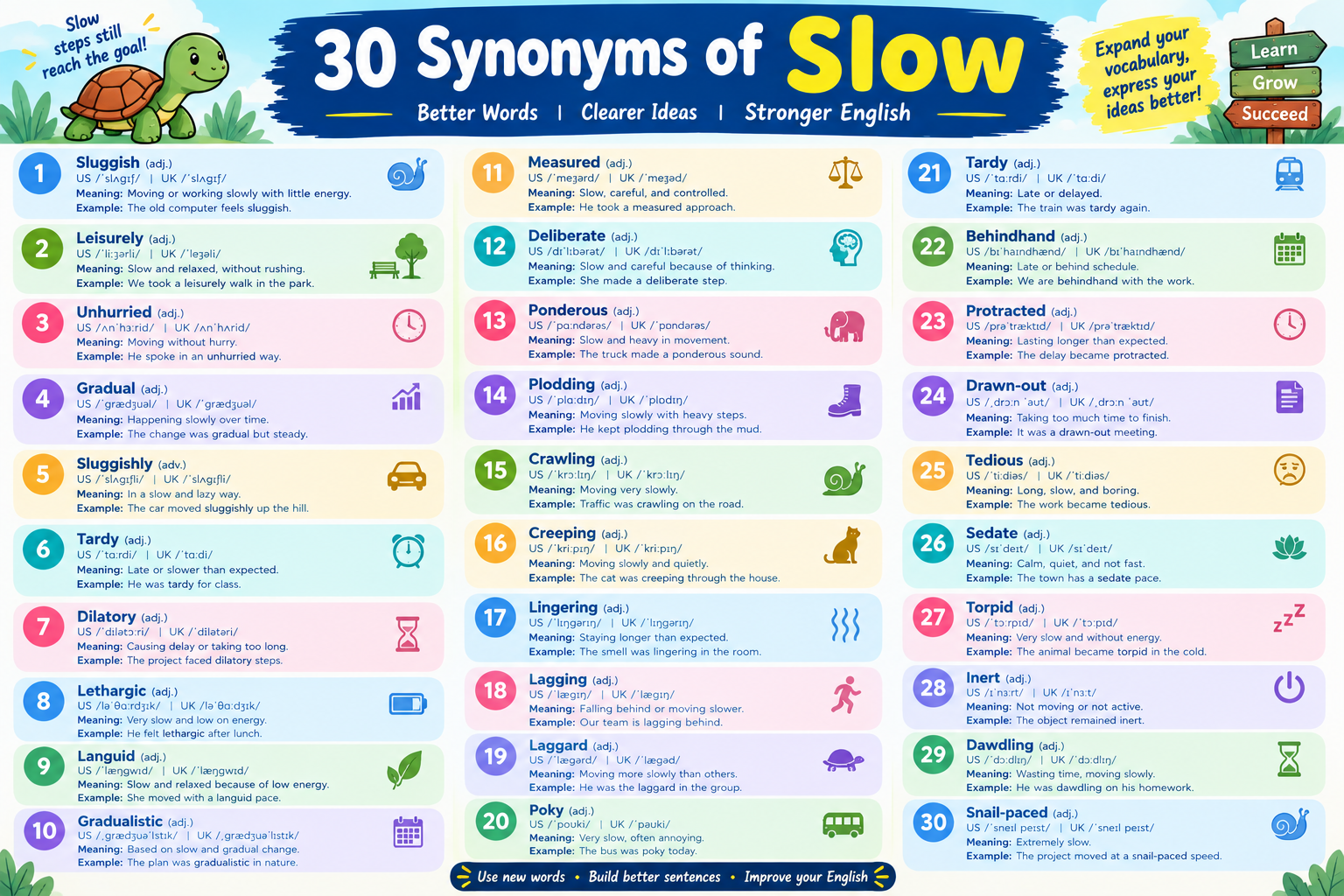
Slow means not moving or happening fast. Imagine you are waiting for a bus, but the bus is moving very slowly because the road is busy. You may say, “The bus is slow today.” We use slow often in daily English. It can describe people, cars, work, movement, speech, music, and even changes. Learning synonyms for slow can help English learners use better words in different situations. It also helps content writers make their work clear and interesting. Instead of using slow again and again, you can use words such as sluggish, gradual, unhurried, leisurely, or tardy when they fit. In this article, we will learn the meaning, examples, grammar, history, pronunciation, and 30 useful synonyms of slow. We will also group the synonyms by meaning to help you choose the right word.
Meaning of Slow
Definition
Slow (Adjective): Moving, happening, or working at a low speed.
Slow can also be used as a verb, adverb, and noun in different situations.
Examples
- The car is slow today.
- My computer is slow when I open many files.
Also read more about https://myprayerss.com/synonyms-of-however/
Connotative Meaning
- Positive tone: Slow can suggest calmness, care, and relaxation.
- Negative tone: Slow can suggest delay, poor progress, or lack of speed.
- Neutral tone: Slow can simply describe something that does not move or happen quickly.
Etymology
- Source: Old English slāw.
- Original meaning: “Sluggish,” “dull,” “lazy,” or “slow to act.”
- Related language: The word is from Germanic roots and has links with old Germanic words meaning dull or blunt.
Short History of Slow
Old English (450–1100):
The word appeared as slāw. It could mean sluggish, lazy, dull, or slow to act.
Middle English (1100–1500):
The word changed into forms such as slou and slow. Around the 1200s, it could describe something that took a long time. By the 1300s, it was also used for physical movement that was not fast.
Modern English (1500–Present):
Slow became a common word for low speed or slow progress. It also developed wider uses. Today, it can describe movement, work, speech, music, business, learning, and many other things. It is also used as a verb, meaning to make something less fast.
Pronunciation (US & UK – IPA)
US: /sloʊ/
UK: /sləʊ/
Syllables
slow
Affixation Pattern of Slow
Root: slow
Prefix: None
Suffix: None
Word formation:
- Adjective: slow, slower, slowest, slowish
- Adverb: slowly
- Noun: slowness
- Verb: slow, slowed, slowing
- Compound words: slowdown, slow-moving, slow-paced, slow-motion
The word slowly comes from slow + -ly, while slowness comes from slow + -ness.
Synonyms of Slow
The 30 words below include direct synonyms and close alternatives. Some focus on low speed, while others describe delay, lack of energy, or a relaxed pace.
1. Sluggish (Adjective) — US /ˈslʌɡɪʃ/ | UK /ˈslʌɡɪʃ/
Meaning: Moving or working slowly and with little energy.
Examples:
- The old computer feels sluggish.
- I felt sluggish after a long day.
2. Leisurely (Adjective) — US /ˈliːʒərli/ | UK /ˈleʒəli/
Meaning: Slow and relaxed, without rushing.
Examples:
- We took a leisurely walk in the park.
- She enjoyed a leisurely breakfast.
3. Unhurried (Adjective) — US /ʌnˈhɜːrid/ | UK /ʌnˈhʌrid/
Meaning: Moving or happening without hurry.
Examples:
- He took an unhurried walk home.
- She spoke in an unhurried way.
4. Gradual (Adjective) — US /ˈɡrædʒuəl/ | UK /ˈɡrædʒuəl/
Meaning: Happening slowly over time.
Examples:
- We saw a gradual change in the weather.
- Her progress was gradual but steady.
5. Sluggishly (Adverb) — US /ˈslʌɡɪʃli/ | UK /ˈslʌɡɪʃli/
Meaning: In a slow way with little energy.
Examples:
- The car moved sluggishly up the hill.
- The worker walked sluggishly after lunch.
6. Tardy (Adjective) — US /ˈtɑːrdi/ | UK /ˈtɑːdi/
Meaning: Late or slower than expected.
Examples:
- He was tardy for class.
- The train was tardy again today.
7. Dilatory (Adjective) — US /ˈdɪlətɔːri/ | UK /ˈdɪlətəri/
Meaning: Causing delay or taking too long to act.
Examples:
- His dilatory actions caused problems.
- The process was dilatory and frustrating.
8. Lethargic (Adjective) — US /ləˈθɑːrdʒɪk/ | UK /ləˈθɑːdʒɪk/
Meaning: Very slow and without much energy.
Examples:
- I felt lethargic after lunch.
- The hot weather made everyone lethargic.
9. Languid (Adjective) — US /ˈlæŋɡwɪd/ | UK /ˈlæŋɡwɪd/
Meaning: Slow and relaxed because of low energy.
Examples:
- He walked at a languid pace.
- The afternoon had a languid feel.
10. Gradualistic (Adjective) — US /ˌɡrædʒuəˈlɪstɪk/ | UK /ˌɡrædʒuəˈlɪstɪk/
Meaning: Based on slow and gradual change.
Examples:
- The group supported a gradualistic approach.
- They chose a gradualistic plan for change.
11. Measured (Adjective) — US /ˈmeʒərd/ | UK /ˈmeʒəd/
Meaning: Slow, careful, and controlled.
Examples:
- He took a measured approach.
- She spoke in a measured voice.
12. Deliberate (Adjective) — US /dɪˈlɪbərət/ | UK /dɪˈlɪbərət/
Meaning: Slow and careful because you are thinking about each step.
Examples:
- He made a deliberate movement.
- She took a deliberate step forward.
13. Ponderous (Adjective) — US /ˈpɑːndərəs/ | UK /ˈpɒndərəs/
Meaning: Moving or happening in a slow and heavy way.
Examples:
- The elephant made a ponderous movement.
- The story had a ponderous pace.
14. Plodding (Adjective) — US /ˈplɑːdɪŋ/ | UK /ˈplɒdɪŋ/
Meaning: Moving slowly with heavy steps.
Examples:
- The tired horse kept plodding along.
- He made a plodding walk through the rain.
15. Crawling (Adjective) — US /ˈkrɔːlɪŋ/ | UK /ˈkrɔːlɪŋ/
Meaning: Moving very slowly.
Examples:
- Traffic was crawling during rush hour.
- The line was crawling forward.
16. Creeping (Adjective) — US /ˈkriːpɪŋ/ | UK /ˈkriːpɪŋ/
Meaning: Moving very slowly and quietly.
Examples:
- The car was creeping through traffic.
- The fog was creeping across the road.
17. Lingering (Adjective) — US /ˈlɪŋɡərɪŋ/ | UK /ˈlɪŋɡərɪŋ/
Meaning: Staying or lasting longer than expected.
Examples:
- A lingering smell filled the room.
- The lingering rain delayed our trip.
18. Lagging (Adjective) — US /ˈlæɡɪŋ/ | UK /ˈlæɡɪŋ/
Meaning: Falling behind or moving more slowly than others.
Examples:
- Our team is lagging behind.
- The computer is lagging today.
19. Laggard (Adjective) — US /ˈlæɡərd/ | UK /ˈlæɡəd/
Meaning: Moving or developing more slowly than others.
Examples:
- The laggard team needed more time.
- The company was a laggard in the new market.
20. Poky (Adjective) — US /ˈpoʊki/ | UK /ˈpəʊki/
Meaning: Very slow, especially in an annoying way.
Examples:
- The poky bus made us late.
- Stop being so poky and get ready.
21. Tardy (Adjective) — US /ˈtɑːrdi/ | UK /ˈtɑːdi/
Meaning: Late or delayed.
Examples:
- His tardy reply caused a delay.
- The tardy delivery upset the customer.
22. Behindhand (Adjective) — US /bɪˈhaɪndhænd/ | UK /bɪˈhaɪndhænd/
Meaning: Late or behind the expected time.
Examples:
- We are behindhand with the project.
- The work is behindhand because of the rain.
23. Protracted (Adjective) — US /prəˈtræktɪd/ | UK /prəˈtræktɪd/
Meaning: Lasting longer than expected.
Examples:
- The meeting became protracted.
- They had a protracted discussion.
24. Drawn-out (Adjective) — US /ˌdrɔːn ˈaʊt/ | UK /ˌdrɔːn ˈaʊt/
Meaning: Taking too much time to finish.
Examples:
- It was a drawn-out meeting.
- The drawn-out process made people tired.
25. Tedious (Adjective) — US /ˈtiːdiəs/ | UK /ˈtiːdiəs/
Meaning: Too slow, long, and boring.
Examples:
- The work was tedious.
- The lesson became tedious after an hour.
26. Sedate (Adjective) — US /sɪˈdeɪt/ | UK /sɪˈdeɪt/
Meaning: Calm, quiet, and not fast.
Examples:
- The town has a sedate pace of life.
- We enjoyed a sedate evening at home.
27. Torpid (Adjective) — US /ˈtɔːrpɪd/ | UK /ˈtɔːpɪd/
Meaning: Very slow and without energy.
Examples:
- The animal became torpid in the cold.
- He felt torpid after the long journey.
28. Inert (Adjective) — US /ɪˈnɜːrt/ | UK /ɪˈnɜːt/
Meaning: Not moving or not active.
Examples:
- The machine remained inert.
- The body lay inert on the ground.
29. Dawdling (Adjective) — US /ˈdɔːdlɪŋ/ | UK /ˈdɔːdlɪŋ/
Meaning: Moving slowly because you are wasting time.
Examples:
- Stop dawdling and come inside.
- He was dawdling on the way home.
30. Snail-paced (Adjective) — US /ˈsneɪl peɪst/ | UK /ˈsneɪl peɪst/
Meaning: Extremely slow.
Examples:
- The traffic was snail-paced.
- The project moved at a snail-paced speed.
Prototype Meaning
The most common meaning of slow is not fast. When people hear slow, they often think of a car moving at low speed, a person walking slowly, or work that takes a long time. The word can also describe a process that develops little by little. In simple English, slow is often the opposite of fast or quick.
Prototype Categorization
The synonyms of slow can be grouped by their main meaning. These groups help writers choose the best word.
- Low speed: sluggish, crawling, creeping, plodding, snail-paced
- Slow and relaxed: leisurely, unhurried, languid, sedate
- Slow change: gradual, gradualistic, protracted
- Slow because of low energy: lethargic, languid, torpid, inert
- Slow because of delay: tardy, dilatory, behindhand, lagging
- Slow and careful: measured, deliberate
- Slow and boring: tedious, drawn-out, ponderous
- Slow movement: plodding, crawling, creeping, dawdling
This grouping helps writers avoid using slow in every sentence. For example, use leisurely for a relaxed walk, sluggish for something with little energy, and gradual for change that happens over time.
Antonyms of Slow
- Fast
- Quick
- Rapid
- Speedy
- Swift
- Rapid-fire
- Hasty
- Brisk
- Prompt
- Expeditious
Short Questions and Answers
- What does slow mean?
Slow means moving, happening, or working at a low speed. - When should slow be used?
Use slow when something does not move or happen quickly. It can describe people, vehicles, work, progress, speech, music, and many other things. - Is slow positive or negative?
It depends on the context. Slow can be positive when it means calm or relaxed. It can be negative when it means delayed or inefficient. - How is slow different from similar words?
Slow is a general word. Sluggish suggests low energy, leisurely suggests a relaxed pace, gradual describes slow change, and tardy means late or delayed.
Conclusion
Synonyms of slow can make your English vocabulary stronger. The word slow has many uses, so learning related words helps you choose the best word for each situation. Words like sluggish, leisurely, unhurried, gradual, crawling, measured, and tardy can make your writing clearer and more exact. These synonyms can also help you avoid repeating slow many times. They are useful in school writing, daily speaking, blogs, articles, stories, and other content. Try to learn a few new words each day. Write simple sentences with them and use them when you speak. With regular practice, you can improve your vocabulary, write better sentences, speak with more confidence, and express your ideas more clearly. Learning small groups of related words is a simple way to build strong English skills.