However means “in spite of that” or “but.” Picture this: you write an email that says, “The project is finished. However, we still need to fix a few small bugs.” That one word, “however,” turns the mood from good news to a small warning, and the reader knows to pay attention. This simple shift is one of the most common tools we use in writing and speech every day.
Because writers use contrast so often, “however” shows up again and again in essays, emails, and articles. This can make writing feel repetitive if the same word appears in every paragraph. This is why English learners and content writers need synonyms. New words let you show contrast in different tones, from formal writing to casual conversation. They also stop your writing from repeating “however” too many times.
This article covers the meaning of “however,” its emotional tone, its history, its pronunciation, and its word parts. Then it gives you 30 strong synonyms with clear meanings and example sentences.
Meaning of However
Definition
However (Adverb / Conjunction): A word used to show contrast between two ideas; it means “but” or “in spite of that.”
Examples
- The trip was long; however, it was worth every minute.
- She was tired. However, she finished the race.
Connotative Meaning
- Positive tone: used to soften bad news with a hopeful turn (“The test was hard, however, most students passed”)
- Negative tone: used to introduce a problem after good news (“The plan worked well; however, costs went up”)
- Neutral tone: simply linking two facts that differ (“The store opens at nine; however, it closes early on Sundays”)
Etymology
- “However” formed in Middle English by joining how and ever.
- The original meaning was “in whatever way” or “to whatever degree,” describing manner or extent, not contrast.
- Over time, the word narrowed to focus on contrast, taking on the modern sense of “but” or “nevertheless.”
Short History
- Old English (450–1100): “How” existed, but it had not yet joined with “ever.” Contrast was shown with words like “þeah” (though) or “ac” (but).
- Middle English (1100–1500): “How” and “ever” combined to form “however,” first meaning “in whatever manner.” It slowly began to be used for contrast as well.
- Modern English (1500–Present): “However” became a standard word for showing contrast, especially in formal writing that links two opposing ideas.
Pronunciation (US & UK – IPA)
- US: /haʊˈɛvər/
- UK: /haʊˈɛvə/
Syllables
how-ev-er
Affixation Pattern of However
- Root: how + ever (a compound of two whole words)
- Prefix: none
- Suffix: none
Word formation
Unlike most words in this series, “however” is not built from a root plus prefixes or suffixes. It is a compound word, formed by joining “how” and “ever” into one fixed term. It functions only as an adverb or conjunction and does not commonly branch into other grammatical forms.
Also read more https://myprayerss.com/synonyms-for-different/
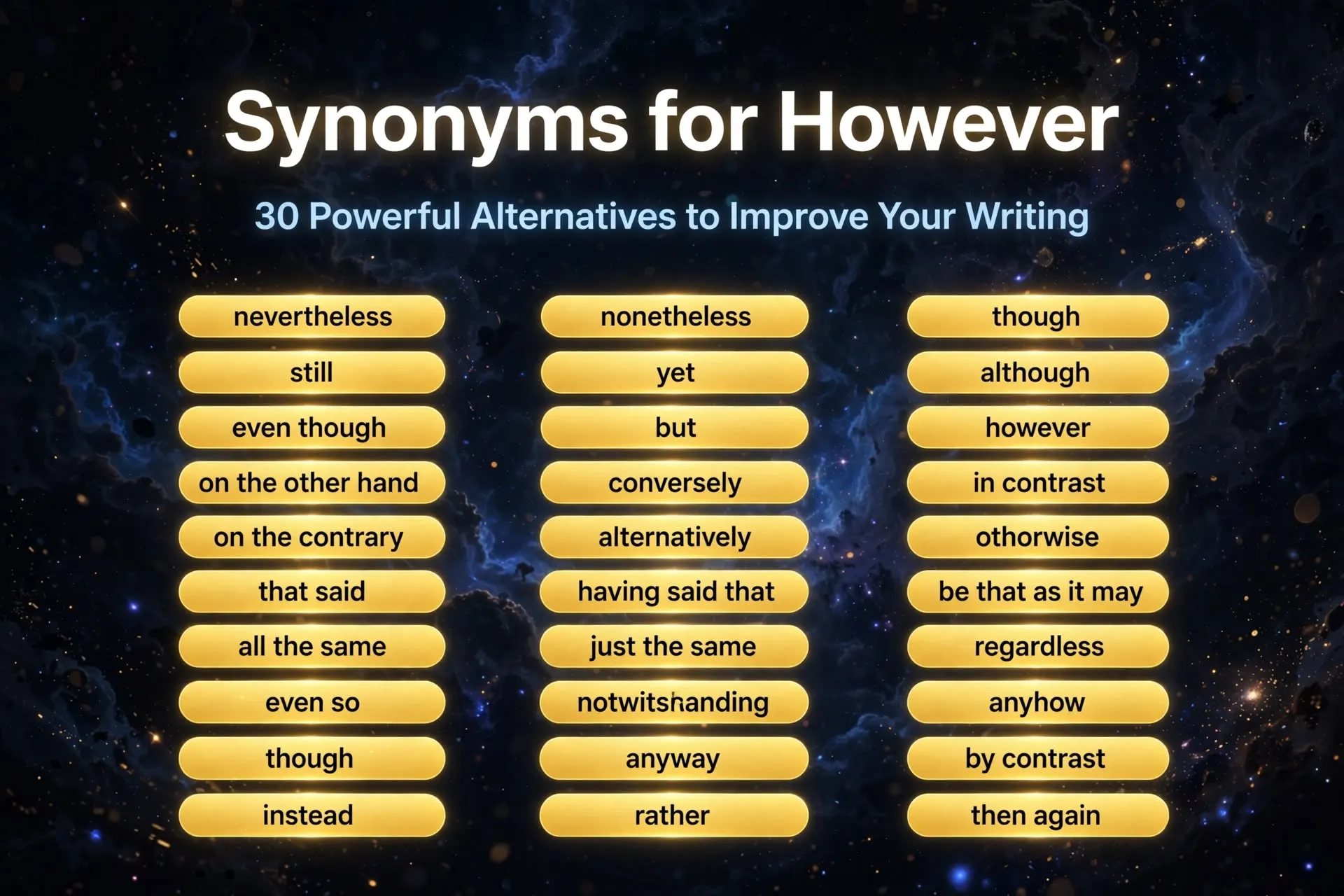
Synonyms of However
1. Nevertheless (Adverb) — US /ˌnɛvərðəˈlɛs/ | UK /ˌnɛvəðəˈlɛs/
Meaning: In spite of what was just said; still.
Examples:
- The rain was heavy; nevertheless, they went hiking.
- He was nervous. Nevertheless, he gave a great speech.
2. Nonetheless (Adverb) — US /ˌnʌnðəˈlɛs/ | UK /ˌnʌnðəˈlɛs/
Meaning: Despite that; even so.
Examples:
- The task was hard; nonetheless, she finished on time.
- He lost the match. Nonetheless, he stayed positive.
3. Still (Adverb) — US /stɪl/ | UK /stɪl/
Meaning: A simple word for continuing contrast.
Examples:
- The traffic was bad. Still, we made it on time.
- She was upset, but still, she smiled.
4. Yet (Conjunction) — US /jɛt/ | UK /jɛt/
Meaning: A short word for “but” or “however.”
Examples:
- He studied hard, yet he failed the test.
- The plan was risky, yet it worked out well.
5. Though (Conjunction) — US /ðoʊ/ | UK /ðəʊ/
Meaning: A casual word for showing contrast.
Examples:
- I like the design. It’s expensive, though.
- She agreed, though she had doubts.
6. Although (Conjunction) — US /ɔlˈðoʊ/ | UK /ɔːlˈðəʊ/
Meaning: A formal word for “even though” or “however.”
Examples:
- Although it rained, the game continued.
- He smiled, although he felt nervous.
7. But (Conjunction) — US /bʌt/ | UK /bʌt/
Meaning: The most common word for showing contrast.
Examples:
- She wanted to stay, but she had to leave.
- The food was good, but the service was slow.
8. Conversely (Adverb) — US /kənˈvɜrsli/ | UK /kənˈvɜːsli/
Meaning: In an opposite way to what was just stated.
Examples:
- Sales rose in summer. Conversely, they dropped in winter.
- He works fast; conversely, his brother is slow and careful.
9. On the Other Hand (Phrase) — US /ɑn ðə ˈʌðər hænd/ | UK /ɒn ði ˈʌðə hænd/
Meaning: Used to show a different or opposite point.
Examples:
- The city is exciting. On the other hand, it’s very noisy.
- He loves sports; on the other hand, his sister prefers books.
10. In Contrast (Phrase) — US /ɪn ˈkɑntræst/ | UK /ɪn ˈkɒntrɑːst/
Meaning: Used to point out a clear difference.
Examples:
- The first plan was cheap. In contrast, the second cost twice as much.
- In contrast to last year, sales have doubled.
11. Notwithstanding (Preposition / Adverb) — US /ˌnɑtwɪθˈstændɪŋ/ | UK /ˌnɒtwɪθˈstændɪŋ/
Meaning: A formal word meaning “despite” or “however.”
Examples:
- The risks notwithstanding, they moved forward with the plan.
- Notwithstanding the delay, the event was a success.
12. Despite This (Phrase) — US /dɪˈspaɪt ðɪs/ | UK /dɪˈspaɪt ðɪs/
Meaning: Even with this fact being true.
Examples:
- The road was closed. Despite this, we found another way.
- Despite this setback, the team kept working.
13. Even So (Adverb) — US /ˈivən soʊ/ | UK /ˈiːvən səʊ/
Meaning: In spite of that fact.
Examples:
- It was late. Even so, she finished her homework.
- The budget was tight; even so, they threw a great party.
14. That Said (Phrase) — US /ðæt sɛd/ | UK /ðæt sɛd/
Meaning: Used to add a contrasting point after a statement.
Examples:
- The idea is good. That said, we need more data.
- He’s talented. That said, he needs more practice.
15. Having Said That (Phrase) — US /ˈhævɪŋ sɛd ðæt/ | UK /ˈhævɪŋ sɛd ðæt/
Meaning: A phrase for adding a contrast after a statement.
Examples:
- The trip was fun. Having said that, it was also tiring.
- She’s strict. Having said that, she’s very fair.
16. All the Same (Phrase) — US /ɔl ðə seɪm/ | UK /ɔːl ðə seɪm/
Meaning: Despite everything just mentioned.
Examples:
- It was cold outside. All the same, they went for a run.
- He disagreed, but he helped all the same.
17. Regardless (Adverb) — US /rɪˈɡɑrdləs/ | UK /rɪˈɡɑːdləs/
Meaning: Without being affected by what was just said.
Examples:
- The odds were low. Regardless, she tried her best.
- Regardless of the cost, they bought the house.
18. Be That as It May (Phrase) — US /bi ðæt æz ɪt meɪ/ | UK /biː ðæt æz ɪt meɪ/
Meaning: A formal way of saying “however that may be.”
Examples:
- He may be right. Be that as it may, we still need proof.
- The plan is risky. Be that as it may, we should try it.
19. In Spite of This (Phrase) — US /ɪn spaɪt əv ðɪs/ | UK /ɪn spaɪt əv ðɪs/
Meaning: Even though this is true.
Examples:
- The team was small. In spite of this, they won the game.
- In spite of this problem, the launch went smoothly.
20. On the Contrary (Phrase) — US /ɑn ðə ˈkɑntrɛri/ | UK /ɒn ðə ˈkɒntrəri/
Meaning: Used to state the opposite of what was expected.
Examples:
- I’m not upset. On the contrary, I’m quite happy.
- On the contrary, the results were excellent.
21. Whereas (Conjunction) — US /wɛrˈæz/ | UK /weərˈæz/
Meaning: A formal word to compare two different facts.
Examples:
- She loves the city, whereas he prefers the countryside.
- The old model was slow, whereas the new one is fast.
22. Alternatively (Adverb) — US /ɔlˈtɜrnətɪvli/ | UK /ɔːlˈtɜːnətɪvli/
Meaning: Used to introduce another possible choice.
Examples:
- We could drive there. Alternatively, we could take the train.
- Alternatively, you can pay online instead of in person.
23. Just the Same (Phrase) — US /dʒʌst ðə seɪm/ | UK /dʒʌst ðə seɪm/
Meaning: Despite everything, in the same way as before.
Examples:
- He was scared, but he climbed the ladder just the same.
- The weather was bad; just the same, they had fun.
24. At the Same Time (Phrase) — US /æt ðə seɪm taɪm/ | UK /æt ðə seɪm taɪm/
Meaning: Used to add a contrasting idea while agreeing partly.
Examples:
- I like the plan. At the same time, I have some concerns.
- The job is exciting; at the same time, it’s very demanding.
25. For All That (Phrase) — US /fɔr ɔl ðæt/ | UK /fɔː ɔːl ðæt/
Meaning: Despite everything that was said before.
Examples:
- He’s difficult to work with. For all that, he’s very talented.
- The house is old. For all that, it has real charm.
26. Albeit (Conjunction) — US /ɔlˈbiɪt/ | UK /ɔːlˈbiːɪt/
Meaning: A formal word meaning “although” or “even though.”
Examples:
- The plan worked, albeit slowly.
- She agreed, albeit with some hesitation.
27. But Then (Phrase) — US /bʌt ðɛn/ | UK /bʌt ðɛn/
Meaning: A casual way to add a contrast or afterthought.
Examples:
- He seemed rude. But then, he was having a bad day.
- The price was high. But then, the quality was excellent.
28. Contrarily (Adverb) — US /kənˈtrɛrəli/ | UK /kənˈtrɛərəli/
Meaning: In a way that goes against what was just said.
Examples:
- He expected to lose. Contrarily, he won by a wide margin.
- The forecast said rain; contrarily, the sky stayed clear.
29. Still and All (Phrase) — US /stɪl ænd ɔl/ | UK /stɪl ænd ɔːl/
Meaning: A casual phrase meaning “even so” or “however.”
Examples:
- It was a small win. Still and all, we celebrated.
- The trip was tiring. Still and all, it was worth it.
30. Howbeit (Adverb) — US /haʊˈbiɪt/ | UK /haʊˈbiːɪt/
Meaning: An old-fashioned word for “however” or “nevertheless.”
Examples:
- The path was long, howbeit, they reached the top.
- Howbeit, the results proved him right in the end.
Prototype Meaning
When most people hear the word “however,” they picture a sentence that starts one way and then turns, usually to add a problem, a warning, or a different point of view. It brings to mind the small pause before a “but” moment in speech or writing. This simple picture is the core meaning of the word. Other uses, like starting a paragraph with “However,” grow out of this same basic idea of shifting from one idea to a contrasting one.
Prototype Categorization
- Formal contrast connectors: nevertheless, nonetheless, notwithstanding, whereas, albeit, howbeit
- Casual, everyday contrast words: still, yet, but, though, even so, all the same, just the same, but then
- Phrase-based transitions: on the other hand, in contrast, despite this, in spite of this, on the contrary, that said, having said that, be that as it may, for all that, still and all, at the same time
- Alternative-view connectors: conversely, alternatively, contrarily, regardless
Antonyms of However
Since “however” is a transition word, its opposite is a word that shows agreement or addition rather than contrast: moreover, furthermore, additionally, likewise, similarly
Short Questions and Answers
- What does “however” mean?
It means “but” or “in spite of that”; it is used to show contrast between two ideas. - When should “however” be used?
Use it to connect two sentences or ideas that oppose or differ from each other. - Is “however” positive or negative?
It is neutral by itself. It can soften bad news or introduce a small problem, depending on the sentences around it. - How is it different from similar words?
“But” is short and casual, while “nevertheless” and “notwithstanding” sound more formal. “On the other hand” often compares two equal but different options, and “however” is the general, flexible word that fits most contrast situations.
Conclusion
Synonyms for however gives you many ways to show contrast, from a quick, casual “but” to a formal “notwithstanding.” It helps you avoid using the same word again and again in your writing or speech. It also makes your English sound more natural and skilled. Each new synonym adds a small tool to your vocabulary kit, ready for the right moment. Try using one new synonym each day in a sentence of your own. Over time, this small habit builds real confidence in both writing and speaking English.