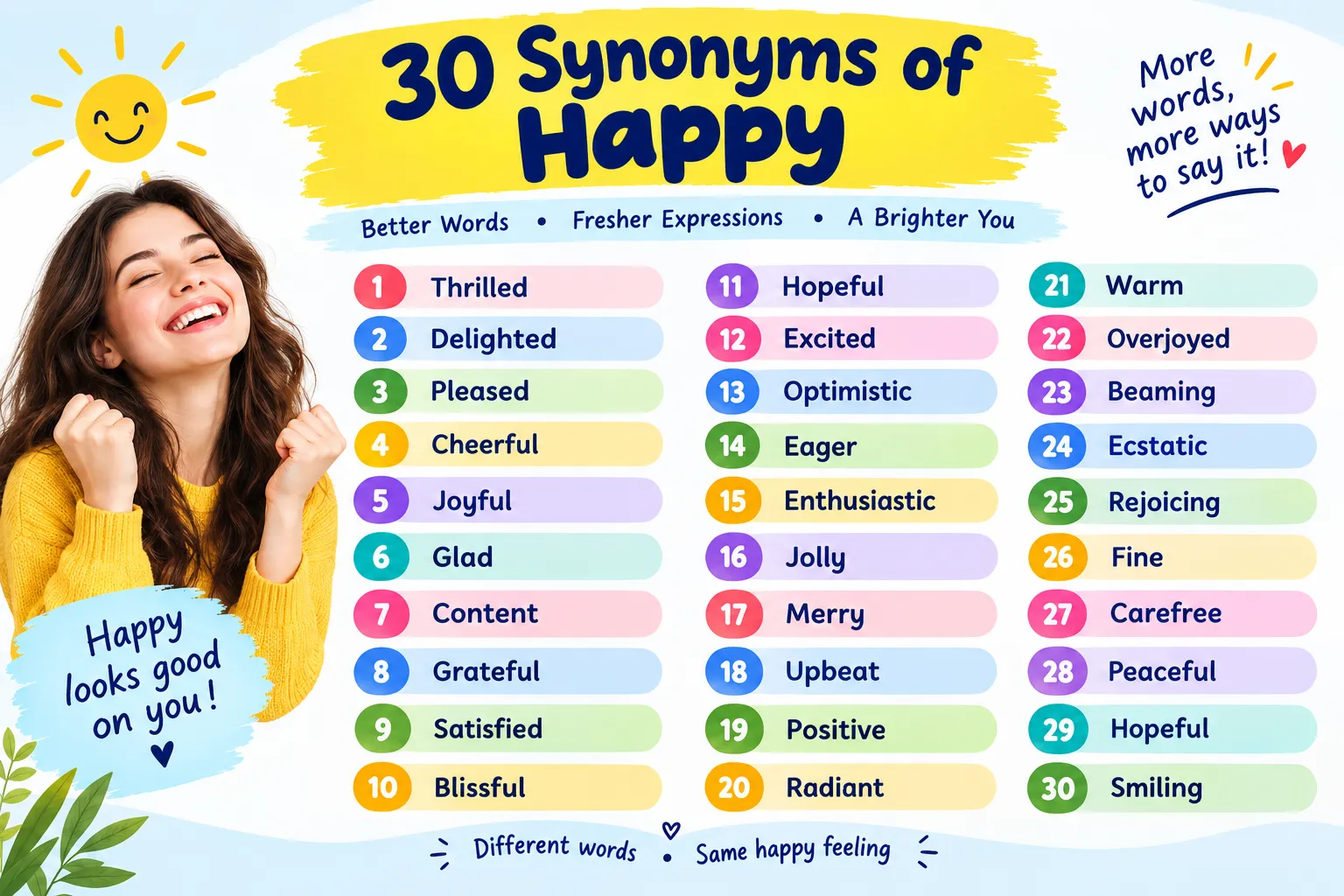
Happy means feeling good and glad. For example, Ali gets a new toy from his father. He smiles and feels happy. We use the word happy many times in daily English. We can be happy when we get good news, meet a friend, win a game, or spend time with our family. English learners should learn synonyms because they give us more words to talk and write about feelings. Writers also use synonyms so they do not use the same word again and again. In this article, we will learn the meaning of happy, its synonyms, examples, pronunciation, word history, word forms, and opposite words. We will also learn how different synonyms can show different kinds of happiness.
Meaning of Happy
Definition
Happy (Adjective): feeling good, glad, or pleased.
Examples
- I am happy today.
- She is happy with her new dress.
Connotative Meaning
- Positive tone: Happy gives a good and pleasant feeling.
- Negative tone: Happy is usually not negative, but the sentence can make it sound different.
- Neutral tone: It can simply tell us how a person feels.
Etymology
- Source language: The word happy came from Middle English.
- Old root: It is linked to hap, which means chance or luck.
- Original idea: A person who had good luck could be called happy.
- also read more about https://myprayerss.com/synonyms-for-beautiful/
Short History
Old English (450–1100): People used other words to talk about joy and good luck.
Middle English (1100–1500): The word happy became part of English. It first had a strong link with luck and good fortune.
Modern English (1500–Present): Happy became a common word for feeling glad, pleased, and good.
Pronunciation (US & UK – IPA)
US: /ˈhæp.i/ UK: /ˈhæp.i/
Syllables
hap-py
Affixation Pattern of Happy
- Root: hap
- Prefix: None
- Suffix: -y
- Word type: Adjective
Word Forms
- happy — adjective
- happiness — noun
- happily — adverb
- unhappy — adjective
- happier — adjective
- happiest — adjective
Synonyms of Happy
1. Glad (Adjective) — US /ɡlæd/ | UK /ɡlæd/
Meaning: Feeling happy about something.
Examples:
- I am glad to see you.
- She is glad about the news.
2. Joyful (Adjective) — US /ˈdʒɔɪ.fəl/ | UK /ˈdʒɔɪ.fəl/
Meaning: Feeling great joy.
Examples:
- The children were joyful.
- She had a joyful smile.
3. Cheerful (Adjective) — US /ˈtʃɪr.fəl/ | UK /ˈtʃɪə.fəl/
Meaning: Happy and full of good feelings.
Examples:
- Tom is cheerful today.
- She has a cheerful face.
4. Pleased (Adjective) — US /pliːzd/ | UK /pliːzd/
Meaning: Feeling happy about something.
Examples:
- I am pleased with my work.
- Dad was pleased with me.
5. Delighted (Adjective) — US /dɪˈlaɪ.tɪd/ | UK /dɪˈlaɪ.tɪd/
Meaning: Very happy.
Examples:
- She was delighted with her gift.
- I was delighted to see him.
6. Thrilled (Adjective) — US /θrɪld/ | UK /θrɪld/
Meaning: Very excited and happy.
Examples:
- I was thrilled to win.
- She was thrilled by the news.
7. Excited (Adjective) — US /ɪkˈsaɪ.tɪd/ | UK /ɪkˈsaɪ.tɪd/
Meaning: Very happy about something that will happen.
Examples:
- I am excited about the trip.
- The children are excited.
8. Cheerful (Adjective) — US /ˈtʃɪr.fəl/ | UK /ˈtʃɪə.fəl/
Meaning: Having a happy mood.
Examples:
- He looks cheerful.
- She is always cheerful.
Better unique word: Merry can also be used instead.
9. Merry (Adjective) — US /ˈmer.i/ | UK /ˈmer.i/
Meaning: Happy and full of fun.
Examples:
- We had a merry party.
- Everyone was merry.
10. Content (Adjective) — US /kənˈtent/ | UK /kənˈtent/
Meaning: Happy with what you have.
Examples:
- He is content with his life.
- She felt content at home.
11. Satisfied (Adjective) — US /ˈsæt̬.ɪs.faɪd/ | UK /ˈsæt.ɪs.faɪd/
Meaning: Happy because something is good enough.
Examples:
- I am satisfied with my work.
- The customer was satisfied.
12. Elated (Adjective) — US /ɪˈleɪ.tɪd/ | UK /ɪˈleɪ.tɪd/
Meaning: Very, very happy.
Examples:
- She was elated after the win.
- He felt elated that day.
13. Ecstatic (Adjective) — US /ɪkˈstæt̬.ɪk/ | UK /ɪkˈstæt.ɪk/
Meaning: Extremely happy.
Examples:
- She was ecstatic about the prize.
- The fans were ecstatic.
14. Overjoyed (Adjective) — US /ˌoʊ.vɚˈdʒɔɪd/ | UK /ˌəʊ.vəˈdʒɔɪd/
Meaning: Extremely happy.
Examples:
- Mom was overjoyed.
- They were overjoyed by the news.
15. Blissful (Adjective) — US /ˈblɪs.fəl/ | UK /ˈblɪs.fəl/
Meaning: Very happy and peaceful.
Examples:
- We had a blissful day.
- She felt blissful at home.
16. Gleeful (Adjective) — US /ˈɡliː.fəl/ | UK /ˈɡliː.fəl/
Meaning: Very happy and excited.
Examples:
- The boy was gleeful.
- She gave a gleeful laugh.
17. Upbeat (Adjective) — US /ˈʌp.biːt/ | UK /ˈʌp.biːt/
Meaning: Happy and positive.
Examples:
- He has an upbeat mood.
- She stayed upbeat.
18. Lighthearted (Adjective) — US /ˌlaɪtˈhɑːr.tɪd/ | UK /ˌlaɪtˈhɑːr.tɪd/
Meaning: Happy and without worry.
Examples:
- We had a lighthearted talk.
- It was a lighthearted movie.
19. Radiant (Adjective) — US /ˈreɪ.di.ənt/ | UK /ˈreɪ.di.ənt/
Meaning: Looking very happy.
Examples:
- She looked radiant.
- Her radiant smile was beautiful.
20. Jubilant (Adjective) — US /ˈdʒuː.bə.lənt/ | UK /ˈdʒuː.bə.lənt/
Meaning: Very happy after a success.
Examples:
- The team was jubilant.
- The crowd was jubilant.
21. Exuberant (Adjective) — US /ɪɡˈzuː.bɚ.ənt/ | UK /ɪɡˈzjuː.bər.ənt/
Meaning: Very happy and full of energy.
Examples:
- The children were exuberant.
- He has an exuberant smile.
22. Buoyant (Adjective) — US /ˈbɔɪ.ənt/ | UK /ˈbɔɪ.ənt/
Meaning: Happy and hopeful.
Examples:
- She felt buoyant after the news.
- He stayed buoyant.
23. Hopeful (Adjective) — US /ˈhoʊp.fəl/ | UK /ˈhəʊp.fəl/
Meaning: Feeling good about the future.
Examples:
- I feel hopeful today.
- She is hopeful about her test.
24. Optimistic (Adjective) — US /ˌɑːp.təˈmɪs.tɪk/ | UK /ˌɒp.tɪˈmɪs.tɪk/
Meaning: Thinking that good things will happen.
Examples:
- He is optimistic about the future.
- She is optimistic about her work.
25. Serene (Adjective) — US /səˈriːn/ | UK /səˈriːn/
Meaning: Calm and peaceful.
Examples:
- The lake looked serene.
- She felt serene and calm.
26. Eager (Adjective) — US /ˈiː.ɡɚ/ | UK /ˈiː.ɡə/
Meaning: Very excited to do something.
Examples:
- The children were eager to play.
- I am eager to learn.
27. Fortunate (Adjective) — US /ˈfɔːr.tʃə.nət/ | UK /ˈfɔː.tʃə.nət/
Meaning: Lucky or having good luck.
Examples:
- I feel fortunate to have good friends.
- We were fortunate to be safe.
28. Sanguine (Adjective) — US /ˈsæŋ.ɡwɪn/ | UK /ˈsæŋ.ɡwɪn/
Meaning: Calm and hopeful.
Examples:
- She was sanguine about the plan.
- He stayed sanguine during the problem.
29. Tickled (Adjective) — US /ˈtɪkəld/ | UK /ˈtɪkəld/
Meaning: Very pleased or amused.
Examples:
- I was tickled by the gift.
- She was tickled to hear the news.
30. Blithe (Adjective) — US /blaɪð/ | UK /blaɪð/
Meaning: Happy and carefree.
Examples:
- She had a blithe smile.
- He was blithe and cheerful.
Prototype Meaning
The most common meaning of happy is feeling good and pleased. When people hear the word happy, they often think of a person who is smiling, laughing, enjoying time with others, or getting good news. It is a simple word for a good feeling.
Prototype Categorization
- Simple happiness: glad, cheerful, merry
- Strong happiness: delighted, thrilled, elated
- Very strong happiness: ecstatic, overjoyed, jubilant
- Peaceful happiness: content, blissful, serene
- Positive feelings: upbeat, hopeful, optimistic
- Excited feelings: excited, eager, gleeful
- Lucky feelings: fortunate
- Carefree feelings: blithe, lighthearted
Antonyms of Happy
- Sad — feeling bad or unhappy
- Unhappy — not happy
- Miserable — very unhappy
- Gloomy — sad and without hope
- Upset — unhappy or worried
- Disappointed — sad because something did not happen as expected
- Dissatisfied — not happy with something
- Sorrowful — very sad
Short Questions and Answers
- What does happy mean? Happy means feeling good, glad, or pleased.
- When should happy be used? Use happy when you want to talk about a good or pleasant feeling.
- Is happy positive or negative? Happy is usually a positive word.
- How is happy different from similar words? Happy is a general word. Glad is often used for good news. Content means quietly happy. Ecstatic means extremely happy.
Conclusion
Synonyms of Happy can make your English better. Synonyms of Happy include words like glad, joyful, cheerful, pleased, delighted, and thrilled. These words help you talk about happy feelings in different ways. Learning Synonyms of Happy can also make your speaking and writing more interesting. They help you avoid using the same word again and again. When you know more Synonyms of Happy, you can explain your ideas more clearly. This can build your English confidence. Try to learn three new synonyms each day. Write a simple sentence with each word and use the words when you speak. With daily practice, your vocabulary will grow. Remember, you do not need to learn every word at once. Start with easy words and slowly learn more.