Cold means having a low temperature. Picture this: you step outside in January without a coat, and the wind cuts right through your sweater. Your hands turn red, and your breath shows in the air. You feel cold. This is one of the most common physical feelings people describe, from a cold winter morning to a cold drink on a hot day.
Because weather and temperature affect us every day, the word “cold” comes up again and again in conversation and writing. This can make our sentences feel plain if we always use the same word. This is why English learners and content writers need synonyms. New words let you describe cold weather, cold objects, and even cold personalities in fresh, exact ways. They also stop your writing from repeating “cold” too many times.
This article covers the meaning of “cold,” its emotional tone, its history, its pronunciation, and its word parts. Then it gives you 30 strong synonyms with clear meanings and example sentences.
Meaning of Cold
Definition
Cold (Adjective): Having a low temperature; not warm or hot.
Examples
- The cold wind made her pull her scarf tighter.
- He drank a glass of cold water after the run.
Connotative Meaning
- Positive tone: refreshing, crisp, energizing (a “cold, refreshing drink”)
- Negative tone: unfriendly, distant, harsh (a “cold reply” from a friend)
- Neutral tone: simply describing low temperature (“The room felt cold”)
Etymology
- “Cold” comes from the Old English word ceald, meaning “cold” or “cool.”
- This root traces back to the Proto-Germanic word kaldaz, and further to the Proto-Indo-European root gel-, meaning “cold.” This same ancient root also gave English words like “gelid” and “congeal.”
- The word has kept a very similar sound and meaning across more than a thousand years of English.
Short History
- Old English (450–1100): “Ceald” described low temperature, much as “cold” does today.
- Middle English (1100–1500): The spelling shifted toward “cold.” The word began to be used for unfriendly or distant behavior, not just temperature.
- Modern English (1500–Present): “Cold” kept its temperature meaning and fully developed its figurative use for emotional distance, as in “a cold reception” or “a cold-hearted person.”
Pronunciation (US & UK – IPA)
- US: /koʊld/
- UK: /kəʊld/
Syllables
cold (one syllable)
Affixation Pattern of Cold
- Root: cold
- Prefix: none common
- Suffix: -ly, -ness
Word formation
From the root “cold,” English builds several words: coldness (noun), coldly (adverb), and cold-hearted (a compound adjective describing an unkind person). This shows how one small root grows into several useful words across both literal and figurative meanings.
Also read more https://myprayerss.com/synonyms-for-slow/
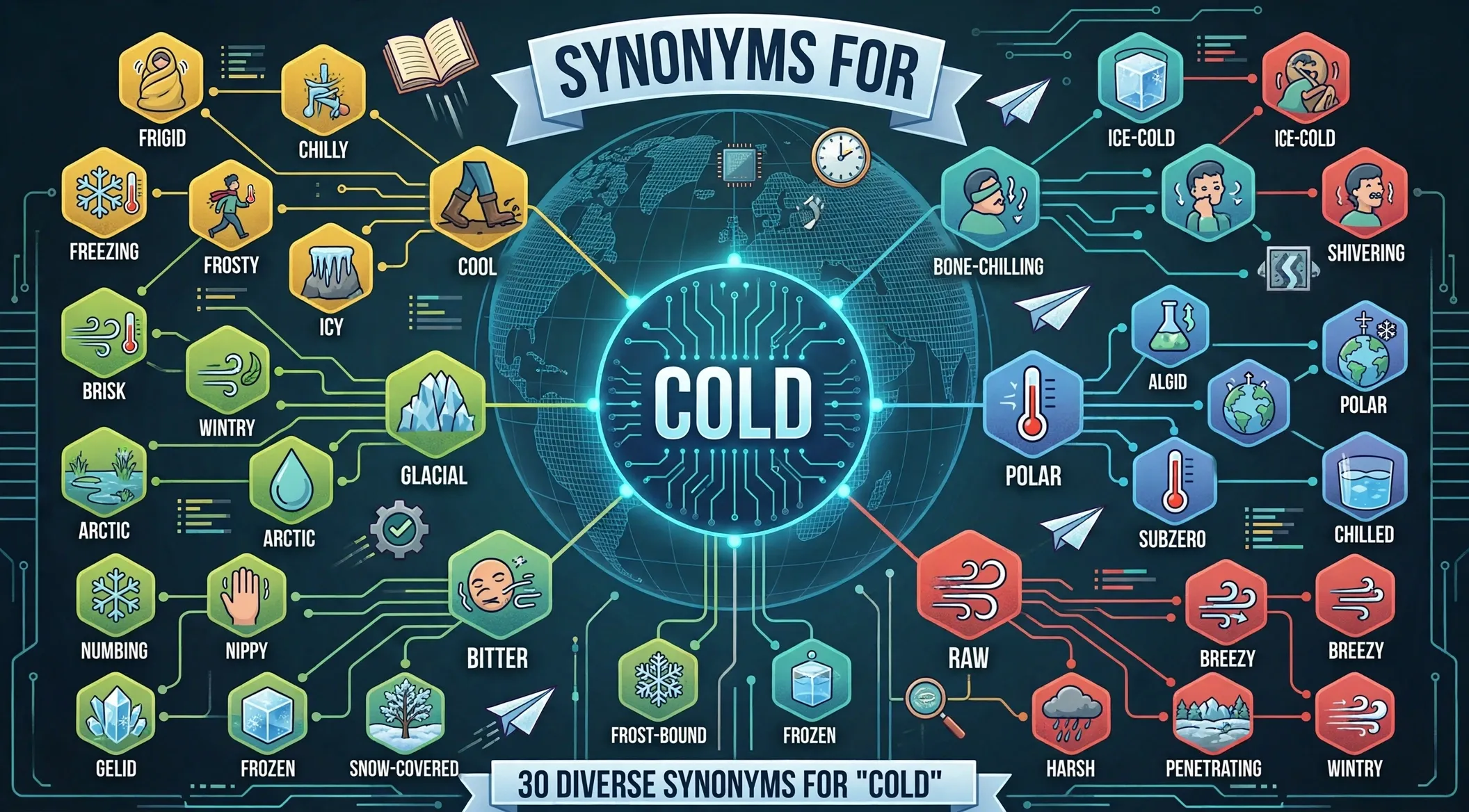
Synonyms of Cold
1. Chilly (Adjective) — US /ˈtʃɪli/ | UK /ˈtʃɪli/
Meaning: Slightly cold, enough to notice.
Examples:
- It was a chilly morning, so she wore a light jacket.
- The chilly breeze made him shiver.
2. Freezing (Adjective) — US /ˈfrizɪŋ/ | UK /ˈfriːzɪŋ/
Meaning: Extremely cold, near or below freezing point.
Examples:
- It was freezing outside, so we stayed indoors.
- Her fingers felt freezing after the snowball fight.
3. Frosty (Adjective) — US /ˈfrɔsti/ | UK /ˈfrɒsti/
Meaning: Cold enough to form frost.
Examples:
- The frosty grass crunched under their boots.
- We woke up to a frosty window.
4. Icy (Adjective) — US /ˈaɪsi/ | UK /ˈaɪsi/
Meaning: Extremely cold, like ice.
Examples:
- The icy road made driving dangerous.
- An icy wind blew across the lake.
5. Frigid (Adjective) — US /ˈfrɪdʒɪd/ | UK /ˈfrɪdʒɪd/
Meaning: Very cold, often used for extreme weather.
Examples:
- The frigid Arctic winds tested the explorers.
- It was a frigid night with no shelter in sight.
6. Cool (Adjective) — US /kul/ | UK /kuːl/
Meaning: Slightly cold in a pleasant, mild way.
Examples:
- A cool breeze came through the window.
- The water felt cool on her tired feet.
7. Wintry (Adjective) — US /ˈwɪntri/ | UK /ˈwɪntri/
Meaning: Cold in the manner of winter weather.
Examples:
- Wintry skies covered the town all week.
- They enjoyed a wintry walk through the snow.
8. Bitter (Adjective) — US /ˈbɪtər/ | UK /ˈbɪtə/
Meaning: Harshly cold, hard to bear.
Examples:
- A bitter wind cut through their coats.
- It was a bitter cold morning at the bus stop.
9. Nippy (Adjective) — US /ˈnɪpi/ | UK /ˈnɪpi/
Meaning: A casual word for sharply cold.
Examples:
- It’s a bit nippy out today, so grab a jacket.
- The nippy air woke her up on the walk.
10. Raw (Adjective) — US /rɔ/ | UK /rɔː/
Meaning: Cold and damp, often uncomfortable.
Examples:
- The raw wind off the sea chilled them to the bone.
- It was a raw, gray winter day.
11. Arctic (Adjective) — US /ˈɑrktɪk/ | UK /ˈɑːktɪk/
Meaning: Extremely cold, like the Arctic region.
Examples:
- Arctic temperatures froze the entire lake.
- She wore three layers against the arctic chill.
12. Glacial (Adjective) — US /ˈɡleɪʃəl/ | UK /ˈɡleɪsiəl/
Meaning: Extremely cold, like the ice of a glacier.
Examples:
- A glacial wind swept across the mountain.
- The room felt glacial without any heating.
13. Frozen (Adjective) — US /ˈfroʊzən/ | UK /ˈfrəʊzən/
Meaning: So cold that liquid turns solid.
Examples:
- The frozen pond was safe for skating.
- Her hands felt frozen after the walk.
14. Bone-chilling (Adjective) — US /ˈboʊn ˌtʃɪlɪŋ/ | UK /ˈbəʊn ˌtʃɪlɪŋ/
Meaning: So cold it feels like it reaches your bones.
Examples:
- A bone-chilling wind blew through the valley.
- It was a bone-chilling night to be camping.
15. Brisk (Adjective) — US /brɪsk/ | UK /brɪsk/
Meaning: Pleasantly cold and refreshing.
Examples:
- They took a brisk walk on the crisp morning.
- The brisk air felt good after the stuffy office.
16. Crisp (Adjective) — US /krɪsp/ | UK /krɪsp/
Meaning: Cold and clear, often describing fresh air.
Examples:
- The crisp autumn air smelled of fallen leaves.
- It was a crisp, clear winter day.
17. Numbing (Adjective) — US /ˈnʌmɪŋ/ | UK /ˈnʌmɪŋ/
Meaning: So cold it makes your body feel numb.
Examples:
- The numbing cold made her fingers hard to move.
- A numbing chill spread through the cabin.
18. Piercing (Adjective) — US /ˈpɪrsɪŋ/ | UK /ˈpɪəsɪŋ/
Meaning: Sharply cold, as if it cuts through you.
Examples:
- A piercing wind blew off the mountain.
- The piercing cold woke him up instantly.
19. Biting (Adjective) — US /ˈbaɪtɪŋ/ | UK /ˈbaɪtɪŋ/
Meaning: Harshly cold and sharp.
Examples:
- The biting wind stung their faces.
- It was a biting cold night at the game.
20. Polar (Adjective) — US /ˈpoʊlər/ | UK /ˈpəʊlə/
Meaning: Extremely cold, like the polar regions.
Examples:
- Polar temperatures gripped the northern towns.
- The polar wind chilled everyone at the station.
21. Aloof (Adjective) — US /əˈluf/ | UK /əˈluːf/
Meaning: Emotionally cold and distant from others.
Examples:
- He stayed aloof during the party.
- Her aloof manner made her hard to approach.
22. Unfeeling (Adjective) — US /ʌnˈfilɪŋ/ | UK /ʌnˈfiːlɪŋ/
Meaning: Showing no warmth or care toward others.
Examples:
- His unfeeling reply hurt her deeply.
- The unfeeling manager ignored their concerns.
23. Distant (Adjective) — US /ˈdɪstənt/ | UK /ˈdɪstənt/
Meaning: Emotionally cold and hard to connect with.
Examples:
- He seemed distant after the argument.
- Her distant tone worried her friends.
24. Indifferent (Adjective) — US /ɪnˈdɪfərənt/ | UK /ɪnˈdɪfərənt/
Meaning: Coldly unconcerned or uninterested.
Examples:
- He was indifferent to their complaints.
- Her indifferent shrug surprised the team.
25. Unfriendly (Adjective) — US /ʌnˈfrɛndli/ | UK /ʌnˈfrɛndli/
Meaning: Cold and unwelcoming in manner.
Examples:
- The staff seemed unfriendly at first.
- His unfriendly tone made her uncomfortable.
26. Detached (Adjective) — US /dɪˈtætʃt/ | UK /dɪˈtætʃt/
Meaning: Emotionally cold and separated from feelings or events.
Examples:
- He gave a detached account of the accident.
- Her detached attitude confused her coworkers.
27. Reserved (Adjective) — US /rɪˈzɜrvd/ | UK /rɪˈzɜːvd/
Meaning: Coldly quiet and careful about sharing feelings.
Examples:
- She was reserved during the first meeting.
- His reserved nature made him hard to read.
28. Stony (Adjective) — US /ˈstoʊni/ | UK /ˈstəʊni/
Meaning: Coldly unemotional, like stone.
Examples:
- He gave a stony look when asked about it.
- Her stony silence filled the room.
29. Hostile (Adjective) — US /ˈhɑstəl/ | UK /ˈhɒstaɪl/
Meaning: Coldly unfriendly, showing dislike or anger.
Examples:
- The hostile crowd booed the decision.
- His hostile tone ended the conversation.
30. Callous (Adjective) — US /ˈkæləs/ | UK /ˈkæləs/
Meaning: Coldly unfeeling toward others’ pain.
Examples:
- His callous remark shocked the room.
- She seemed callous about the whole situation.
Prototype Meaning
When most people hear the word “cold,” they picture a winter day with a biting wind, or a chilled drink in their hand. It brings to mind shivering, wrapping up in a coat, or seeing your breath in the air. This simple physical picture is the core meaning of the word. Other uses, like “a cold reply” or “a cold-hearted decision,” grow out of this same basic idea of a lack of warmth, whether physical or emotional.
Prototype Categorization
- Weather and temperature-related: chilly, freezing, frosty, icy, frigid, cool, wintry, bitter, nippy, raw, arctic, glacial, frozen, bone-chilling, brisk, crisp, numbing, piercing, biting, polar
- Emotional coldness-related: aloof, unfeeling, distant, indifferent, unfriendly, detached, reserved, stony, hostile, callous
Antonyms of Cold
hot, warm, heated, scorching, tropical
Short Questions and Answers
- What does “cold” mean?
It means having a low temperature; it can also describe an unfriendly or distant manner. - When should “cold” be used?
Use it to describe low temperature in weather or objects, or a lack of warmth in someone’s behavior. - Is “cold” positive or negative?
It depends on context. It can sound refreshing, like a “cold drink,” or harsh, like a “cold reply” from someone you trust. - How is it different from similar words?
“Chilly” describes a mild cold, while “freezing” or “frigid” point to extreme cold. “Aloof” and “distant” describe emotional coldness rather than temperature, and “cold” is the general word that covers both physical and emotional senses.
Conclusion
Synonyms for cold gives you many ways to describe temperature and mood, from a mild chill to a bitter freeze, and from a distant glance to a truly cold heart. It helps you avoid using the same word again and again in your writing or speech. It also makes your English sound more natural and skilled. Each new synonym adds a small tool to your vocabulary kit, ready for the right moment. Try using one new synonym each day in a sentence of your own. Over time, this small habit builds real confidence in both writing and speaking English.