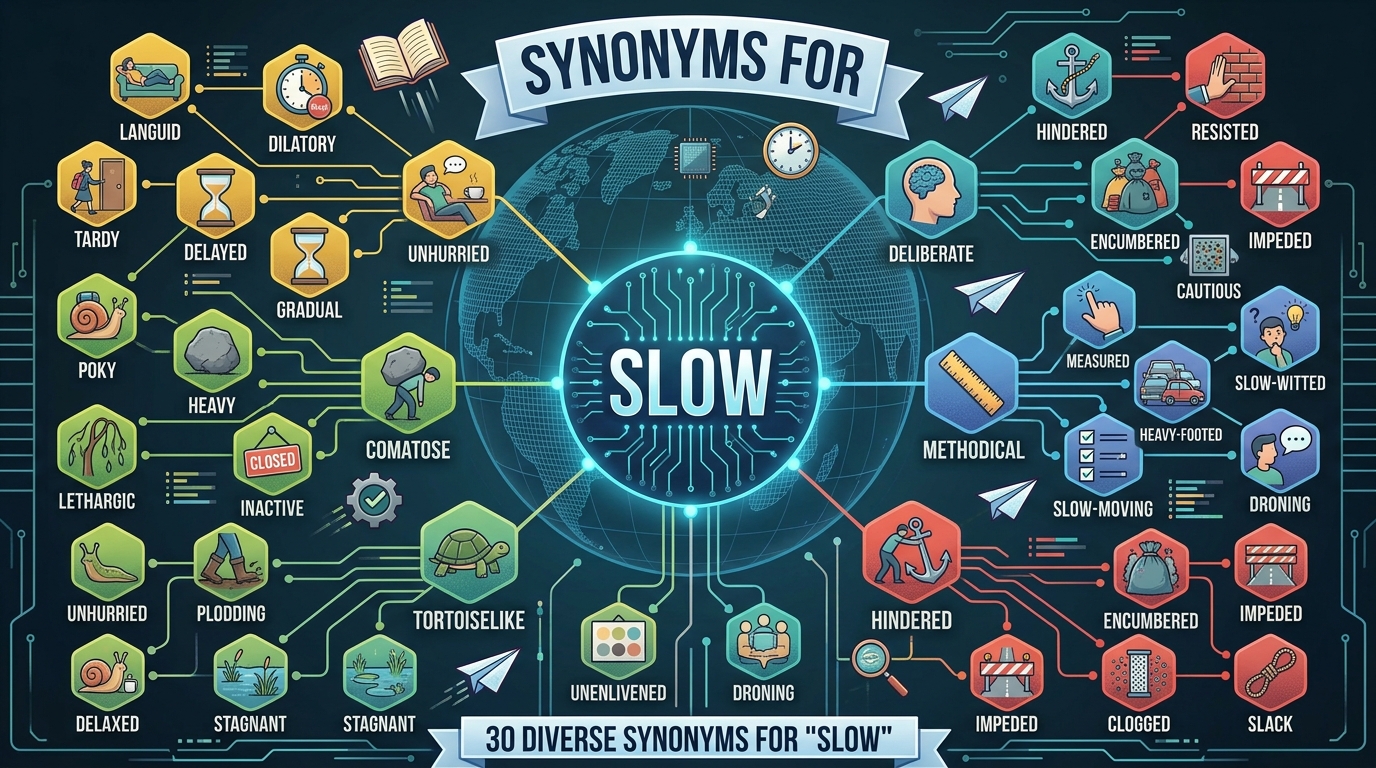
Slow means taking a long time to move or happen. Picture this: you’re stuck behind a car on a narrow road, and it barely moves. You tap the wheel, glance at the clock, and sigh. The car is slow, and so is your trip. This is one of the most common ideas we describe every day, from slow traffic to a slow internet connection.
Because delays and slow moments happen so often, the word “slow” shows up again and again in daily talk and writing. This can make our sentences feel plain if we always reach for the same word. This is why English learners and content writers need synonyms. New words let you describe different kinds of slowness, from a calm, relaxed pace to a frustrating delay. They also stop your writing from repeating “slow” too many times.
This article covers the meaning of “slow,” its emotional tone, its history, its pronunciation, and its word parts. Then it gives you 30 strong synonyms with clear meanings and example sentences.
Meaning of Slow
Definition
Slow (Adjective): Taking a long time to move, act, or happen; not fast.
Examples
- The turtle moved at a slow pace across the yard.
- Traffic was slow on the highway this morning.
Connotative Meaning
- Positive tone: calm, relaxed, careful (a “slow, peaceful walk”)
- Negative tone: frustrating, lazy, behind schedule (a “slow response” at work)
- Neutral tone: simply describing a low speed or pace (“a slow-cooked meal”)
Etymology
- “Slow” comes from the Old English word slaw, meaning “sluggish” or “dull.”
- This root connects to Old Saxon sleu and Old High German sleo, both meaning “blunt” or “dull.”
- The word traces further back to a Proto-Germanic root, slaiwaz, which carried the same sense of dullness or lack of sharpness, later applied to speed.
Short History
- Old English (450–1100): “Slaw” described both slow movement and a dull, sluggish mind.
- Middle English (1100–1500): The spelling shifted toward “slow.” The word stayed close to its old meaning of “not fast.”
- Modern English (1500–Present): “Slow” kept its core meaning and grew new uses, such as “a slow learner” or “business is slow this month.”
Pronunciation (US & UK – IPA)
- US: /sloʊ/
- UK: /sləʊ/
Syllables
slow (one syllable)
Affixation Pattern of Slow
- Root: slow
- Prefix: none common
- Suffix: -ly, -ness
Word formation
From the root “slow,” English builds several words: slowly (adverb), slowness (noun), and slower / slowest (comparative and superlative forms). “Slow” can also work directly as a verb, as in “slow down.” This shows how one small root grows into several useful forms.
Also learn more about https://www.thesaurus.com/browse/slow
Synonyms of Slow
1. Sluggish (Adjective) — US /ˈslʌɡɪʃ/ | UK /ˈslʌɡɪʃ/
Meaning: Slow and lacking energy or speed.
Examples:
- The sluggish printer took ten minutes to finish.
- He felt sluggish after the long flight.
2. Leisurely (Adjective) — US /ˈliʒərli/ | UK /ˈlɛʒəli/
Meaning: Slow and relaxed, without any rush.
Examples:
- We took a leisurely walk along the beach.
- She enjoyed a leisurely breakfast on Sunday.
3. Unhurried (Adjective) — US /ʌnˈhɜrid/ | UK /ʌnˈhʌrid/
Meaning: Slow and calm, with no pressure to hurry.
Examples:
- He gave an unhurried answer to the question.
- Their unhurried pace suited the quiet town.
4. Gradual (Adjective) — US /ˈɡrædʒuəl/ | UK /ˈɡrædʒuəl/
Meaning: Happening slowly, over a period of time.
Examples:
- The gradual change in weather surprised no one.
- Her gradual recovery took several months.
5. Lethargic (Adjective) — US /lɪˈθɑrdʒɪk/ | UK /lɪˈθɑːdʒɪk/
Meaning: Slow and tired, lacking energy to move.
Examples:
- The heat made everyone feel lethargic.
- He felt lethargic after the heavy lunch.
6. Plodding (Adjective) — US /ˈplɑdɪŋ/ | UK /ˈplɒdɪŋ/
Meaning: Moving slowly and heavily, step by step.
Examples:
- The plodding horse pulled the wagon uphill.
- His plodding pace matched the tired crowd.
7. Snail-paced (Adjective) — US /ˈsneɪl peɪst/ | UK /ˈsneɪl peɪst/
Meaning: Extremely slow, like the pace of a snail.
Examples:
- The snail-paced line barely moved.
- Progress on the project felt snail-paced.
8. Crawling (Adjective) — US /ˈkrɔlɪŋ/ | UK /ˈkrɔːlɪŋ/
Meaning: Moving very slowly, almost not moving at all.
Examples:
- Traffic was crawling on the bridge.
- The crawling internet made the video freeze.
9. Dawdling (Adjective) — US /ˈdɔdlɪŋ/ | UK /ˈdɔːdlɪŋ/
Meaning: Slow because of wasting time or delaying.
Examples:
- The dawdling child made them late for school.
- His dawdling pace annoyed the group.
10. Slack (Adjective) — US /slæk/ | UK /slæk/
Meaning: Slow due to a lack of effort or activity.
Examples:
- Sales were slack during the off-season.
- The slack response upset the customers.
11. Tardy (Adjective) — US /ˈtɑrdi/ | UK /ˈtɑːdi/
Meaning: Slow to arrive; late.
Examples:
- He was tardy for the meeting again.
- The tardy bus made everyone wait.
12. Delayed (Adjective) — US /dɪˈleɪd/ | UK /dɪˈleɪd/
Meaning: Made slower than planned; held back in time.
Examples:
- The delayed flight kept them at the airport for hours.
- Her delayed reply worried her friend.
13. Lagging (Adjective) — US /ˈlæɡɪŋ/ | UK /ˈlæɡɪŋ/
Meaning: Falling behind; slower than others.
Examples:
- The lagging runner fell to last place.
- His lagging sales worried the manager.
14. Deliberate (Adjective) — US /dɪˈlɪbərət/ | UK /dɪˈlɪbərət/
Meaning: Slow and careful, done with full thought.
Examples:
- She took a deliberate approach to the surgery.
- His deliberate steps showed his careful nature.
15. Measured (Adjective) — US /ˈmɛʒərd/ | UK /ˈmɛʒəd/
Meaning: Slow and controlled, with careful pace.
Examples:
- He gave a measured response to the criticism.
- Her measured walk showed calm confidence.
16. Ponderous (Adjective) — US /ˈpɑndərəs/ | UK /ˈpɒndərəs/
Meaning: Slow and heavy in movement or manner.
Examples:
- The ponderous elephant moved across the field.
- His ponderous speech tested our patience.
17. Torpid (Adjective) — US /ˈtɔrpɪd/ | UK /ˈtɔːpɪd/
Meaning: Slow and inactive, almost sleepy.
Examples:
- The torpid snake barely moved in the cold.
- He felt torpid after the long meal.
18. Languid (Adjective) — US /ˈlæŋɡwɪd/ | UK /ˈlæŋɡwɪd/
Meaning: Slow and relaxed, without much energy.
Examples:
- They spent a languid afternoon by the pool.
- Her languid movements matched the quiet mood.
19. Sedate (Adjective) — US /sɪˈdeɪt/ | UK /sɪˈdeɪt/
Meaning: Slow and calm in manner or pace.
Examples:
- The town had a sedate, quiet feel.
- He drove at a sedate speed through the village.
20. Gentle (Adjective) — US /ˈdʒɛntəl/ | UK /ˈdʒɛntl/
Meaning: Slow and soft, without force or rush.
Examples:
- The gentle stream moved slowly past the rocks.
- She kept a gentle pace during the walk.
21. Creeping (Adjective) — US /ˈkripɪŋ/ | UK /ˈkriːpɪŋ/
Meaning: Moving slowly and quietly, often unnoticed.
Examples:
- A creeping fog rolled over the hills.
- The creeping vine spread across the wall.
22. Dilatory (Adjective) — US /ˈdɪləˌtɔri/ | UK /ˈdɪlətəri/
Meaning: Slow to act, often causing delay on purpose.
Examples:
- The dilatory committee delayed the vote for weeks.
- His dilatory habits frustrated his team.
23. Slothful (Adjective) — US /ˈslɔθfəl/ | UK /ˈslɒθfʊl/
Meaning: Slow due to laziness or lack of effort.
Examples:
- The slothful cat barely moved all day.
- His slothful attitude hurt his grades.
24. Lackadaisical (Adjective) — US /ˌlækəˈdeɪzɪkəl/ | UK /ˌlækəˈdeɪzɪkl/
Meaning: Slow and careless, showing little interest.
Examples:
- He gave a lackadaisical effort on the test.
- Her lackadaisical pace annoyed the coach.
25. Relaxed (Adjective) — US /rɪˈlækst/ | UK /rɪˈlækst/
Meaning: Slow and calm, free from stress or rush.
Examples:
- We had a relaxed evening at home.
- His relaxed manner put everyone at ease.
26. Unrushed (Adjective) — US /ʌnˈrʌʃt/ | UK /ʌnˈrʌʃt/
Meaning: Slow because there is no pressure to hurry.
Examples:
- She gave an unrushed answer during the interview.
- Their unrushed dinner lasted three hours.
27. Poky (Adjective) — US /ˈpoʊki/ | UK /ˈpəʊki/
Meaning: A casual word for annoyingly slow.
Examples:
- The poky elevator took forever to arrive.
- His poky old car struggled up the hill.
28. Lumbering (Adjective) — US /ˈlʌmbərɪŋ/ | UK /ˈlʌmbərɪŋ/
Meaning: Moving slowly and heavily, in a clumsy way.
Examples:
- The lumbering truck rolled down the narrow street.
- A lumbering bear crossed the trail ahead of us.
29. Glacial (Adjective) — US /ˈɡleɪʃəl/ | UK /ˈɡleɪsiəl/
Meaning: Extremely slow, like the movement of a glacier.
Examples:
- Progress on the deal was glacial.
- The glacial pace of the meeting tested our patience.
30. Laggardly (Adjective) — US /ˈlæɡərdli/ | UK /ˈlæɡədli/
Meaning: Slow and falling behind others.
Examples:
- His laggardly pace put him last in the race.
- The laggardly reply came a week too late.
Prototype Meaning
When most people hear the word “slow,” they picture something moving at a low speed, taking longer than expected. Think of a turtle crossing a path or a long line that barely moves. This simple picture is the core meaning of the word. Other uses, like “a slow learner” or “slow business,” grow out of this same basic idea of taking more time than normal.
Prototype Categorization
- Physical pace-related: sluggish, plodding, snail-paced, crawling, creeping, lumbering, poky, glacial
- Time and delay-related: tardy, delayed, lagging, dilatory, laggardly
- Calm and unhurried manner: leisurely, unhurried, gradual, deliberate, measured, sedate, gentle, relaxed, unrushed
- Low energy-related: lethargic, torpid, languid, slothful, lackadaisical, slack, dawdling
Antonyms of Slow
fast, quick, swift, rapid, speedy, hasty
Short Questions and Answers
- What does “slow” mean?
It means taking a long time to move, act, or happen. - When should “slow” be used?
Use it to describe low speed, a delay, or a calm, unhurried pace. - Is “slow” positive or negative?
It depends on context. It can sound calm and pleasant, like a “slow, relaxing evening,” or frustrating, like “a slow response.” - How is it different from similar words?
“Sluggish” points to a lack of energy, while “leisurely” points to a calm choice to take your time. “Delayed” refers to something held back from a schedule, and “slow” is the general word that covers all of these smaller shades of low speed.
Conclusion
Synonyms for slow gives you many ways to describe pace, from a calm, easy walk to a frustrating delay. It helps you avoid using the same word again and again in your writing or speech. It also makes your English sound more natural and skilled. Each new synonym adds a small tool to your vocabulary kit, ready for the right moment. Try using one new synonym each day in a sentence of your own. Over time, this small habit builds real confidence in both writing and speaking English.