Rich means having a lot of money or valuable things. Picture this: a man wins the lottery and moves into a big house with a pool and a garden full of flowers. His neighbors call him rich. This is one of the most common ideas people talk about, from a rich business owner to a rich, tasty meal.
Because money and wealth are common topics in daily life, business, and news, the word “rich” comes up again and again. This can make our speech and writing sound plain if we always use the same word. This is why English learners and content writers need synonyms. New words let you describe wealth, luxury, and abundance in fresh, exact ways. They also stop your writing from repeating “rich” too many times.
This article covers the meaning of “rich,” its emotional tone, its history, its pronunciation, and its word parts. Then it gives you 30 strong synonyms with clear meanings and example sentences.
Meaning of Rich
Definition
Rich (Adjective): Having a large amount of money, property, or valuable things.
Examples
- The rich family owned three houses across the country.
- Her rich uncle paid for the whole trip.
Connotative Meaning
- Positive tone: successful, comfortable, generous (a “rich and giving” person)
- Negative tone: greedy, unfair, out of touch (a “rich elite” that ignores others)
- Neutral tone: simply describing wealth without judgment (“a rich country”)
Etymology
- “Rich” comes from the Old English word rice, meaning “powerful” or “of high rank.”
- This root connects to the Proto-Germanic word rikijaz, and further back to the Celtic word rix, meaning “king,” and the Latin word rex, also meaning “king.”
- The word first pointed mainly to power and rank, and only later grew to focus on money and wealth.
Short History
- Old English (450–1100): “Rice” described someone powerful or of high social rank, more about status than money.
- Middle English (1100–1500): The meaning began to shift toward wealth and property, though the old sense of power still lingered.
- Modern English (1500–Present): “Rich” settled mainly into meaning “having a lot of money,” while also growing figurative uses like “a rich flavor” or “rich soil.”
Pronunciation (US & UK – IPA)
- US: /rɪtʃ/
- UK: /rɪtʃ/
Syllables
rich (one syllable)
Affixation Pattern of Rich
- Root: rich
- Prefix: en- (as in enrich)
- Suffix: -ly, -ness
Word formation
From the root “rich,” English builds several words: enrich (verb, with the prefix “en-“), richness (noun), richly (adverb), and richer / richest (comparative and superlative forms). This shows how one root word can grow into many useful forms.
Read about more https://myprayerss.com/synonyms-for-success/
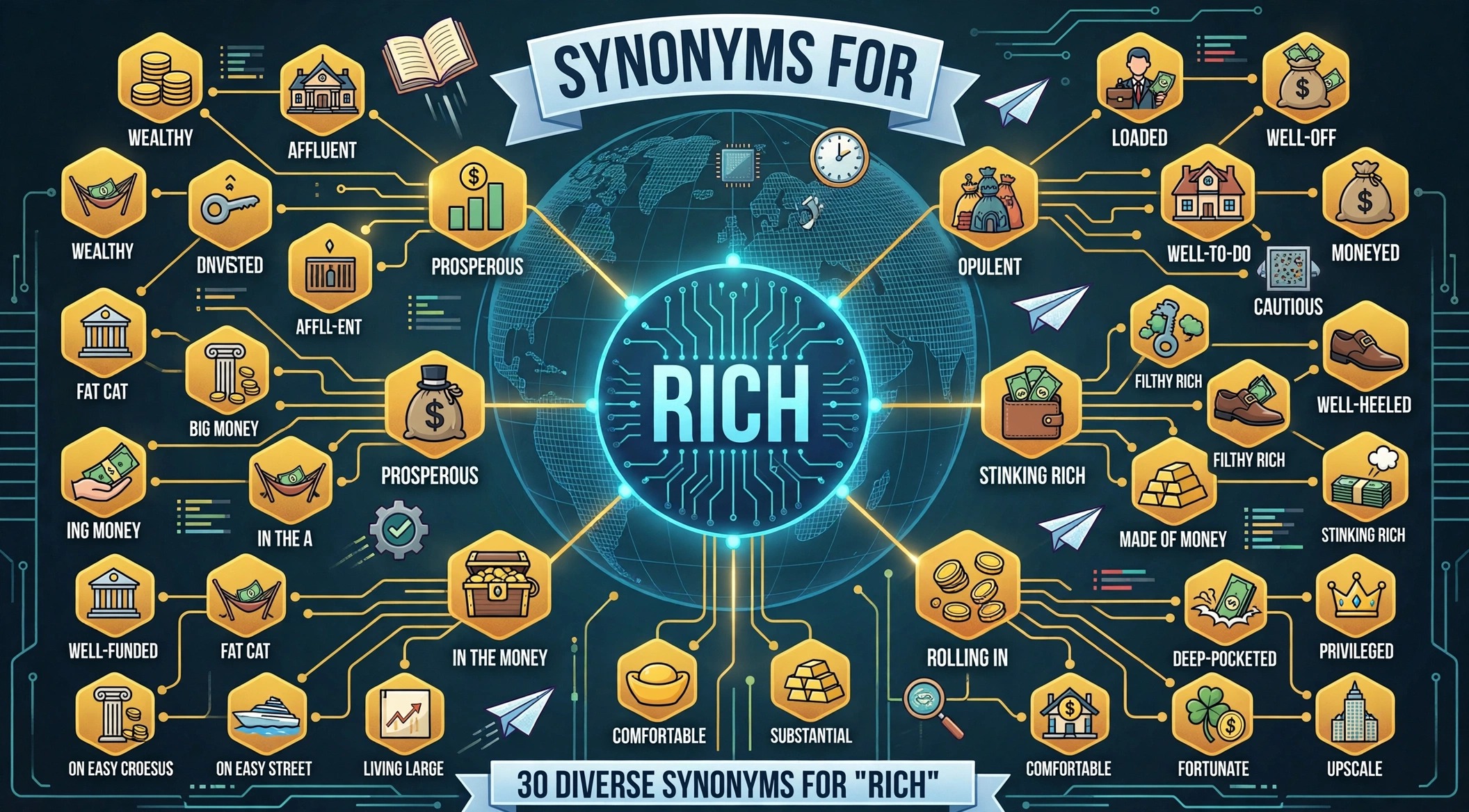
Synonyms of Rich
1. Wealthy (Adjective) — US /ˈwɛlθi/ | UK /ˈwɛlθi/
Meaning: Having a great deal of money or property.
Examples:
- The wealthy investor bought another building.
- She grew up in a wealthy neighborhood.
2. Affluent (Adjective) — US /ˈæfluənt/ | UK /ˈæfluənt/
Meaning: Having plenty of money; well-off.
Examples:
- The affluent suburb had large, new homes.
- His affluent lifestyle included frequent travel.
3. Prosperous (Adjective) — US /ˈprɑspərəs/ | UK /ˈprɒspərəs/
Meaning: Successful and financially thriving.
Examples:
- The prosperous company opened new offices.
- They lived a prosperous life after the business grew.
4. Well-off (Adjective) — US /ˈwɛl ɔf/ | UK /ˈwɛl ɒf/
Meaning: Having enough money to live comfortably.
Examples:
- Her parents were well-off but never showed it.
- He felt well-off after the promotion.
5. Well-to-do (Adjective) — US /ˈwɛl tə du/ | UK /ˈwɛl tə duː/
Meaning: Wealthy and comfortable in daily life.
Examples:
- The well-to-do family owned a large estate.
- She married into a well-to-do household.
6. Loaded (Adjective) — US /ˈloʊdɪd/ | UK /ˈləʊdɪd/
Meaning: A casual word for having a lot of money.
Examples:
- Everyone knew his uncle was loaded.
- She acted like she was loaded, but she wasn’t.
7. Opulent (Adjective) — US /ˈɑpjələnt/ | UK /ˈɒpjʊlənt/
Meaning: Extremely wealthy and showing rich, fancy style.
Examples:
- The opulent hotel had gold-trimmed walls.
- Their opulent wedding cost a fortune.
8. Moneyed (Adjective) — US /ˈmʌnid/ | UK /ˈmʌnid/
Meaning: Having a large amount of money, often inherited.
Examples:
- The moneyed class filled the front rows.
- He came from a moneyed family.
9. Flush (Adjective) — US /flʌʃ/ | UK /flʌʃ/
Meaning: Having plenty of money at a certain time.
Examples:
- She felt flush after her big paycheck.
- The team was flush with cash after the sale.
10. Comfortable (Adjective) — US /ˈkʌmftərbəl/ | UK /ˈkʌmftəbl/
Meaning: Having enough money to live without money worries.
Examples:
- They live a comfortable life in the countryside.
- His savings made him financially comfortable.
11. Well-heeled (Adjective) — US /ˈwɛl hild/ | UK /ˈwɛl hiːld/
Meaning: Wealthy, often shown through style or spending.
Examples:
- The well-heeled crowd filled the gallery opening.
- He looked well-heeled in his tailored suit.
12. Prospering (Adjective) — US /ˈprɑspərɪŋ/ | UK /ˈprɒspərɪŋ/
Meaning: Growing wealthy through success.
Examples:
- The prospering town built new schools.
- Their business kept prospering each year.
13. Thriving (Adjective) — US /ˈθraɪvɪŋ/ | UK /ˈθraɪvɪŋ/
Meaning: Growing strong and wealthy quickly.
Examples:
- The thriving startup hired ten new workers.
- She runs a thriving online shop.
14. Privileged (Adjective) — US /ˈprɪvəlɪdʒd/ | UK /ˈprɪvəlɪdʒd/
Meaning: Having advantages, often through wealth or status.
Examples:
- He grew up in a privileged household.
- Privileged students had access to private tutors.
15. Solvent (Adjective) — US /ˈsɑlvənt/ | UK /ˈsɒlvənt/
Meaning: Having enough money to pay all debts.
Examples:
- The company remained solvent through the crisis.
- She worked hard to stay solvent after college.
16. High-income (Adjective) — US /ˈhaɪ ˈɪnkʌm/ | UK /ˈhaɪ ˈɪnkʌm/
Meaning: Earning a large amount of money regularly.
Examples:
- High-income families paid more in taxes.
- He moved into a high-income job after graduation.
17. Well-fixed (Adjective) — US /ˈwɛl fɪkst/ | UK /ˈwɛl fɪkst/
Meaning: Financially secure and comfortable.
Examples:
- Her grandparents were well-fixed after selling the farm.
- They felt well-fixed with their savings plan.
18. Filthy Rich (Adjective) — US /ˈfɪlθi rɪtʃ/ | UK /ˈfɪlθi rɪtʃ/
Meaning: An informal phrase for being extremely wealthy.
Examples:
- His filthy rich neighbor owned three yachts.
- She became filthy rich after selling the company.
19. Sitting Pretty (Adjective) — US /ˈsɪtɪŋ ˈprɪti/ | UK /ˈsɪtɪŋ ˈprɪti/
Meaning: An idiom for being in a comfortable, wealthy position.
Examples:
- After the deal closed, he was sitting pretty.
- With her savings, she felt sitting pretty for retirement.
20. In the Money (Adjective) — US /ɪn ðə ˈmʌni/ | UK /ɪn ðə ˈmʌni/
Meaning: An informal phrase for having plenty of cash.
Examples:
- After the bonus, he was really in the money.
- The team felt in the money after the big win.
21. Luxurious (Adjective) — US /lʌɡˈʒʊriəs/ | UK /lʌɡˈʒʊəriəs/
Meaning: Showing great comfort and expensive style.
Examples:
- They stayed in a luxurious beach resort.
- The car had a luxurious leather interior.
22. Lavish (Adjective) — US /ˈlævɪʃ/ | UK /ˈlævɪʃ/
Meaning: Rich and generous, often spent freely.
Examples:
- They threw a lavish birthday party.
- The lavish gift surprised everyone.
23. Plush (Adjective) — US /plʌʃ/ | UK /plʌʃ/
Meaning: Richly comfortable and expensive-looking.
Examples:
- The plush hotel room had a huge bed.
- She sat on the plush velvet sofa.
24. Sumptuous (Adjective) — US /ˈsʌmptʃuəs/ | UK /ˈsʌmptʃuəs/
Meaning: Rich and grand, especially in food or style.
Examples:
- They enjoyed a sumptuous holiday feast.
- The sumptuous ballroom impressed every guest.
25. Abundant (Adjective) — US /əˈbʌndənt/ | UK /əˈbʌndənt/
Meaning: Rich in amount; existing in large quantity.
Examples:
- The region has abundant natural resources.
- Fresh fruit was abundant at the market.
26. Bountiful (Adjective) — US /ˈbaʊntɪfəl/ | UK /ˈbaʊntɪfʊl/
Meaning: Rich and generous in supply.
Examples:
- The farm had a bountiful harvest this year.
- Nature gave them a bountiful supply of fish.
27. Plentiful (Adjective) — US /ˈplɛntɪfəl/ | UK /ˈplɛntɪfʊl/
Meaning: Present in large amounts; rich in supply.
Examples:
- Rain was plentiful during the spring.
- Job openings were plentiful in the city.
28. Fertile (Adjective) — US /ˈfɜrtəl/ | UK /ˈfɜːtaɪl/
Meaning: Rich enough to grow plants well.
Examples:
- The fertile soil produced a great crop.
- Farmers valued the fertile valley.
29. Fruitful (Adjective) — US /ˈfrutfəl/ | UK /ˈfruːtfʊl/
Meaning: Rich in good results or outcomes.
Examples:
- The meeting was fruitful for both sides.
- Their partnership proved fruitful over time.
30. Ample (Adjective) — US /ˈæmpəl/ | UK /ˈæmpl/
Meaning: Rich in quantity; more than enough.
Examples:
- There was ample food for all the guests.
- She had ample time to finish the project.
Prototype Meaning
When most people hear the word “rich,” they picture a person with a big house, a fancy car, and no worries about money. It brings to mind comfort, luxury, and freedom from financial stress. This simple picture is the core meaning of the word. Other uses, like “rich soil” or “rich flavor,” grow out of this same basic idea of having plenty, even outside of money.
Prototype Categorization
- Wealth-related (money): wealthy, affluent, prosperous, well-off, well-to-do, loaded, moneyed, flush, comfortable, well-heeled, solvent, high-income, well-fixed, filthy rich, sitting pretty, in the money, prospering, thriving, privileged
- Luxury-related (style and comfort): luxurious, lavish, plush, sumptuous
- Abundance-related (quantity or quality): abundant, bountiful, plentiful, fertile, fruitful, ample
Antonyms of Rich
poor, broke, impoverished, destitute, needy
Short Questions and Answers
- What does “rich” mean?
It means having a large amount of money, property, or valuable things. - When should “rich” be used?
Use it to describe wealth, luxury, or an abundance of something good, like rich soil or a rich flavor. - Is “rich” positive or negative?
It is usually positive, since it points to comfort and success. It can sound negative when it suggests unfairness, like “the rich elite.” - How is it different from similar words?
“Affluent” often describes a whole community or lifestyle, while “loaded” is a casual word for one person’s money. “Abundant” points to a large quantity of something, and “rich” is the broad word that covers wealth, luxury, and abundance together.
Conclusion
Synonyms for rich gives you many ways to describe wealth, luxury, and abundance. It helps you avoid using the same word again and again in your writing or speech. It also makes your English sound more natural and skilled. Each new synonym adds a small tool to your vocabulary kit, ready for the right moment. Try using one new synonym each day in a sentence of your own. Over time, this small habit builds real confidence in both writing and speaking English.