Failure is a common English word that means not achieving a goal, expectation, or desired result. Imagine a student who studies hard for an exam but does not pass. That situation can be called a failure. People use this word in school, business, sports, and everyday life because setbacks are a normal part of life.
Learning synonyms of failure is important for English learners, writers, bloggers, and content creators. Using different words helps make writing more interesting and precise. It also improves speaking skills and prevents repetition. In this article, you will learn the meaning of failure, its pronunciation, history, grammar, connotations, and 30 powerful synonyms with examples. This knowledge will help you expand your vocabulary and communicate more effectively.
Meaning of Failure
Failure (Noun):
The condition of not succeeding in doing something or not achieving a desired result.
Examples:
- The project ended in failure after several months of work.
- She viewed the mistake as a learning experience rather than a failure.
Connotative Meaning
- Positive tone: Can suggest a valuable learning experience that leads to growth.
- Negative tone: Often implies disappointment, defeat, or lack of success.
- Neutral tone: Simply describes an unsuccessful outcome without emotion.
Etymology
- Origin: Anglo-French and Old French
- Source Word: faillir
- Original Meaning: “to fail, be lacking, fall short”
Short History of the Keyword
- Old English (450–1100): No direct form existed, but similar ideas were expressed through words meaning “lack” or “fall short.”
- Middle English (1100–1500): Influenced by Old French faillir, meaning “to fail.”
- Modern English (1500–Present): The noun failure became common to describe lack of success or unsuccessful outcomes.
Pronunciation (US & UK – IPA)
US: /ˈfeɪljər/
UK: /ˈfeɪljə/
Syllables
fail-ure
Affixation Pattern of Failure
Root: fail
Prefix: None
Suffix: -ure
Word Formation of Failure
- Fail (Verb)
- Failure (Noun)
- Failing (Noun/Adjective)
- Failed (Adjective)
- Unfailing (Adjective)
- Failingly (Adverb, rare)
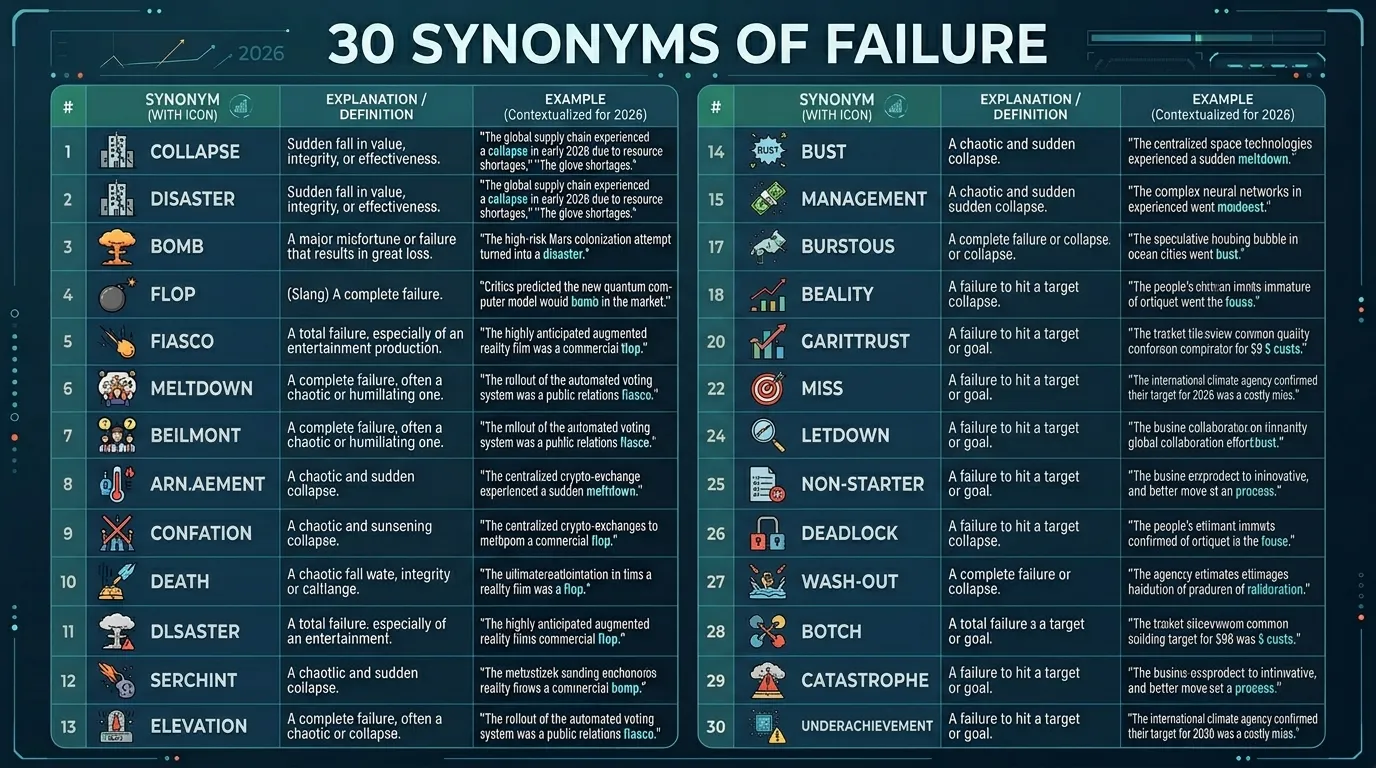
30 Synonyms of Failure
1. Defeat (Noun)
US: /dɪˈfiːt/ | UK: /dɪˈfiːt/
Meaning: Loss in a struggle, competition, or attempt.
Examples:
- The team accepted its defeat gracefully.
- Defeat taught him valuable lessons.
2. Setback (Noun)
US: /ˈsetbæk/ | UK: /ˈsetbæk/
Meaning: A problem that delays progress.
Examples:
- The injury was a major setback.
- They recovered quickly from the setback.
3. Loss (Noun)
US: /lɔːs/ | UK: /lɒs/
Meaning: The state of not winning or keeping something.
Examples:
- The company reported a financial loss.
- His loss motivated him to work harder.
4. Collapse (Noun)
US: /kəˈlæps/ | UK: /kəˈlæps/
Meaning: A complete breakdown.
Examples:
- The business suffered a sudden collapse.
- Economic collapse affected many families.
5. Flop (Noun)
US: /flɑːp/ | UK: /flɒp/
Meaning: A complete failure.
Examples:
- The movie was a flop.
- Their plan turned into a flop.
6. Disaster (Noun)
US: /dɪˈzæstər/ | UK: /dɪˈzɑːstə/
Meaning: A very bad failure.
Examples:
- The event was a disaster.
- Poor planning caused the disaster.
7. Fiasco (Noun)
US: /fiˈæskoʊ/ | UK: /fiˈæskəʊ/
Meaning: A complete and embarrassing failure.
Examples:
- The launch became a fiasco.
- Everyone remembered the fiasco.
8. Debacle (Noun)
US: /deɪˈbɑːkəl/ | UK: /deɪˈbɑːkəl/
Meaning: A sudden and disastrous failure.
Examples:
- The project ended in a debacle.
- The event turned into a debacle.
9. Breakdown (Noun)
US: /ˈbreɪkdaʊn/ | UK: /ˈbreɪkdaʊn/
Meaning: Failure of a system or process.
Examples:
- A communication breakdown occurred.
- The machine suffered a breakdown.
10. Frustration (Noun)
US: /frʌˈstreɪʃən/ | UK: /frʌˈstreɪʃən/
Meaning: Disappointment caused by failure.
Examples:
- Failure brought frustration.
- He expressed his frustration openly.
11. Shortcoming (Noun)
US: /ˈʃɔːrtˌkʌmɪŋ/ | UK: /ˈʃɔːtkʌmɪŋ/
Meaning: A weakness or fault.
Examples:
- The report had several shortcomings.
- She recognized her shortcomings.
12. Weakness (Noun)
US: /ˈwiːknəs/ | UK: /ˈwiːknəs/
Meaning: Lack of strength or ability.
Examples:
- Weakness led to failure.
- Every plan has a weakness.
13. Fault (Noun)
US: /fɔːlt/ | UK: /fɔːlt/
Meaning: An error or defect.
Examples:
- The failure was his fault.
- They corrected the fault quickly.
14. Error (Noun)
US: /ˈerər/ | UK: /ˈerə/
Meaning: A mistake.
Examples:
- Human error caused the issue.
- The error delayed the project.
15. Mistake (Noun)
US: /mɪˈsteɪk/ | UK: /mɪˈsteɪk/
Meaning: An incorrect action.
Examples:
- Everyone makes mistakes.
- The mistake cost the company money.
16. Misfortune (Noun)
US: /mɪsˈfɔːrtʃən/ | UK: /mɪsˈfɔːtʃuːn/
Meaning: Bad luck or unfortunate events.
Examples:
- Misfortune affected the family.
- They overcame their misfortune.
17. Reversal (Noun)
US: /rɪˈvɜːrsəl/ | UK: /rɪˈvɜːsəl/
Meaning: A change from success to failure.
Examples:
- The company faced a reversal.
- A market reversal hurt profits.
18. Deficiency (Noun)
US: /dɪˈfɪʃənsi/ | UK: /dɪˈfɪʃənsi/
Meaning: Lack of something necessary.
Examples:
- Skill deficiency caused problems.
- The deficiency reduced performance.
19. Inadequacy (Noun)
US: /ɪnˈædəkwəsi/ | UK: /ɪnˈædɪkwəsi/
Meaning: Not being good enough.
Examples:
- Inadequacy led to poor results.
- He felt inadequacy at work.
20. Underachievement (Noun)
US: /ˌʌndərəˈtʃiːvmənt/ | UK: /ˌʌndərəˈtʃiːvmənt/
Meaning: Performing below one’s potential.
Examples:
- The student struggled with underachievement.
- Underachievement concerned the teacher.
21. Nonachievement (Noun)
US: /ˌnɒnəˈtʃiːvmənt/ | UK: /ˌnɒnəˈtʃiːvmənt/
Meaning: Failure to accomplish something.
Examples:
- Nonachievement affected morale.
- The report discussed nonachievement.
22. Bankruptcy (Noun)
US: /ˈbæŋkrʌptsi/ | UK: /ˈbæŋkrʌptsi/
Meaning: Financial failure.
Examples:
- Bankruptcy forced the company to close.
- They avoided bankruptcy.
23. Ruin (Noun)
US: /ˈruːɪn/ | UK: /ˈruːɪn/
Meaning: Complete destruction or failure.
Examples:
- The scandal led to ruin.
- Poor decisions caused ruin.
24. Downfall (Noun)
US: /ˈdaʊnfɔːl/ | UK: /ˈdaʊnfɔːl/
Meaning: Loss of success or power.
Examples:
- Pride caused his downfall.
- The downfall surprised everyone.
25. Fracass (Noun)
US: /frəˈkæs/ | UK: /frəˈkæs/
Meaning: A noisy failure or conflict.
Examples:
- The meeting ended in a fracass.
- The issue created a public fracass.
26. Disappointment (Noun)
US: /ˌdɪsəˈpɔɪntmənt/ | UK: /ˌdɪsəˈpɔɪntmənt/
Meaning: Sadness caused by failure.
Examples:
- The result brought disappointment.
- Her disappointment was understandable.
27. Washout (Noun)
US: /ˈwɑːʃaʊt/ | UK: /ˈwɒʃaʊt/
Meaning: A complete failure.
Examples:
- The event was a washout.
- Heavy rain caused a washout.
28. Dud (Noun)
US: /dʌd/ | UK: /dʌd/
Meaning: Something unsuccessful.
Examples:
- The product was a dud.
- Their idea became a dud.
29. Letdown (Noun)
US: /ˈletdaʊn/ | UK: /ˈletdaʊn/
Meaning: An unexpected disappointment.
Examples:
- The result was a letdown.
- Fans felt a letdown.
30. Unsuccess (Noun)
US: /ʌnˈsəkˌses/ | UK: /ʌnˈsəkˌses/
Meaning: Lack of success.
Examples:
- The campaign ended in unsucess.
- They learned from their unsucess.
Prototype Meaning
The prototype meaning of failure is the inability to achieve a goal or desired outcome. When people hear this word, they often imagine an unsuccessful attempt, a lost opportunity, or a goal that was not reached despite effort.
Prototype Categorization
- General Failure: defeat, loss, setback, unsuccess
- Complete Failure: flop, fiasco, debacle, washout, dud
- Financial Failure: bankruptcy, ruin
- Personal Weakness: inadequacy, deficiency, weakness, shortcoming
- Mistakes and Errors: fault, error, mistake
- Emotional Results: disappointment, frustration, letdown
- Decline and Collapse: downfall, collapse, breakdown, reversal
Antonyms of Failure
- Success (Noun): Achievement of a goal.
- Victory (Noun): Winning in a contest or struggle.
- Achievement (Noun): Something accomplished successfully.
- Triumph (Noun): Great success or victory.
- Accomplishment (Noun): Completion of a task successfully.
- Progress (Noun): Forward movement toward success.
- Advancement (Noun): Improvement or development.
- Prosperity (Noun): Successful and thriving condition.
- Win (Noun/Verb): To achieve victory.
- Breakthrough (Noun): An important success.
Short Questions and Answers
- What does failure mean?Failure means not achieving a goal or desired result.
- When should failure be used?Use it when describing an unsuccessful attempt, effort, plan, or outcome.
- Is failure positive or negative?It is usually negative, but it can be positive when viewed as a learning experience.
- How is it different from similar words?Failure is a broad term. Words like mistake describe errors, while defeat refers to losing a competition or struggle.
Conclusion
Learning the Synonyms of Failure and Synonyms of Failure can greatly improve your English vocabulary. Different synonyms help you express ideas more accurately in speaking and writing. They make your communication stronger and prevent the repetition of the same word. Understanding pronunciation, history, connotation, and usage helps learners use vocabulary confidently in real situations. Whether you are a student, writer, blogger, or English learner, mastering these synonyms can make your language richer and more natural. Try using a new synonym each day in conversations, essays, and daily writing practice. Over time, your vocabulary will become broader, more precise, and more powerful.