Success means reaching a goal or getting a good result after effort. Picture a young runner who trains every morning for months. On race day, she crosses the finish line first. That moment is success. People use synonyms of success to talk about small wins, like passing a test, and big wins, like building a company. It fits almost any story about hard work paying off.
But repeating “success” again and again can make writing feel dull. English learners and content writers need synonyms to describe achievement with precision. Different words can show different kinds of success. Learning these words builds stronger and clearer English.
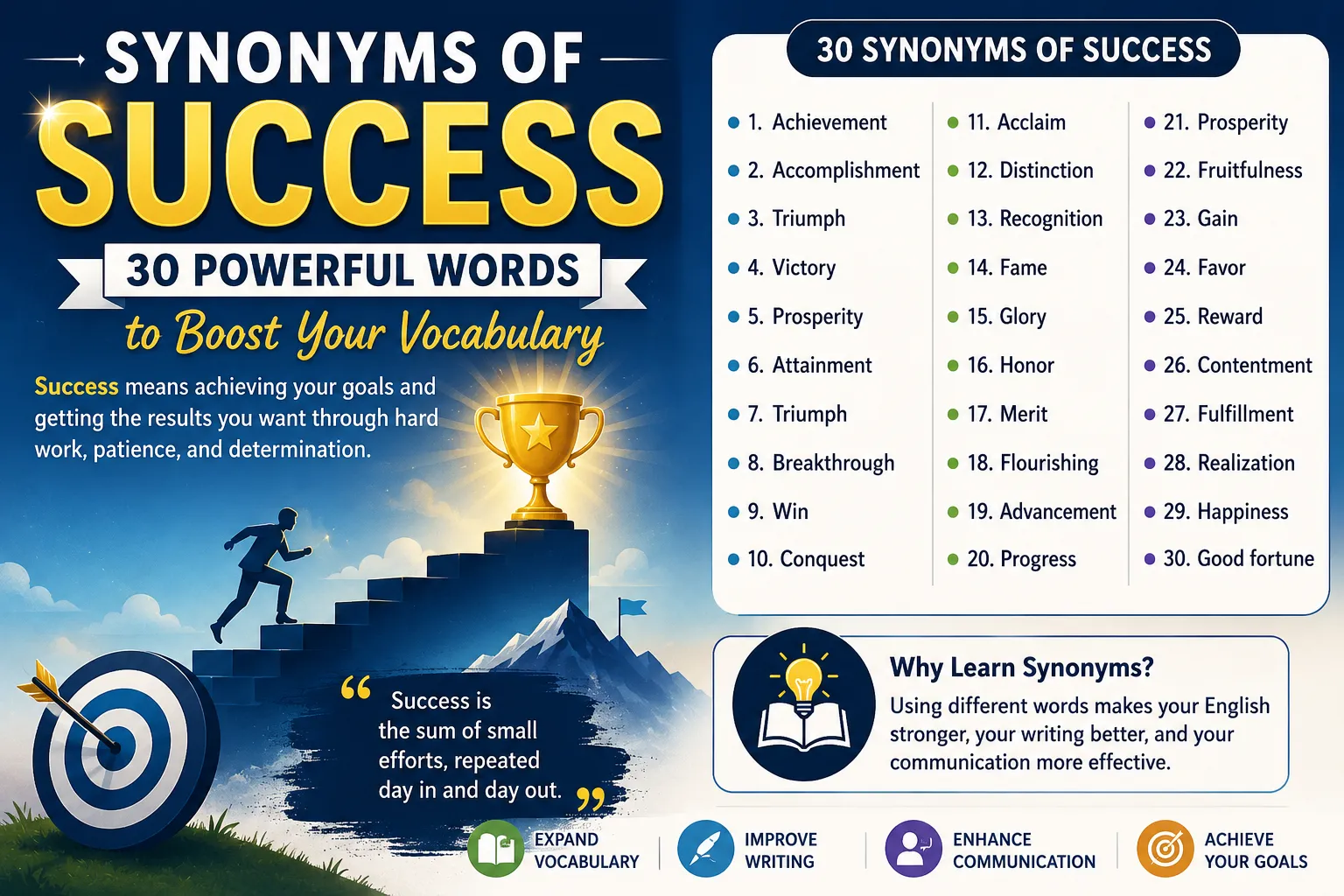
This article explores the word “success” in full detail. You will learn its meaning, grammar, pronunciation, history, and connotation. Then you will discover 30 useful synonyms of success, each with clear meanings, examples, and US and UK pronunciation.
Meaning of Success
Definition
Success (noun): The act of reaching a goal, or a good result gained through effort.
Examples
- Her hard work led to great success in her career.
- The new product was a huge success in the market.
Connotative Meaning
- Positive tone: “Success” almost always carries a strong, positive feeling. It suggests pride, achievement, and reward.
- Negative tone: “Success” rarely sounds negative, though it can feel hollow in phrases like “success at any cost,” which hints at unfair methods.
- Neutral tone: In business or academic writing, “success” can describe measured results without strong emotion, such as “the success rate of the treatment.”
Etymology
- “Success” comes from the Latin word successus, meaning an advance or a coming after.
- It traces back to the Latin verb succedere, formed from “sub-” (close to, under) and “cedere” (to go or yield).
- The word first meant any outcome, good or bad. Over time, its meaning narrowed to mean only a good outcome.
Short History
- Old English (450–1100): The word “success” did not exist. English speakers used words like “spēd,” which meant speed, prosperity, or good fortune.
- Middle English (1100–1500): “Success” had not yet entered English. French and Latin words were blending into the language during this period.
- Modern English (1500–Present): “Success” entered English in the 16th century from Latin, through French. At first, it meant “an outcome.” By the 17th century, it settled into its modern meaning of a good or favorable result.
Pronunciation (US & UK – IPA)
- US: /səkˈsɛs/
- UK: /səkˈsɛs/
Syllables
suc-cess
Affixation Pattern of Success
- Root: success (from Latin “succedere,” to go close to or follow after)
- Prefix: suc- (a form of “sub-,” meaning under or close to, found in the Latin root)
- Suffix: -ful (forms the adjective “successful”), -fully (forms the adverb “successfully”)
Word formation: From this root, English formed several words across grammatical categories: “success” (noun), “successful” (adjective), “successfully” (adverb), “succeed” (verb), and “successor” (noun, meaning a person who follows another).
Synonyms of Success
1. Achievement (noun) — US /əˈtʃiːvmənt/ | UK /əˈtʃiːvmənt/
Meaning: Something done well through effort and skill. Examples:
- Winning the award was a great achievement for her.
- His biggest achievement was finishing the marathon.
2. Accomplishment (noun) — US /əˈkɑːmplɪʃmənt/ | UK /əˈkʌmplɪʃmənt/
Meaning: Something successfully completed or done. Examples:
- Learning a new language is a real accomplishment.
- The team celebrated their accomplishment together.
3. Triumph (noun) — US /ˈtraɪəmf/ | UK /ˈtraɪʌmf/
Meaning: A great victory or success, often after struggle. Examples:
- Her win was a triumph over many years of hard work.
- The film was a triumph at the awards show.
4. Attainment (noun) — US /əˈteɪnmənt/ | UK /əˈteɪnmənt/
Meaning: The act of reaching a goal through effort. Examples:
- His attainment of a degree took five years.
- The attainment of peace took long negotiations.
5. Victory (noun) — US /ˈvɪktəri/ | UK /ˈvɪktəri/
Meaning: A win in a contest, battle, or struggle. Examples:
- The team celebrated their victory on the field.
- It was a small victory after a long fight.
6. Feat (noun) — US /fiːt/ | UK /fiːt/
Meaning: An impressive act showing skill or strength. Examples:
- Climbing the mountain was a remarkable feat.
- Building the bridge was a great feat of engineering.
7. Win (noun) — US /wɪn/ | UK /wɪn/
Meaning: A success or victory, often used casually. Examples:
- Getting the job was a big win for her.
- The new deal was a win for the whole company.
8. Gain (noun) — US /ɡeɪn/ | UK /ɡeɪn/
Meaning: An increase or improvement gained through effort. Examples:
- The company saw a gain in sales this year.
- Her hard work led to real personal gain.
9. Realization (noun) — US /ˌriːələˈzeɪʃən/ | UK /ˌrɪəlaɪˈzeɪʃən/
Meaning: The act of making a goal or dream come true. Examples:
- Opening her shop was the realization of a lifelong dream.
- The project’s realization took years of planning.
10. Completion (noun) — US /kəmˈpliːʃən/ | UK /kəmˈpliːʃən/
Meaning: The finishing of a task or goal. Examples:
- The completion of the bridge took two years.
- She felt proud at the completion of her thesis.
11. Fulfillment (noun) — US /fʊlˈfɪlmənt/ | UK /fʊlˈfɪlmənt/
Meaning: The satisfying achievement of a goal or wish. Examples:
- Finishing the book gave her deep fulfillment.
- His career brought him great fulfillment.
12. Breakthrough (noun) — US /ˈbreɪkθruː/ | UK /ˈbreɪkθruː/
Meaning: A sudden, important success, often after a struggle. Examples:
- Scientists made a major breakthrough in the study.
- Her breakthrough came after years of research.
13. Prosperity (noun) — US /prɑːˈspɛrəti/ | UK /prɒˈspɛrəti/
Meaning: The state of being successful, often in wealth or health. Examples:
- The town enjoyed years of prosperity.
- They wished the couple health and prosperity.
14. Conquest (noun) — US /ˈkɑːŋkwɛst/ | UK /ˈkɒŋkwɛst/
Meaning: The act of successfully overcoming something. Examples:
- Her conquest of the difficult exam impressed everyone.
- The team’s conquest of the league surprised fans.
15. Milestone (noun) — US /ˈmaɪlstoʊn/ | UK /ˈmaɪlstəʊn/
Meaning: An important stage or event marking progress. Examples:
- Graduating college was a major milestone for him.
- The company reached a new milestone this quarter.
16. Coup (noun) — US /kuː/ | UK /kuː/
Meaning: A sudden, clever, and successful action. Examples:
- Signing the star player was a real coup for the club.
- Landing that client was a business coup.
17. Mastery (noun) — US /ˈmæstəri/ | UK /ˈmɑːstəri/
Meaning: Great skill or success in a certain area. Examples:
- Her mastery of the piano amazed the audience.
- Years of practice led to his mastery of the craft.
18. Progress (noun) — US /ˈprɑːɡrɛs/ | UK /ˈprəʊɡrɛs/
Meaning: Forward movement toward success or improvement. Examples:
- The team made steady progress on the project.
- Her progress in class pleased the teacher.
19. Advancement (noun) — US /ədˈvænsmənt/ | UK /ədˈvɑːnsmənt/
Meaning: Progress or success in rank, skill, or position. Examples:
- His advancement to manager took two years.
- The advancement of technology changed the industry.
20. Glory (noun) — US /ˈɡlɔːri/ | UK /ˈɡlɔːri/
Meaning: Great honor or success that brings praise. Examples:
- The team basked in the glory of their win.
- She achieved glory in the world championship.
21. Distinction (noun) — US /dɪˈstɪŋkʃən/ | UK /dɪˈstɪŋkʃən/
Meaning: Special recognition for excellent achievement. Examples:
- She graduated with distinction.
- His work earned him great distinction in the field.
22. Fruition (noun) — US /fruˈɪʃən/ | UK /fruːˈɪʃən/
Meaning: The point when a plan or effort finally succeeds. Examples:
- Her plans finally came to fruition after years of work.
- The project reached fruition last spring.
23. Culmination (noun) — US /ˌkʌlmɪˈneɪʃən/ | UK /ˌkʌlmɪˈneɪʃən/
Meaning: The final and highest point of success in a process. Examples:
- The award was the culmination of her career.
- The concert was the culmination of months of practice.
24. Landmark (noun) — US /ˈlændmɑːrk/ | UK /ˈlændmɑːk/
Meaning: A highly important achievement or event. Examples:
- The discovery was a landmark in medical science.
- It was a landmark decision for the company.
25. Blockbuster (noun) — US /ˈblɑːkbʌstər/ | UK /ˈblɒkbʌstə/
Meaning: A huge success, often in entertainment or sales. Examples:
- The movie was a summer blockbuster.
- Their new app became an instant blockbuster.
26. Winner (noun) — US /ˈwɪnər/ | UK /ˈwɪnə/
Meaning: A person or thing that succeeds or wins. Examples:
- Everyone agreed the new recipe was a winner.
- She felt like a winner after finishing the race.
27. Sensation (noun) — US /sɛnˈseɪʃən/ | UK /sɛnˈseɪʃən/
Meaning: Something or someone that causes great excitement through success. Examples:
- The young singer became an overnight sensation.
- Her debut novel was a literary sensation.
28. Phenomenon (noun) — US /fɪˈnɑːmɪnɑːn/ | UK /fɪˈnɒmɪnən/
Meaning: A remarkable success or event that draws great attention. Examples:
- The app became a global phenomenon within months.
- Her rise to fame was a cultural phenomenon.
29. Masterstroke (noun) — US /ˈmæstərstroʊk/ | UK /ˈmɑːstəstrəʊk/
Meaning: A brilliant. successful move or decision. Examples:
- Hiring her was a masterstroke for the company.
- The coach’s tactic proved to be a masterstroke.
30. Hit (noun) — US /hɪt/ | UK /hɪt/
Meaning: Something that becomes very popular and successful. Examples:
- The song became a huge hit on the radio.
- Her new cookbook was an instant hit.
Prototype Meaning
When people hear the word “success,” they usually picture someone reaching a goal after working hard, such as winning a prize, finishing a big project. It brings to mind pride, reward, and a sense of “I did it.” This basic image of effort meeting a good result sits at the center of the word. While other synonyms add detail about scale, speed, or type of achievement.
Prototype Categorization
Synonyms of “success” can be grouped by their focus and scale:
- Personal achievement: achievement, accomplishment, attainment, fulfillment, mastery
- Competitive success: victory, triumph, win, conquest, glory
- Sudden or notable success: breakthrough, coup, masterstroke, landmark
- Public or popular success: hit, blockbuster, sensation, phenomenon, winner
- Progress toward a goal: progress, advancement, milestone, gain, completion
- Final or peak success: fruition, culmination, realization, distinction, prosperity
Antonyms of Success
failure, defeat, disaster, catastrophe, fiasco, flop, setback, downfall
Short Questions and Answers
- What does “success” mean? It means reaching a goal or getting a good result through effort.
- When should “success” be used? Use it to describe any achievement, from a small personal win to a large public victory.
- Is “success” positive or negative? It is almost always positive. It rarely carries a negative tone.
- How is it different from similar words? “Success” is broad and general. Words like “triumph” show a bigger, harder-won victory, “milestone” marks a stage of progress, and “hit” fits public success.
Conclusion
Synonyms of success strengthens your English in real ways. Each word adds a different shade of achievement, from a small “gain” to a huge “triumph.” This variety improves your vocabulary and makes your writing and speaking sound rich. Synonyms of success also helps you describe achievements with more precision and confidence. Whether you are a student, or an English learner, practicing these words daily. It will sharpen your skills. Try using one new synonyms of success each day in a sentence about your own goals. Over time, this small habit will build real, lasting confidence in your English.