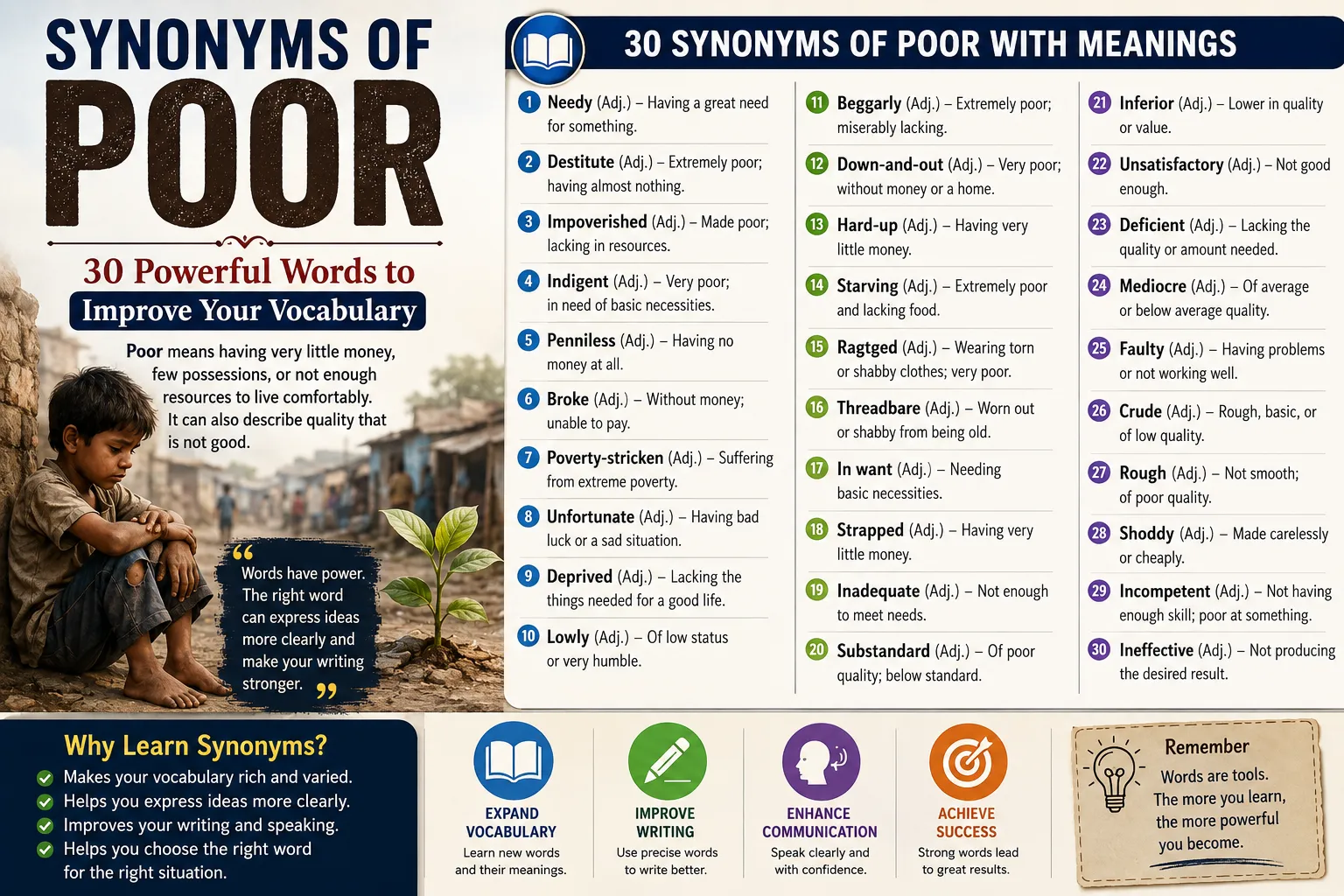
Poor means you have very little money. Think about a family that cannot pay for food or rent. They work hard, but money is still hard to find. That is what “poor” means.
People use this word a lot. They use synonyms of poor to talk about one person, a whole family, or even a country. It is a common word in news, school, and daily talk.
But saying “poor” again and again gets boring. English learners and writers need synonyms of poor words too. New words help you tell a story with more feeling. Synonyms of poor also help you say exactly what you mean.
This article looks at the word “poor” in a simple way. You will learn what it means, how to say it, where it came from, and how to use it. Then you will learn 30 synonyms of poor that mean almost the same thing.
Definition
Poor (adjective): Having very little money or few things.
Examples
- The poor family struggled to buy food each week.
- Many poor students could not afford new books.
Connotative Meaning
- Positive tone: “Poor” is rarely positive. But it can bring out sympathy, like when people want to help.
- Negative tone: “Poor” often feels sad or hard. It shows a person is struggling.
- Neutral tone: In reports or numbers, “poor” can just be a fact, like “poor families in the region.”
Etymology
- “Poor” comes from the Old French word povre, which meant lacking money or goods.
- This word came from the Latin word pauper, made of two parts: “paucus” (little) and an old root meaning “to get.” Together, they meant “getting little.”
- Over time, the word moved into English and kept its simple meaning: having very little.
Short History
- Old English (450–1100): The word “poor” did not exist yet. People used the word “earm,” which meant sad or without money.
- Middle English (1100–1500): The word “poor” entered English from French around the 1200s. It meant a person with little money or few goods.
- Modern English (1500–Present): The word kept its main meaning. It also grew to mean “low quality,” like “poor weather” or “poor work.”
Pronunciation (US & UK – IPA)
- US: /pʊr/
- UK: /pɔː/
Syllables
poor (one syllable)
Affixation Pattern of Poor
- Root: poor
- Prefix: im- (used in the related word “impoverish,” meaning to make poor)
- Suffix: -ly (makes the adverb “poorly”), -er/-est (makes “poorer” and “poorest”)
Word formation: This root gives us several words. “Poor” is an adjective. “Poorly” is an adverb. “Poverty” is a noun that means the state of being poor. “Impoverish” is a verb that means to make someone poor.
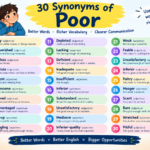
Synonyms of Poor
1. Needy (adjective) — US /ˈniːdi/ | UK /ˈniːdi/
Meaning: Not having enough money or basic things. Examples:
- The charity helps needy families every winter.
- She gave old clothes to a needy shelter.
2. Impoverished (adjective) — US /ɪmˈpɑːvərɪʃt/ | UK /ɪmˈpɒvərɪʃt/
Meaning: Made poor, often over time. Examples:
- The war left many people impoverished.
- The impoverished village needed clean water.
3. Destitute (adjective) — US /ˈdɛstɪtuːt/ | UK /ˈdɛstɪtjuːt/
Meaning: Having nothing at all, extremely poor. Examples:
- The flood left the family destitute.
- He was destitute after losing his job.
4. Penniless (adjective) — US /ˈpɛnilɪs/ | UK /ˈpɛnɪləs/
Meaning: Having no money at all. Examples:
- The traveler arrived in the city penniless.
- She felt penniless after paying all her bills.
5. Broke (adjective) — US /broʊk/ | UK /brəʊk/
Meaning: Having no money, often used in casual talk. Examples:
- I can’t go out tonight, I’m broke.
- He was broke after buying the new car.
6. Poverty-stricken (adjective) — US /ˈpɑːvərti ˈstrɪkən/ | UK /ˈpɒvəti ˈstrɪkən/
Meaning: Deeply affected by a lack of money. Examples:
- The poverty-stricken town needed help.
- Many poverty-stricken families lack clean water.
7. Underprivileged (adjective) — US /ˌʌndərˈprɪvəlɪdʒd/ | UK /ˌʌndəˈprɪvəlɪdʒd/
Meaning: Having fewer chances or resources than others. Examples:
- The school helps underprivileged children learn to read.
- He grew up in an underprivileged neighborhood.
8. Disadvantaged (adjective) — US /ˌdɪsədˈvæntɪdʒd/ | UK /ˌdɪsədˈvɑːntɪdʒd/
Meaning: Lacking money, support, or opportunity. Examples:
- The program supports disadvantaged students.
- Disadvantaged families often need extra help.
9. Hard-up (adjective) — US /ˈhɑːrd ʌp/ | UK /ˈhɑːd ʌp/
Meaning: Short of money, often for a short time. Examples:
- We were hard-up after moving to a new city.
- He felt hard-up before his next paycheck.
10. Insolvent (adjective) — US /ɪnˈsɑːlvənt/ | UK /ɪnˈsɒlvənt/
Meaning: Unable to pay debts, often used for businesses. Examples:
- The company became insolvent last year.
- An insolvent business often has to close.
11. Bankrupt (adjective) — US /ˈbæŋkrʌpt/ | UK /ˈbæŋkrʌpt/
Meaning: Legally unable to pay what you owe. Examples:
- The store went bankrupt after years of losses.
- He felt bankrupt in both money and hope.
12. Indigent (adjective) — US /ˈɪndɪdʒənt/ | UK /ˈɪndɪdʒənt/
Meaning: Very poor, often used in formal writing. Examples:
- The clinic offers free care to indigent patients.
- Indigent families received food and supplies.
13. Deprived (adjective) — US /dɪˈpraɪvd/ | UK /dɪˈpraɪvd/
Meaning: Without things that most people have. Examples:
- Children in deprived areas often lack good schools.
- He grew up deprived of basic comforts.
14. Struggling (adjective) — US /ˈstrʌɡəlɪŋ/ | UK /ˈstrʌɡəlɪŋ/
Meaning: Having a hard time meeting basic needs. Examples:
- The struggling family asked for help with rent.
- Many struggling workers took a second job.
15. Down-and-out (adjective) — US /ˌdaʊn ənd ˈaʊt/ | UK /ˌdaʊn ənd ˈaʊt/
Meaning: Extremely poor, with no home or money. Examples:
- The down-and-out man slept on the bench.
- She helped down-and-out people find shelter.
16. Skint (adjective) — US /skɪnt/ | UK /skɪnt/
Meaning: Having no money, a casual British word. Examples:
- I’m totally skint until payday.
- We were skint after the long trip.
17. Impecunious (adjective) — US /ˌɪmpɪˈkjuːniəs/ | UK /ˌɪmpɪˈkjuːniəs/
Meaning: Having little or no money, a formal word. Examples:
- The impecunious writer lived in a small room.
- He remained impecunious for most of his life.
18. Strapped (adjective) — US /stræpt/ | UK /stræpt/
Meaning: Short on money, often used casually. Examples:
- We are strapped for cash this month.
- The school is strapped for funds.
19. Beggarly (adjective) — US /ˈbɛɡərli/ | UK /ˈbɛɡəli/
Meaning: Extremely poor or very small in amount. Examples:
- He received a beggarly wage for his work.
- The room had only beggarly furniture.
20. Cash-strapped (adjective) — US /ˈkæʃ stræpt/ | UK /ˈkæʃ stræpt/
Meaning: Lacking enough money to cover costs. Examples:
- The cash-strapped city cut public services.
- Many cash-strapped students work part-time jobs.
21. Low-income (adjective) — US /ˈloʊ ˈɪnkʌm/ | UK /ˈləʊ ˈɪnkʌm/
Meaning: Earning very little money. Examples:
- The program helps low-income families pay rent.
- She grew up in a low-income neighborhood.
22. Pinched (adjective) — US /pɪntʃt/ | UK /pɪntʃt/
Meaning: Short of money, feeling tight financially. Examples:
- We felt pinched after the price increase.
- The family was pinched during the winter months.
23. Ruined (adjective) — US /ˈruːɪnd/ | UK /ˈruːɪnd/
Meaning: Left with nothing after losing money or resources. Examples:
- The storm left the farmer financially ruined.
- He was ruined after the failed business deal.
24. Moneyless (adjective) — US /ˈmʌnilɪs/ | UK /ˈmʌnɪləs/
Meaning: Having no money. Examples:
- He arrived in the city moneyless and alone.
- The moneyless traveler asked for food.
25. Poverty-ridden (adjective) — US /ˈpɑːvərti ˈrɪdən/ | UK /ˈpɒvəti ˈrɪdən/
Meaning: Filled with poverty, deeply affected by it. Examples:
- The poverty-ridden area needed new schools.
- Aid workers helped the poverty-ridden village.
26. Threadbare (adjective) — US /ˈθrɛdbɛr/ | UK /ˈθrɛdbeə/
Meaning: Very worn or poor, often describing clothes or life. Examples:
- He wore a threadbare coat all winter.
- Their threadbare furniture showed years of hard times.
27. Meager (adjective) — US /ˈmiːɡər/ | UK /ˈmiːɡə/
Meaning: Very small in amount, not enough. Examples:
- He lived on a meager salary.
- The family survived on meager supplies.
28. Deficient (adjective) — US /dɪˈfɪʃənt/ | UK /dɪˈfɪʃənt/
Meaning: Lacking something needed, such as money or resources. Examples:
- The school was deficient in basic funding.
- A deficient diet can harm your health.
29. Short (adjective) — US /ʃɔːrt/ | UK /ʃɔːt/
Meaning: Not having enough money, used casually. Examples:
- I’m a bit short this week, can you lend me some?
- We were short on cash after the trip.
30. Underresourced (adjective) — US /ˌʌndərɪˈzɔːrst/ | UK /ˌʌndərɪˈzɔːst/
Meaning: Not having enough money, tools, or support. Examples:
- The underresourced clinic lacked basic supplies.
- Many underresourced schools need more funding.
Prototype Meaning
When people hear the word “poor,” they often picture someone who does not have enough money for food, a home, or basic needs. It brings to mind a hard life and a daily struggle. This simple picture sits at the center of the word. Other synonyms add small details, like how deep the struggle is or how it is talked about in daily life versus formal writing.
Prototype Categorization
You can group these synonyms by how they are used:
- Extreme poverty: destitute, penniless, down-and-out, moneyless, poverty-stricken
- Short-term money trouble: broke, hard-up, strapped, pinched, short, skint
- Formal or written words: indigent, impecunious, insolvent, deficient
- Lacking chances or support: underprivileged, disadvantaged, deprived, underresourced
- Describing groups or places: low-income, poverty-ridden, needy, struggling
- Describing loss of money: bankrupt, ruined, impoverished.
Antonyms of Poor
rich, wealthy, prosperous, affluent, well-off, loaded, comfortable
Short Questions and Answers
- What does “poor” mean? It means having very little money or few things.
- When should “poor” be used? Use it to describe a person, family, or place that lacks money or basic needs.
- Is “poor” positive or negative? It is mostly negative, since it shows hardship. It can also bring out sympathy or a wish to help.
- How is it different from similar words? “Poor” is simple and common. “Destitute” shows an even deeper level of need. “Broke” is casual and often short-term. “Low-income” is often used in formal or official writing.
Conclusion
Synonyms of poor will help your English grow. Each word shows a different kind of hardship, from a casual “broke” to a deep “destitute.” Synonyms of poor help your writing sound clear and fit each situation. They also help you avoid using the same word again and again. Anyone learning English can use these words to speak and write with more care and feeling. Try to learn one new word each day. Use it in a sentence about a story you know. Over time, this small habit will make your English much stronger.