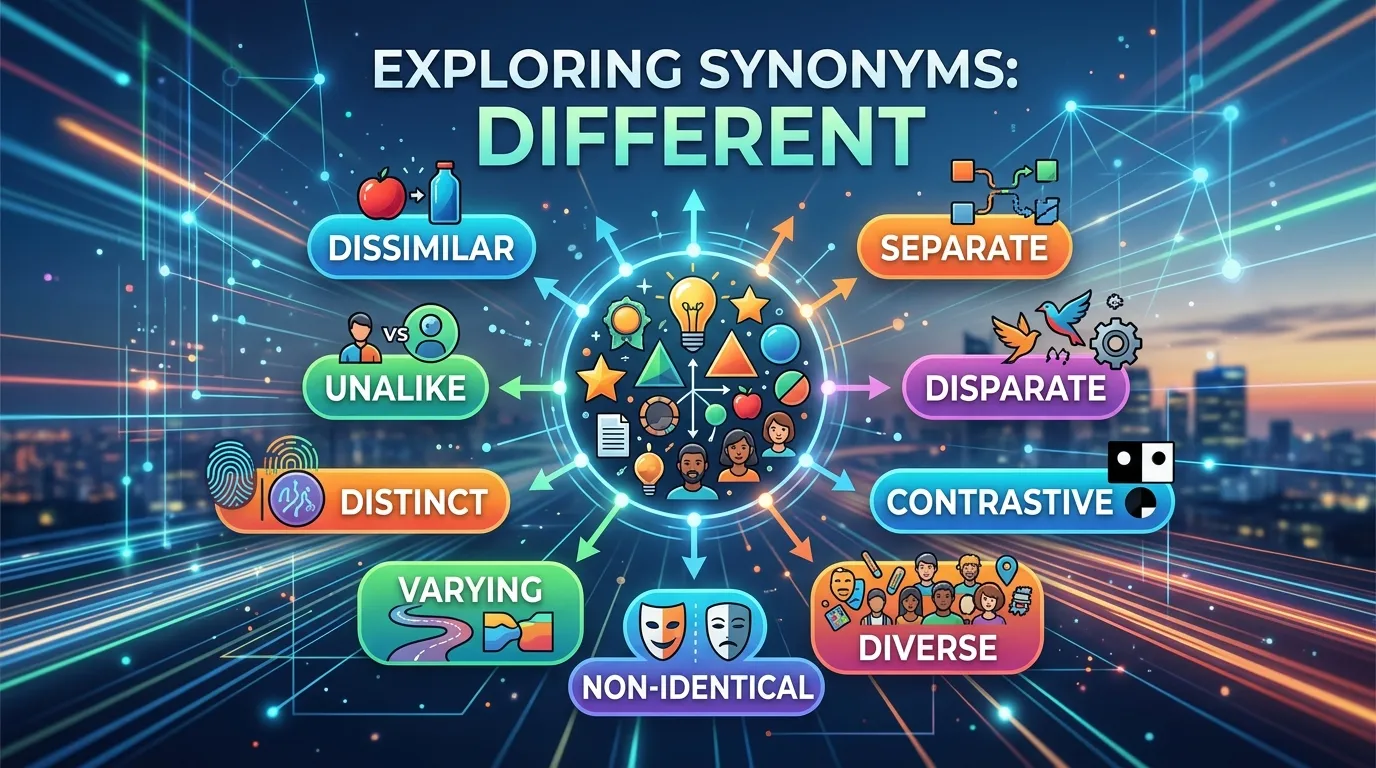
Imagine you order a meal at a new restaurant. Your friend asks how it tastes. You say it is different. You mean it is unique and surprising, but your friend thinks you mean it tastes bad. The word different means not the same. It is one of the most common words in English because we notice changes every day. However, synonym of different it too often makes your speaking and writing boring. Learning synonyms of different helps English learners and content writers share exact ideas . This complete guide explores the word different through its basic definition, everyday examples, grammar structure and accurate pronunciation. You will also learn thirty powerful synonyms of different sorted into clear semantic groups.
Meaning of Different
Definition
Different (adjective): Not the same as another thing or person.
Examples
- Sarah decided to wear a different coat to school today.
- The two brothers have very different hobbies.
Connotative Meaning
- Positive tone: Expresses beauty, creativity, or interest (e.g., a fresh and different approach to art).
- Negative tone: Expresses odd behavior, wrong outcomes, or uncomfortable change (e.g., an awkward and different smell).
- Neutral tone: Expresses a clear statement of fact without feeling (e.g., two different page numbers).
Etymology
- Source language: Latin (differentia / differre), meaning “to carry apart” or “to defer.”
- Old English (450–1100): The word did not exist in Old English. Speakers used words like unlic (unlike) or mislice (various).
- Middle English (1100–1500): Entered the language through Old French (différent) in the late fourteenth century to describe non-identical items.
- Modern English (1500–Present): Synonyms of different expanded to describe diverse social groups, changing concepts, and distinct personal styles.
Pronunciation (US & UK – IPA)
- US: /ˈdɪf.ɚ.ənt/ or /ˈdɪf.ɹənt/
- UK: /ˈdɪf.ə.ɹənt/ or /ˈdɪf.ɹənt/
Syllables
dif-fer-ent
Affixation Pattern of Different
- Root: Differ (verb)
- Prefix: None
- Suffix: -ent (adjective-forming suffix)
Word Formation:
- Differ (verb)
- Difference (noun)
- Differently (adverb)
- Differential (adjective/noun)
- Differentiate (verb)
- Differentiation (noun)
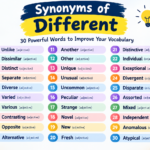
30 Synonyms of Different
1. Diverse (Adjective) — US: /daɪˈvɝːs/ | UK: /daɪˈvɜːs/
- Meaning: Showing a great deal of variety and difference.
- Examples:
- The city has a diverse population from many countries.
- Our team brings diverse skills to the project.
2. Distinct (Adjective) — US: /dɪˈstɪŋkt/ | UK: /dɪˈstɪŋkt/
- Meaning: Clear and separate from anything else.
- Examples:
- There are three distinct steps in this recipe.
- The bird has a distinct red marking on its chest.
3. Separate (Adjective) — US: /ˈsɛp.ɚ.ət/ | UK: /ˈsɛp.ə.ɹət/
- Meaning: Not joined, connected, or shared with another.
- Examples:
- The kids sleep in separate rooms.
- Please put the trash in a separate bin.
4. Varied (Adjective) — US: /ˈvɛɹ.id/ | UK: /ˈvɛə.ɹid/
- Meaning: Involving many different types or forms.
- Examples:
- He has a varied background in music and sports.
- The store offers a varied selection of fruits.
5. Various (Adjective) — US: /ˈvɛɹ.i.əs/ | UK: /ˈvɛə.ɹi.əs/
- Meaning: More than one; several different types.
- Examples:
- She bought various items at the market.
- We discussed various ways to fix the car.
6. Disparate (Adjective) — US: /ˈdɪs.pɚ.ət/ | UK: /ˈdɪs.pə.ɹət/
- Meaning: Different in kind and impossible to compare.
- Examples:
- The two scientists held disparate views on space.
- They gathered data from disparate sources.
7. Divergent (Adjective) — US: /daɪˈvɝː.dʒənt/ | UK: /daɪˈvɜː.dʒənt/
- Meaning: Developing in different directions away from a point.
- Examples:
- They took divergent paths after high school.
- The partners had divergent goals for the business.
8. Dissimilar (Adjective) — US: /dɪˈsɪm.ə.lɚ/ | UK: /dɪˈsɪm.ɪ.lə/
- Meaning: Not matching or alike in appearance or nature.
- Examples:
- The twins have dissimilar voices.
- These two cases are completely dissimilar.
9. Unlike (Adjective) — US: /ʌnˈlaɪk/ | UK: /ʌnˈlaɪk/
- Meaning: Different from another person, thing, or group.
- Examples:
- The new model is unlike any previous car.
- It is unlike him to be late for work.
10. Distinctive (Adjective) — US: /dɪˈstɪŋk.tɪv/ | UK: /dɪˈstɪŋk.tɪv/
- Meaning: Having a special quality that makes something easy to recognize.
- Examples:
- The bakery has a distinctive smell of cinnamon.
- She wears a distinctive yellow hat.
11. Variant (Adjective) — US: /ˈvɛɹ.i.ənt/ | UK: /ˈvɛə.ɹi.ənt/
- Meaning: Different from a main form or standard.
- Examples:
- The teacher accepted a variant spelling of the word.
- They tested a variant version of the software.
12. Miscellaneous (Adjective) — US: /ˌmɪs.əˈleɪ.ni.əs/ | UK: /ˌmɪs.əlˈeɪ.ni.əs/
- Meaning: Consisting of many different kinds connected without order.
- Examples:
- He placed miscellaneous tools inside the drawer.
- The box contained miscellaneous paperwork.
13. Sundry (Adjective) — US: /ˈsʌn.dɹi/ | UK: /ˈsʌn.dɹi/
- Meaning: Of various kinds; several items not named individually.
- Examples:
- She bought sundry items at the corner shop.
- The policy covers sundry expenses during travel.
14. Alternative (Adjective) — US: /ɑːlˈtɝː.nə.tɪv/ | UK: /ɔːlˈtɜː.nə.tɪv/
- Meaning: Available as another choice or possibility.
- Examples:
- We need an alternative route to avoid traffic.
- Solar energy is an alternative power source.
15. Alternate (Adjective) — US: /ˈɑːl.tɚ.nət/ | UK: /ɔːlˈtɜː.nət/
- Meaning: Every other one, or serving as a substitute.
- Examples:
- He works on alternate Saturdays.
- We have an alternate plan if it rains.
16. Peculiar (Adjective) — US: /pɪˈkjuː.ljɚ/ | UK: /pɪˈkjuː.li.ə/
- Meaning: Strange, unusual, or belonging uniquely to one item.
- Examples:
- That plant has a peculiar leaf shape.
- The animal has habits peculiar to its species.
17. Individual (Adjective) — US: /ˌɪn.dəˈvɪdʒ.u.əl/ | UK: /ˌɪn.dɪˈvɪdʒ.u.əl/
- Meaning: Single and separate from a larger group.
- Examples:
- Each student gets individual help from the teacher.
- Pack the cakes in individual boxes.
18. Particular (Adjective) — US: /pɚˈtɪk.jə.lɚ/ | UK: /pəˈtɪk.jʊ.lə/
- Meaning: Specific or special rather than general.
- Examples:
- Is there a particular movie you want to see?
- She is very particular about her coffee temperature.
19. Unequal (Adjective) — US: /ʌnˈiː.kwəl/ | UK: /ʌnˈiː.kwəl/
- Meaning: Not identical in size, amount, quality, or value.
- Examples:
- The players received an unequal share of prizes.
- The two teams fought under unequal conditions.
20. Distinguishable (Adjective) — US: /dɪˈstɪŋ.ɡwɪ.ʃə.bəl/ | UK: /dɪˈstɪŋ.ɡwɪ.ʃə.bəl/
- Meaning: Easy to notice or recognize as separate.
- Examples:
- The stars were distinguishable in the sky.
- The two brands have distinguishable logo designs.
21. Nonidentical (Adjective) — US: /ˌnɑːn.aɪˈdɛn.tɪ.kəl/ | UK: /ˌnɒn.aɪˈdɛn.tɪ.kəl/
- Meaning: Not exactly the same in appearance or nature.
- Examples:
- The hospital delivered nonidentical twin girls.
- The two printed pages look nonidentical under light.
22. Unalike (Adjective) — US: /ˌʌn.əˈlaɪk/ | UK: /ˌʌn.əˈlaɪk/
- Meaning: Not similar to each other.
- Examples:
- The two sisters are unalike in personality.
- The houses on this street are completely unalike.
23. Disproportionate (Adjective) — US: /ˌdɪs.pɹəˈpɔːɹ.ʃən.ət/ | UK: /ˌdɪs.pɹəˈpɔː.ʃən.ət/
- Meaning: Too large or too small in comparison with something else.
- Examples:
- He spends a disproportionate amount of time gaming.
- The small child carried a disproportionate load.
24. Offbeat (Adjective) — US: /ˌɑːfˈbiːt/ | UK: /ˌɒfˈbiːt/
- Meaning: Unconventional, unusual, and original.
- Examples:
- The director makes offbeat comedy films.
- She has an offbeat sense of style.
25. Unconventional (Adjective) — US: /ˌʌn.kənˈvɛn.ʃən.əl/ | UK: /ˌʌn.kənˈvɛn.ʃən.əl/
- Meaning: Not following accepted rules, standards, or habits.
- Examples:
- The artist uses unconventional painting methods.
- They took an unconventional path to success.
26. Atypical (Adjective) — US: /ˌeɪˈtɪp.ɪ.kəl/ | UK: /ˌeɪˈtɪp.ɪ.kəl/
- Meaning: Not representative of a type, group, or class.
- Examples:
- Snow in May is atypical for this region.
- His quiet behavior was atypical today.
27. Novel (Adjective) — US: /ˈnɑː.vəl/ | UK: /ˈnɒv.əl/
- Meaning: New and original, not like anything seen before.
- Examples:
- The engineer came up with a novel solution.
- Buying food online was a novel idea back then.
28. Novelty (Adjective) — US: /ˈnɑː.vəl.ti/ | UK: /ˈnɒv.əl.ti/
- Meaning: Intended to be interesting because it is unusual or new.
- Examples:
- He wore a novelty socks pattern to the party.
- She bought a novelty clock shaped like an owl.
29. Contrary (Adjective) — US: /ˈkɑːn.tɹɛɹ.i/ | UK: /ˈkɒn.tɹə.ɹi/
- Meaning: Opposite in nature, direction, or meaning.
- Examples:
- The results were contrary to our expectations.
- He holds a contrary opinion on the topic.
30. Incongruous (Adjective) — US: /ɪnˈkɑːŋ.ɡɹu.əs/ | UK: /ɪnˈkɒŋ.ɡɹu.əs/
- Meaning: Out of place or not fitting well with surroundings.
- Examples:
- The modern house looked incongruous in the old village.
- A coat felt incongruous on such a hot day.
Prototype Meaning
The prototype meaning of different is the simple idea of “not the same.” When people hear this word, they picture two objects placed side-by-side that do not match. Synonyms of different creates a basic picture of separation or contrast without adding strong emotion.
Prototype Categorization
- Variety and Multiplicity:Diverse, Varied, Various, Miscellaneous, Sundry.
- These words emphasize a rich collection or quantity of distinct items.
- Separation and Identity:Distinct, Separate, Individual, Particular, Distinguishable.
- These words highlight boundaries, clarity, and independent single items.
- Comparison and Contrast:Dissimilar, Unlike, Nonidentical, Unalike, Unequal, Disproportionate.
- These words describe two items examined side-by-side to highlight missing shared traits.
- Divergence and Conflict:Disparate, Divergent, Contrary, Incongruous.
- These words describe ideas or things that clash, move apart, or fail to fit together .
- Unusualness and Innovation:Peculiar, Offbeat, Unconventional, Atypical, Novel, Novelty, Distinctive, Variant, Alternative, Alternate.
- These words describe things that break normal expectations, rules, or patterns.
Antonyms of Different
- Same
- Similar
- Identical
- Like
- Alike
- Equivalent
- Equal
- Uniform
- Parallel
- Homogeneous
Short Questions and Answers
- What does different mean?
- It means not the same, separate, or changed from another thing or person.
- When should different be used?
- Use it when comparing two or more items that do not share the exact same qualities or identity.
- Is different positive or negative?
- It is neutral on its own, but context can make it positive (creative) or negative (odd).
- How is it different from similar words?
- Different states a basic contrast, while words like diverse highlight rich variety.
Conclusion
Synonyms of different expands your vocabulary or improve your writing. Replacing repetitive words with precise choices helps you express exact feelings. Synonyms of different also show clear comparisons and hold your reader’s attention. Broadening your word choices removes self-doubt and builds true confidence in professional life. Practice using one or two new synonyms of different in your daily conversations.