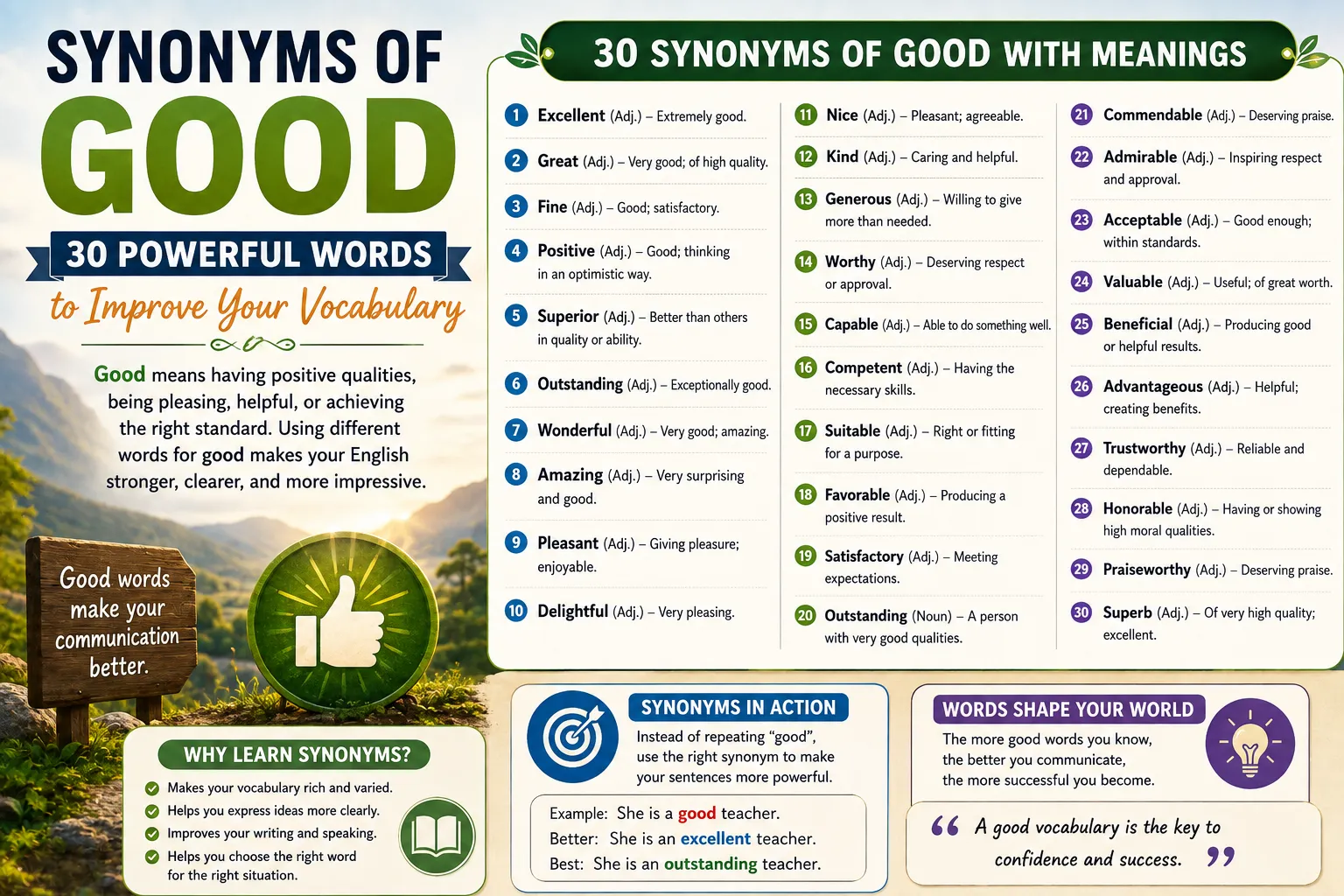
Good means something is right, nice, or well done. Think about a boy who helps his neighbor carry groceries. His mom smiles and says, “That was a good thing to do.” That is what “good” means.
People use this word all day, every day. Use synonyms for food, for people, for weather, and for work. It is one of the first words English learners ever hear.
But saying “good” over and over gets boring fast. English learners and writers need other words too. New words help you say exactly how good something is. They also make your writing feel fresh and clear.
This article looks at the word “good” in a simple way. You will learn what it means, how to say it, where it came from, and how to use it. Then you will learn 30 other words that mean almost the same thing.
Meaning of Good
Definition
Good (adjective): Having the right or best qualities; pleasing or well done.
Examples
- She did a good job on her homework.
- The soup tasted really good.
Connotative Meaning
- Positive tone: “Good” almost always feels warm and kind. It shows praise or approval.
- Negative tone: “Good” is rarely negative. It can sound flat or sarcastic, like “Oh, good, more homework.”
- Neutral tone: In simple facts, “good” can just describe a normal, fine level, like “good weather for the drive.”
Etymology
- “Good” comes from the Old English word gōd, which meant good, useful, or fitting.
- This word came from an old Germanic root that meant “to fit together” or “to be suitable.”
- The word has stayed close to its early meaning for over a thousand years.
Short History
- Old English (450–1100): “Gōd” was already a common word. It meant something was right, useful, or valuable.
- Middle English (1100–1500): The word kept its main meaning. It also grew to describe kind or moral people, not just useful things.
- Modern English (1500–Present): “Good” became one of the most used words in English. It now describes quality, kindness, skill, taste, and much more.
Pronunciation (US & UK – IPA)
- US: /ɡʊd/
- UK: /ɡʊd/
Syllables
good (one syllable)
Affixation Pattern of Good
- Root: good
- Prefix: none common
- Suffix: -ness (makes the noun “goodness”)
Word formation: This root gives us several words. “Good” is an adjective. “Goodness” is a noun that means the quality of being good. “Goods” is a noun that means items for sale. The word “well” acts as the adverb form of “good,” as in “she did well.”
Synonyms of Good
1. Nice (adjective) — US /naɪs/ | UK /naɪs/
Meaning: Pleasant and easy to enjoy. Examples:
- We had a nice walk in the park.
- She is a nice person to talk to.
2. Fine (adjective) — US /faɪn/ | UK /faɪn/
Meaning: Good enough or of good quality. Examples:
- The weather was fine for a picnic.
- He did a fine job painting the fence.
3. Great (adjective) — US /ɡreɪt/ | UK /ɡreɪt/
Meaning: Very good or impressive. Examples:
- That was a great movie.
- She had a great idea for the project.
4. Excellent (adjective) — US /ˈɛksələnt/ | UK /ˈɛksələnt/
Meaning: Extremely good in quality. Examples:
- He got an excellent grade on the test.
- The food at that restaurant is excellent.
5. Wonderful (adjective) — US /ˈwʌndərfəl/ | UK /ˈwʌndəfʊl/
Meaning: Very pleasing, causing joy. Examples:
- We had a wonderful time at the beach.
- She has a wonderful singing voice.
6. Pleasant (adjective) — US /ˈplɛzənt/ | UK /ˈplɛzənt/
Meaning: Enjoyable and easy to be around. Examples:
- It was a pleasant afternoon in the garden.
- He has a pleasant way of speaking.
7. Superb (adjective) — US /suˈpɜːrb/ | UK /suːˈpɜːb/
Meaning: Extremely good, of the highest quality. Examples:
- The chef made a superb meal.
- Her superb effort won her the prize.
8. Positive (adjective) — US /ˈpɑːzətɪv/ | UK /ˈpɒzətɪv/
Meaning: Good and hopeful, showing a good side. Examples:
- The test results were positive.
- She stayed positive during hard times.
9. Satisfactory (adjective) — US /ˌsætɪsˈfæktəri/ | UK /ˌsætɪsˈfæktəri/
Meaning: Good enough to meet a need or standard. Examples:
- His work was satisfactory this term.
- The repair was satisfactory for now.
10. Decent (adjective) — US /ˈdiːsənt/ | UK /ˈdiːsənt/
Meaning: Good enough, fair, or proper. Examples:
- She got a decent score on the exam.
- He earns a decent salary.
11. Admirable (adjective) — US /ˈædmərəbəl/ | UK /ˈædmərəbəl/
Meaning: Deserving respect or praise. Examples:
- His hard work is admirable.
- She showed admirable courage during the storm.
12. Favorable (adjective) — US /ˈfeɪvərəbəl/ | UK /ˈfeɪvərəbəl/
Meaning: Good, helpful, or working in your favor. Examples:
- The weather was favorable for the trip.
- She got a favorable response from the manager.
13. Suitable (adjective) — US /ˈsuːtəbəl/ | UK /ˈsjuːtəbəl/
Meaning: Right or good for a certain purpose. Examples:
- This coat is suitable for cold weather.
- He found a suitable job near his home.
14. Valuable (adjective) — US /ˈvæljuəbəl/ | UK /ˈvæljuəbəl/
Meaning: Good and useful, worth a lot. Examples:
- Her advice was valuable to me.
- The training gave him valuable skills.
15. Beneficial (adjective) — US /ˌbɛnɪˈfɪʃəl/ | UK /ˌbɛnɪˈfɪʃəl/
Meaning: Good because it helps someone or something. Examples:
- Exercise is beneficial for your health.
- The new law was beneficial to small businesses.
16. Skilled (adjective) — US /skɪld/ | UK /skɪld/
Meaning: Good at doing something through training. Examples:
- She is a skilled painter.
- He is a skilled driver with years of practice.
17. Kind (adjective) — US /kaɪnd/ | UK /kaɪnd/
Meaning: Good and caring toward others. Examples:
- The kind neighbor helped carry the boxes.
- She is always kind to new students.
18. Virtuous (adjective) — US /ˈvɜːrtʃuəs/ | UK /ˈvɜːtʃuəs/
Meaning: Morally good and honest. Examples:
- The story praised his virtuous behavior.
- She lived a simple, virtuous life.
19. Proper (adjective) — US /ˈprɑːpər/ | UK /ˈprɒpə/
Meaning: Right or correct for the situation. Examples:
- Please use the proper tools for this job.
- He gave a proper answer to the question.
20. Sound (adjective) — US /saʊnd/ | UK /saʊnd/
Meaning: Good and reliable, based on solid reasons. Examples:
- She gave sound advice about saving money.
- The bridge was built with sound materials.
21. Solid (adjective) — US /ˈsɑːlɪd/ | UK /ˈsɒlɪd/
Meaning: Good and dependable, without weak points. Examples:
- He gave a solid performance on stage.
- Their plan is solid and well thought out.
22. Reliable (adjective) — US /rɪˈlaɪəbəl/ | UK /rɪˈlaɪəbəl/
Meaning: Good and trustworthy, does what it should. Examples:
- She is a reliable friend.
- This car is very reliable.
23. Worthy (adjective) — US /ˈwɜːrði/ | UK /ˈwɜːði/
Meaning: Good enough to deserve praise or attention. Examples:
- His work is worthy of an award.
- She felt worthy of the new job.
24. Capable (adjective) — US /ˈkeɪpəbəl/ | UK /ˈkeɪpəbəl/
Meaning: Good at doing something well. Examples:
- He is a capable manager.
- She is capable of solving hard problems.
25. Competent (adjective) — US /ˈkɑːmpɪtənt/ | UK /ˈkɒmpɪtənt/
Meaning: Good enough at a skill or job. Examples:
- The nurse was competent and calm.
- He is a competent public speaker.
26. Wholesome (adjective) — US /ˈhoʊlsəm/ | UK /ˈhəʊlsəm/
Meaning: Good for your health or well-being. Examples:
- They enjoy wholesome family meals.
- The show has a wholesome message for kids.
27. Agreeable (adjective) — US /əˈɡriːəbəl/ | UK /əˈɡriːəbəl/
Meaning: Pleasant and easy to accept. Examples:
- We reached an agreeable solution.
- He has an agreeable personality.
28. Splendid (adjective) — US /ˈsplɛndɪd/ | UK /ˈsplɛndɪd/
Meaning: Very good, often used for something impressive. Examples:
- They had a splendid dinner at the hotel.
- The view from the hill was splendid.
29. Commendable (adjective) — US /kəˈmɛndəbəl/ | UK /kəˈmɛndəbəl/
Meaning: Good enough to deserve praise. Examples:
- Her effort in class was commendable.
- He showed commendable patience with the children.
30. Top-notch (adjective) — US /ˈtɑːp nɑːtʃ/ | UK /ˈtɒp nɒtʃ/
Meaning: Extremely good, the best kind. Examples:
- The hotel gave top-notch service.
- She did top-notch work on the report.
Prototype Meaning
When people hear the word “good,” they think of something that is right, pleasing, or well done. It could be good food, a good friend, or a good grade. There is no single strong picture, like with words such as “ecstatic” or “destitute.” Instead, “good” gives a simple feeling of approval. It tells you something meets or beats a normal standard. Other synonyms add more detail, like how impressive, how kind, or how skilled something is.
Prototype Categorization
You can group these synonyms by what part of “good” they focus on:
- General praise: great, excellent, wonderful, superb, splendid, top-notch
- Skill and ability: skilled, capable, competent
- Moral goodness: kind, virtuous, admirable, commendable
- Being useful or helpful: valuable, beneficial, favorable, suitable
- Being trustworthy: reliable, sound, solid, worthy
- Simple, everyday goodness: nice, fine, decent, pleasant, agreeable, positive, satisfactory, proper, wholesome
Antonyms of Good
bad, poor, terrible, awful, unpleasant, inferior, weak
Short Questions and Answers
- What does “good” mean? It means something is right, pleasing, or well done.
- When should “good” be used? Use it any time you want to show approval, from small things like food to big things like a job well done.
- Is “good” positive or negative? It is almost always positive. It shows praise or approval.
- How is it different from similar words? “Good” is simple and general. “Excellent” shows a much higher level of praise. “Kind” focuses on character. “Skilled” focuses on ability.
Conclusion
Synonyms of good and its 30 synonyms will help your English grow strong. Each word shows a slightly different kind of praise, from a simple “nice” to a strong “excellent.” Synonyms of good make your writing sound clear and full of life, not repeated. They also help you say exactly what kind of “good” you mean, whether it is about skill, kindness, or trust. Anyone learning English can use synonyms of good to speak and write with more color. Try to learn one new word each day. Use synonyms of good in a sentence about your own life. Over time, this small habit will make your English much stronger.