Help means giving support, assistance, or aid to someone who needs it. Imagine that your friend falls while riding a bicycle. You quickly hold out your hand and help them stand up. This simple act shows the true meaning of the word help.
The word help is one of the most common words in English. People use it every day at home, school, work, hospitals, and many other places. It appears in conversations, books, articles, websites, and social media.
Learning synonyms of help is useful because it improves your vocabulary and makes your writing and speaking more natural. It also helps English learners, students, bloggers, and content writers avoid repeating the same word. In this article, you will learn the meaning of help, its pronunciation, history, grammar, connotation, word formation, and thirty useful synonyms with simple meanings and examples. You will also discover semantic categories, antonyms, and common questions about the word.
Meaning of Help
Definition
Help (Verb, Noun):
To make it easier for someone by giving support, assistance, or useful action. As a noun, it means the support or assistance that someone gives.
Examples
- She helped her grandmother carry the shopping bags.
- Thank you for your help during the project.
Connotative Meaning
- Positive tone: Kindness, care, support, generosity, teamwork.
- Negative tone: It may suggest dependence if someone always needs help.
- Neutral tone: Simply giving assistance without any emotional meaning.
Etymology
- Source language: Old English
- Original word: helpan
- Original meaning: To aid, assist, support, or save.
Short History of the Keyword
- Old English (450–1100): Helpan meant to aid or rescue someone.
- Middle English (1100–1500): The spelling became helpen, and the word was widely used in speech and writing.
- Modern English (1500–Present): The spelling changed to help, becoming one of the most frequently used English words.
Pronunciation (US & UK – IPA)
US: /hɛlp/
UK: /help/
Syllables
help
Affixation Pattern of Help
Root: help
Prefix: None
Suffix: None
Word Formation of Help
- help (verb)
- help (noun)
- helper (noun)
- helpful (adjective)
- helpfully (adverb)
- helpfulness (noun)
- helpless (adjective)
- helplessly (adverb)
- helplessness (noun)
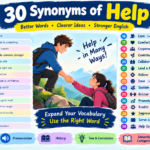
30 Synonyms of Help
1. Assist (Verb)
US: /əˈsɪst/ | UK: /əˈsɪst/
Meaning: To give support or make a task easier.
Examples
- She assisted the teacher during class.
- The nurse assisted the doctor.
2. Aid (Verb, Noun)
US: /eɪd/ | UK: /eɪd/
Meaning: To provide practical support or assistance.
Examples
- Volunteers aided the flood victims.
- Medical aid arrived quickly.
3. Support (Verb, Noun)
US: /səˈpɔrt/ | UK: /səˈpɔːt/
Meaning: To encourage or give assistance.
Examples
- My parents always support me.
- Friends supported the new business.
4. Serve (Verb)
US: /sɝːv/ | UK: /sɜːv/
Meaning: To be useful or beneficial.
Examples
- This guide serves beginners well.
- The tool serves many purposes.
5. Benefit (Verb)
US: /ˈbɛnəfɪt/ | UK: /ˈbenɪfɪt/
Meaning: To improve someone’s condition.
Examples
- Exercise benefits your health.
- The program benefited many families.
6. Rescue (Verb)
US: /ˈrɛskjuː/ | UK: /ˈreskjuː/
Meaning: To save someone from danger.
Examples
- Firefighters rescued the child.
- They rescued the stranded hikers.
7. Save (Verb)
US: /seɪv/ | UK: /seɪv/
Meaning: To protect someone from harm.
Examples
- The lifeguard saved the swimmer.
- Quick action saved many lives.
8. Encourage (Verb)
US: /ɪnˈkɝːɪdʒ/ | UK: /ɪnˈkʌrɪdʒ/
Meaning: To give confidence or hope.
Examples
- Teachers encourage students daily.
- Her words encouraged me.
9. Guide (Verb)
US: /ɡaɪd/ | UK: /ɡaɪd/
Meaning: To show the right direction.
Examples
- He guided the visitors.
- The map guided us home.
10. Cooperate (Verb)
US: /koʊˈɑːpəreɪt/ | UK: /kəʊˈɒpəreɪt/
Meaning: To work together toward a goal.
Examples
- We cooperated on the project.
- The teams cooperated successfully.
11. Facilitate (Verb)
US: /fəˈsɪləteɪt/ | UK: /fəˈsɪlɪteɪt/
Meaning: To make something easier.
Examples
- Technology facilitates learning.
- Good planning facilitated success.
12. Promote (Verb)
US: /prəˈmoʊt/ | UK: /prəˈməʊt/
Meaning: To encourage growth or progress.
Examples
- The campaign promotes health.
- Exercise promotes wellness.
13. Foster (Verb)
US: /ˈfɔstər/ | UK: /ˈfɒstə/
Meaning: To encourage development.
Examples
- Parents foster creativity.
- Schools foster learning.
14. Advance (Verb)
US: /ədˈvæns/ | UK: /ədˈvɑːns/
Meaning: To move something forward.
Examples
- Research advanced medicine.
- Training advanced his career.
15. Improve (Verb)
US: /ɪmˈpruv/ | UK: /ɪmˈpruːv/
Meaning: To make something better.
Examples
- Reading improves vocabulary.
- Practice improves skills.
16. Comfort (Verb)
US: /ˈkʌmfərt/ | UK: /ˈkʌmfət/
Meaning: To make someone feel better.
Examples
- She comforted the crying child.
- Friends comforted him.
17. Protect (Verb)
US: /prəˈtɛkt/ | UK: /prəˈtekt/
Meaning: To keep safe from harm.
Examples
- Sunscreen protects your skin.
- Parents protect their children.
18. Sustain (Verb)
US: /səˈsteɪn/ | UK: /səˈsteɪn/
Meaning: To keep something going.
Examples
- Healthy food sustains energy.
- Rain sustained the crops.
19. Reinforce (Verb)
US: /ˌriːɪnˈfɔrs/ | UK: /ˌriːɪnˈfɔːs/
Meaning: To strengthen support.
Examples
- Practice reinforces learning.
- Steel reinforced the bridge.
20. Back (Verb)
US: /bæk/ | UK: /bæk/
Meaning: To support someone.
Examples
- I back your decision.
- They backed the proposal.
21. Lend a Hand (Verb Phrase)
US: /lɛnd ə hænd/ | UK: /lend ə hænd/
Meaning: To give practical help.
Examples
- Please lend a hand.
- Everyone lent a hand.
22. Contribute (Verb)
US: /kənˈtrɪbjut/ | UK: /kənˈtrɪbjuːt/
Meaning: To give something useful.
Examples
- Everyone contributed ideas.
- She contributed money.
23. Relieve (Verb)
US: /rɪˈliv/ | UK: /rɪˈliːv/
Meaning: To reduce pain or difficulty.
Examples
- Medicine relieved the pain.
- Rain relieved the heat.
24. Supply (Verb)
US: /səˈplaɪ/ | UK: /səˈplaɪ/
Meaning: To provide what is needed.
Examples
- The company supplied food.
- Farmers supplied vegetables.
25. Provide (Verb)
US: /prəˈvaɪd/ | UK: /prəˈvaɪd/
Meaning: To give something needed.
Examples
- The school provides books.
- Parents provide care.
26. Accommodate (Verb)
US: /əˈkɑməˌdeɪt/ | UK: /əˈkɒmədeɪt/
Meaning: To meet someone’s needs.
Examples
- The hotel accommodated guests.
- We accommodated their request.
27. Enable (Verb)
US: /ɪˈneɪbəl/ | UK: /ɪˈneɪbəl/
Meaning: To make something possible.
Examples
- Technology enables communication.
- Training enabled success.
28. Empower (Verb)
US: /ɪmˈpaʊər/ | UK: /ɪmˈpaʊə/
Meaning: To give confidence or authority.
Examples
- Education empowers people.
- Good leaders empower teams.
29. Boost (Verb)
US: /buːst/ | UK: /buːst/
Meaning: To increase or improve.
Examples
- Exercise boosts energy.
- Advertising boosted sales.
30. Encourage Along (Verb)
US: /ɪnˈkɝːɪdʒ əˈlɔŋ/ | UK: /ɪnˈkʌrɪdʒ əˈlɒŋ/
Meaning: To help someone continue making progress.
Examples
- Parents encouraged him along.
- Coaches encouraged players along.
Prototype Meaning
The prototype meaning of help is giving support to someone who cannot complete a task alone. Most people imagine one person assisting another by solving a problem, carrying something heavy, giving advice, or offering protection. This simple idea represents the central meaning of the word.
Prototype Categorization
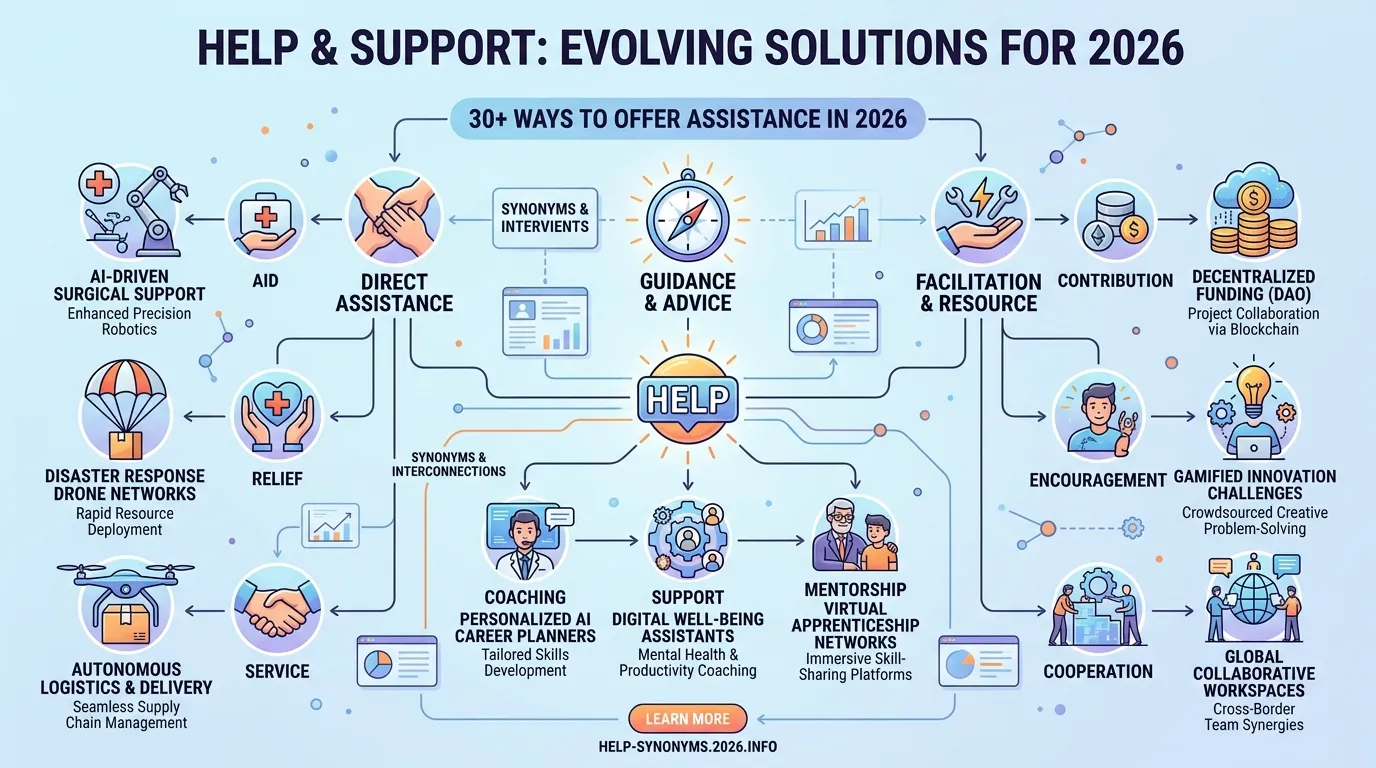
- General assistance: assist, aid, support, lend a hand, provide.
- Protection and rescue: rescue, save, protect, relieve.
- Improvement and growth: improve, foster, promote, advance, boost.
- Guidance and cooperation: guide, cooperate, contribute.
- Making things easier: facilitate, enable, accommodate.
- Emotional support: comfort, encourage, empower, back.
- Long-term support: sustain, reinforce, serve.
Antonyms of Help
- Hinder (Verb): To make something difficult.
- Obstruct (Verb): To block progress.
- Prevent (Verb): To stop something from happening.
- Harm (Verb): To cause damage.
- Ignore (Verb): To refuse assistance.
- Neglect (Verb): To fail to care for someone.
- Oppose (Verb): To work against someone.
- Discourage (Verb): To reduce confidence.
- Damage (Verb): To make something worse.
- Injure (Verb): To hurt someone physically.
Short Questions and Answers
- What does help mean?
Help means giving support, assistance, or useful action to someone. - When should help be used?
Use help whenever someone makes a task easier or provides support. - Is help positive or negative?
It is usually positive because it shows kindness and cooperation, but it can be neutral depending on the situation. - How is it different from similar words?
Help is a general word. Assist is more formal, aid is common in official situations, and support often includes emotional or long-term encouragement.
Conclusion
Learning the Synonyms of Help and synonyms of help makes your English stronger and more natural. Instead of repeating the same word, you can choose expressions such as assist, support, aid, facilitate, or encourage to match different situations. This improves your vocabulary, strengthens your writing and speaking, and makes your communication clearer and more engaging. Understanding pronunciation, history, grammar, and connotation also helps you use each synonym correctly. Practice using a few new words every day in conversations, emails, essays, and social media posts. Over time, these words will become part of your everyday English, giving you greater confidence as both a speaker and a writerusing Synonyms of Help.