Interesting means holding your attention or curiosity. Picture this: you sit down to watch a documentary you almost skipped. Ten minutes in, you’re leaning forward, phone forgotten, eyes fixed on the screen. You find it interesting. This is one of the most common words we use to describe anything that grabs our focus, from a book to a conversation to a strange fact.
Because so many things in life catch our attention, we use the word “interesting” constantly. This can make our writing and speech sound plain if we always reach for it. This is why English learners and content writers need synonyms. New words let you show the exact type of appeal something has, from mildly curious to totally spellbinding. They also stop your writing from repeating “interesting” too many times.
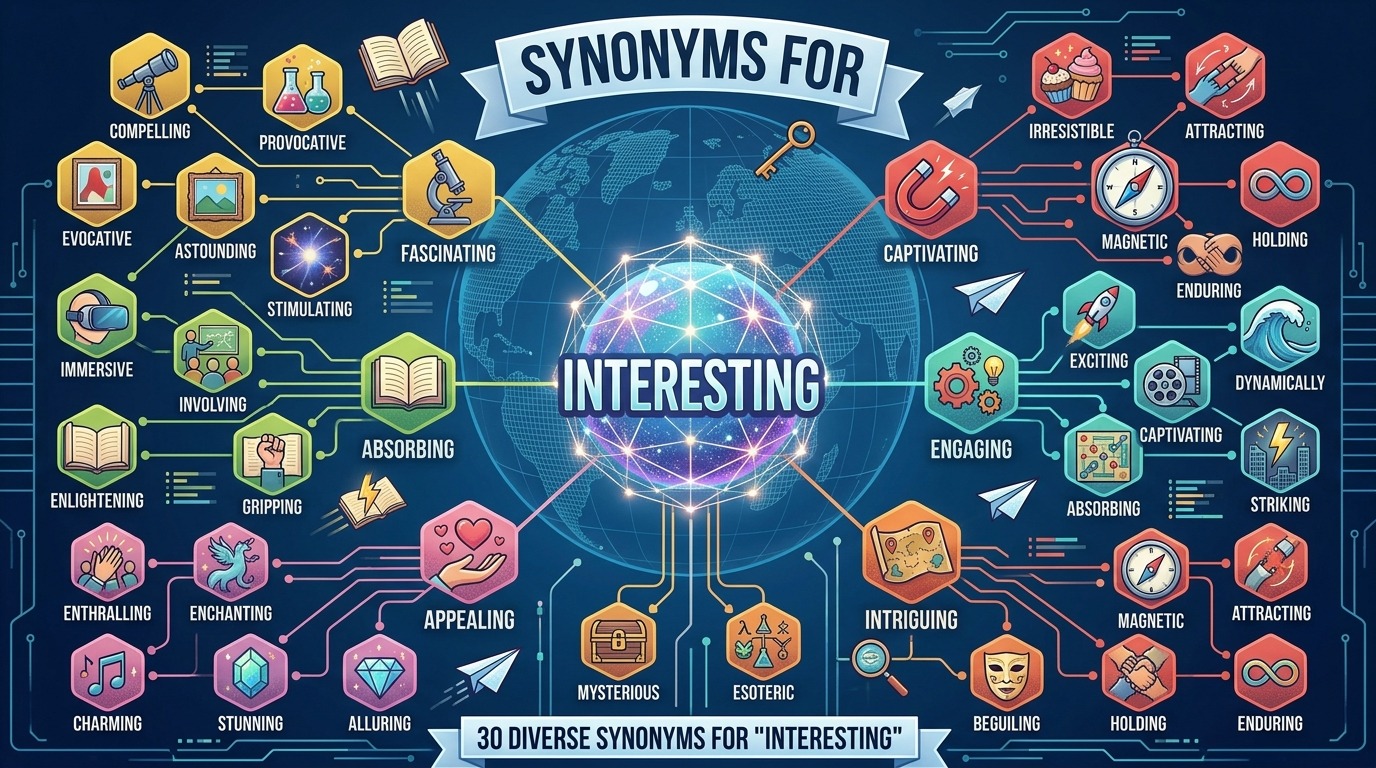
This article covers the meaning of “interesting,” its emotional tone, its history, its pronunciation, and its word parts. Then it gives you 30 strong synonyms with clear meanings and example sentences.
Meaning of Interesting
Definition
Interesting (Adjective): Holding your attention; making you want to know more.
Examples
- The documentary about deep-sea life was very interesting.
- She told an interesting story about her trip to Peru.
Connotative Meaning
- Positive tone: engaging, curious, enjoyable (most common use)
- Negative tone: rarely used politely to hide a critical opinion (“That’s an interesting choice,” meaning you disagree)
- Neutral tone: simply describing something worth attention (“an interesting data point”)
Also learn about this https://myprayerss.com/synonyms-for-success/
Etymology
- “Interesting” comes from the word interest, formed by adding the suffix -ing.
- “Interest” traces back to the Latin word interesse, meaning “to concern” or “to make a difference,” built from inter- (“between”) and esse (“to be”).
- The word first had a legal and financial sense, referring to a claim or share in something, before it grew to mean “attention” or “curiosity.”
Short History
- Old English (450–1100): The word “interesting” did not exist. Speakers used words like “weorþ” (worthy) or similar terms to show something deserved attention.
- Middle English (1100–1500): “Interest” entered English through French, mainly as a legal and money term meaning a claim or share in property.
- Modern English (1500–Present): By the 1600s and 1700s, “interest” grew to mean “curiosity” or “attention.” Adding “-ing” created “interesting,” the word we use today for anything that holds our focus.
Pronunciation (US & UK – IPA)
- US: /ˈɪntrəstɪŋ/
- UK: /ˈɪntrəstɪŋ/
Syllables
in-ter-est-ing
Affixation Pattern of Interesting
- Root: interest (from Latin interesse)
- Prefix: inter- (meaning “between”)
- Suffix: -ing
Word formation
From the root “interest,” English builds several words: interested (adjective), interestingly (adverb), and interest itself (noun and verb). Adding the prefix “un-” or “dis-” creates uninterested and disinterested, which carry different shades of meaning. This shows how one root word can branch into many related forms.
Synonyms of Interesting
1. Fascinating (Adjective) — US /ˈfæsɪneɪtɪŋ/ | UK /ˈfæsɪneɪtɪŋ/
Meaning: So interesting that it fully holds your attention.
Examples:
- The museum had a fascinating exhibit on ancient Egypt.
- I find her research fascinating.
2. Engaging (Adjective) — US /ɪnˈɡeɪdʒɪŋ/ | UK /ɪnˈɡeɪdʒɪŋ/
Meaning: Pleasant and interesting enough to keep you involved.
Examples:
- He gave an engaging talk on climate change.
- The book has an engaging main character.
3. Captivating (Adjective) — US /ˈkæptɪveɪtɪŋ/ | UK /ˈkæptɪveɪtɪŋ/
Meaning: So interesting that it holds your attention completely.
Examples:
- Her captivating voice filled the theater.
- The captivating view stopped us in our tracks.
4. Intriguing (Adjective) — US /ɪnˈtriɡɪŋ/ | UK /ɪnˈtriːɡɪŋ/
Meaning: Interesting because it raises curiosity or mystery.
Examples:
- The intriguing plot kept me guessing.
- She made an intriguing point during the meeting.
5. Compelling (Adjective) — US /kəmˈpɛlɪŋ/ | UK /kəmˈpɛlɪŋ/
Meaning: So interesting or convincing that you must pay attention.
Examples:
- He made a compelling argument for the change.
- The compelling story moved the whole audience.
6. Absorbing (Adjective) — US /əbˈsɔrbɪŋ/ | UK /əbˈsɔːbɪŋ/
Meaning: Interesting enough to take up all your focus.
Examples:
- The novel was so absorbing I forgot to eat.
- She found the puzzle absorbing.
7. Riveting (Adjective) — US /ˈrɪvɪtɪŋ/ | UK /ˈrɪvɪtɪŋ/
Meaning: Extremely interesting and hard to look away from.
Examples:
- The trial was riveting to watch on the news.
- His riveting speech held the whole room.
8. Enthralling (Adjective) — US /ɪnˈθrɔlɪŋ/ | UK /ɪnˈθrɔːlɪŋ/
Meaning: Deeply interesting, as if it holds you under a spell.
Examples:
- The enthralling dance performance amazed everyone.
- She told an enthralling tale of her travels.
9. Gripping (Adjective) — US /ˈɡrɪpɪŋ/ | UK /ˈɡrɪpɪŋ/
Meaning: So interesting and tense that it holds your full attention.
Examples:
- The gripping thriller kept us up all night.
- The match had a gripping final round.
10. Stimulating (Adjective) — US /ˈstɪmjəleɪtɪŋ/ | UK /ˈstɪmjʊleɪtɪŋ/
Meaning: Interesting in a way that gets your mind active.
Examples:
- The lecture was intellectually stimulating.
- We had a stimulating chat about philosophy.
11. Appealing (Adjective) — US /əˈpilɪŋ/ | UK /əˈpiːlɪŋ/
Meaning: Interesting because it draws you in with charm.
Examples:
- The idea sounded appealing to the whole team.
- Her appealing smile made the ad memorable.
12. Entertaining (Adjective) — US /ˌɛntərˈteɪnɪŋ/ | UK /ˌɛntəˈteɪnɪŋ/
Meaning: Interesting in a fun and enjoyable way.
Examples:
- The comedian gave an entertaining show.
- His stories are always entertaining.
13. Thought-provoking (Adjective) — US /ˈθɔt prəˌvoʊkɪŋ/ | UK /ˈθɔːt prəˌvəʊkɪŋ/
Meaning: Interesting because it makes you think deeply.
Examples:
- The film raised thought-provoking questions.
- Her essay was short but thought-provoking.
14. Curious (Adjective) — US /ˈkjʊriəs/ | UK /ˈkjʊəriəs/
Meaning: Interesting because it seems unusual or strange.
Examples:
- We found a curious old map in the attic.
- It was a curious coincidence.
15. Remarkable (Adjective) — US /rɪˈmɑrkəbəl/ | UK /rɪˈmɑːkəbl/
Meaning: Interesting enough to deserve special notice.
Examples:
- She made a remarkable recovery.
- It was a remarkable piece of engineering.
16. Notable (Adjective) — US /ˈnoʊtəbəl/ | UK /ˈnəʊtəbl/
Meaning: Interesting enough to be worth mentioning.
Examples:
- There were several notable moments in the game.
- He made a notable improvement this year.
17. Enticing (Adjective) — US /ɪnˈtaɪsɪŋ/ | UK /ɪnˈtaɪsɪŋ/
Meaning: Interesting in a way that tempts or attracts you.
Examples:
- The menu had many enticing options.
- Her offer sounded enticing.
18. Alluring (Adjective) — US /əˈlʊrɪŋ/ | UK /əˈljʊərɪŋ/
Meaning: Interesting because it draws you in with charm or mystery.
Examples:
- The alluring city lights drew tourists in.
- His alluring pitch convinced the investors.
19. Provocative (Adjective) — US /prəˈvɑkətɪv/ | UK /prəˈvɒkətɪv/
Meaning: Interesting because it stirs strong thought or reaction.
Examples:
- The article made a provocative claim.
- Her provocative question started a debate.
20. Exciting (Adjective) — US /ɪkˈsaɪtɪŋ/ | UK /ɪkˈsaɪtɪŋ/
Meaning: Interesting in a way that creates energy or thrill.
Examples:
- The final match was exciting to watch.
- She had exciting news to share.
21. Attractive (Adjective) — US /əˈtræktɪv/ | UK /əˈtræktɪv/
Meaning: Interesting enough to draw people toward it.
Examples:
- The job offer looked attractive.
- The plan seemed attractive to investors.
22. Charming (Adjective) — US /ˈtʃɑrmɪŋ/ | UK /ˈtʃɑːmɪŋ/
Meaning: Interesting in a warm, pleasant way.
Examples:
- The small town had a charming main street.
- His charming manner won the room over.
23. Amusing (Adjective) — US /əˈmjuzɪŋ/ | UK /əˈmjuːzɪŋ/
Meaning: Interesting because it makes you smile or laugh.
Examples:
- She told an amusing story about her cat.
- The amusing video went viral online.
24. Diverting (Adjective) — US /daɪˈvɜrtɪŋ/ | UK /daɪˈvɜːtɪŋ/
Meaning: Interesting enough to take your mind off other things.
Examples:
- The puzzle was a diverting way to pass the time.
- We found the game quite diverting.
25. Spellbinding (Adjective) — US /ˈspɛlˌbaɪndɪŋ/ | UK /ˈspɛlˌbaɪndɪŋ/
Meaning: So interesting it feels like it casts a spell on you.
Examples:
- The spellbinding performance left the crowd silent.
- Her spellbinding voice filled the hall.
26. Mesmerizing (Adjective) — US /ˈmɛzməraɪzɪŋ/ | UK /ˈmɛzməraɪzɪŋ/
Meaning: So interesting you cannot look away.
Examples:
- The dancer’s moves were mesmerizing.
- We watched the mesmerizing sunset in silence.
27. Engrossing (Adjective) — US /ɪnˈɡroʊsɪŋ/ | UK /ɪnˈɡrəʊsɪŋ/
Meaning: Interesting enough to take over your full attention.
Examples:
- The engrossing mystery kept me reading all night.
- Her engrossing lecture ran past the hour.
28. Novel (Adjective) — US /ˈnɑvəl/ | UK /ˈnɒvəl/
Meaning: Interesting because it is new or different.
Examples:
- The company tried a novel approach to marketing.
- It was a novel idea for the science fair.
29. Piquant (Adjective) — US /ˈpikənt/ | UK /ˈpiːkənt/
Meaning: Interesting in a sharp, lively way.
Examples:
- The piquant plot twist surprised everyone.
- Her piquant comments added spark to the panel.
30. Arresting (Adjective) — US /əˈrɛstɪŋ/ | UK /əˈrɛstɪŋ/
Meaning: So interesting or striking that it stops you in your tracks.
Examples:
- The photo had an arresting quality.
- His arresting opening line hooked the readers.
Prototype Meaning
When most people hear the word “interesting,” they picture leaning in, eyes widening, and wanting to know more. It brings to mind a story, fact, or idea that pulls your focus away from everything else. This simple picture is the core meaning of the word. Other uses, like “an interesting choice,” grow out of this same basic idea of something that catches attention, even if the feeling behind it shifts.
Prototype Categorization
- Attention-grabbing: fascinating, captivating, riveting, gripping, engrossing, spellbinding, mesmerizing, arresting, absorbing
- Curiosity-related: intriguing, curious, thought-provoking, provocative, novel, piquant
- Enjoyable and appealing: entertaining, amusing, diverting, charming, appealing, attractive, enticing, alluring
- General engagement: engaging, compelling, stimulating, exciting, remarkable, notable
Antonyms of Interesting
boring, dull, tedious, uninteresting, monotonous
Short Questions and Answers
- What does “interesting” mean?
It means holding your attention or curiosity; making you want to know more. - When should “interesting” be used?
Use it to describe anything that catches your focus, from a story to a fact to a person. - Is “interesting” positive or negative?
It is usually positive. It can sound neutral or even mildly negative when used politely to avoid a direct opinion, like saying “an interesting choice.” - How is it different from similar words?
“Exciting” points to energy and thrill, while “curious” points to something odd or puzzling. “Entertaining” focuses on fun and enjoyment, and “interesting” is the general word that covers all of these smaller shades of attention and appeal.
Conclusion
Synonyms for success gives you many ways to describe attention and curiosity, from a gentle appeal to a full spellbinding grip. It helps you avoid using the same word again and again in your writing or speech. It also makes your English sound more natural and skilled. Each new synonym adds a small tool to your vocabulary kit, ready for the right moment. Try using one new synonym each day in a sentence of your own. Over time, this small habit builds real confidence in both writing and speaking English.